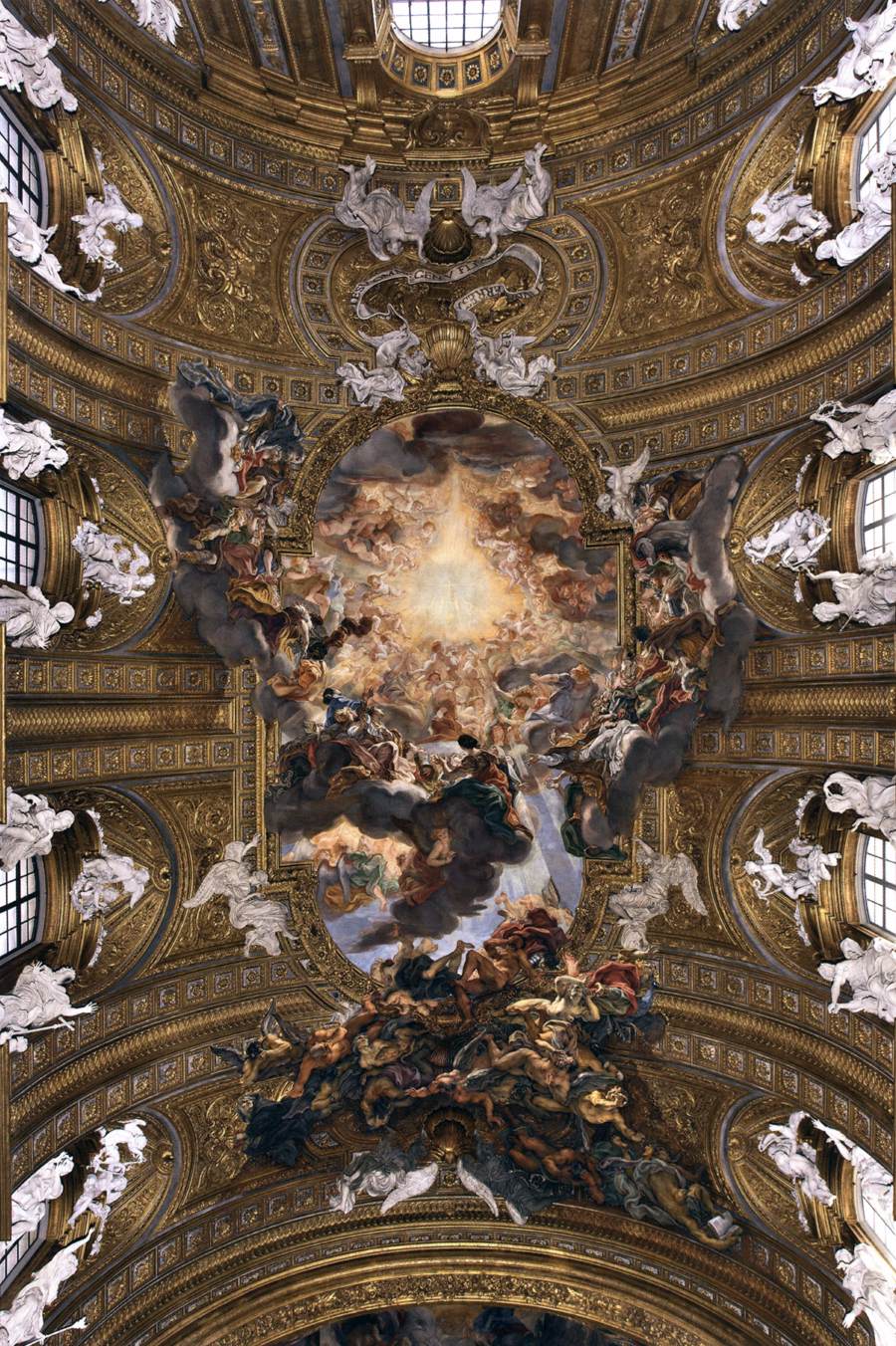
03 — ARTWORK
Nave vault
- MEDIUM
- Fresco
- TYPE
- Religious
PALETTE
HOVER OR TAP A SWATCH FOR NAME, SHARE AND HEX. SAMPLED FROM THE IMAGE — INDICATIVE, NOT A PIGMENT ANALYSIS.
DEVELOPMENT BUILD — NOT FOR PUBLIC USE. CONTRIBUTE ON GITHUB.
03 — ARTWORK
PALETTE
HOVER OR TAP A SWATCH FOR NAME, SHARE AND HEX. SAMPLED FROM THE IMAGE — INDICATIVE, NOT A PIGMENT ANALYSIS.
COMMENTARY
UNDERLINED TERMS ARE DEFINED IN THE GLOSSARY.
In BaroqueThe period in art history from about 1600 to about 1750. In this sense the term covers a wide range of styles and artists. In painting and sculpture there were three main forms of Baroque: (1) sumptuous display, a style associated with the Catholic Counter Reformation and the absolutist courts of Europe (Bernini, Rubens); (2) dramatic realism (Caravaggio); and (3) everyday realism, a development seen in particular in Holland (Rembrandt, Vermeer). In architecture, there was an emphasis on expressiveness and grandeur, achieved through scale, the dramatic use of light and shadow, and increasingly elaborate decoration. In a more limited sense the term Baroque often refers to the first of these categories. The development of the Baroque reflects the period's religious tensions (Catholic versus Protestant); a new and more expansive world view based on science and exploration; and the growth of absolutist monarchies. churches, in addition to the choirthe part of a church interior, usually raised and set apart from the rest of the church, reserved for the clergy to pray together, or for choral singing. Since Carolingian times, "choir" has been the word for the part of the central nave of the church extending over the crossing (the place where nave and transept intersect), and including the apse (a niche in the wall, roofed with a half dome) that often stands at the end of this area., the navethe main interior space of a church building. It may have parallel aisles on each side, often separated from it by pillars, and is intersected by the transept, which cuts across it at the point where the choir begins. vaults, transeptsection of a church at right-angles to the nave and in front of the choir. chapels, and cupolaIn architecture, a small dome, usually one set on a much larger dome or on a roof; a semi-circular vault. (if present) offered large and attractive surfaces for painting. Although fictive openings in ceilings and vaults had already been created in painting in the sixteenth century, permitting vivid views of events taking place in heaven, the heavenly visions of the seventeenth century take on a new quality, scale, and intensity. The supreme example is the ceiling composition executed by Baciccio (Giovanni Battista Gaulli) in Il Gesù, the most spectacular of a frescoWall painting technique in which pigments are applied to wet (fresh) plaster (intonaco). The pigments bind with the drying plaster to form a very durable image. Only a small area can be painted in a day, and these areas, drying to a slightly different tint, can in time be seen. Small amounts of retouching and detail work could be carried out on the dry plaster, a technique known as a secco fresco. program encompassing virtually the entire church that Baciccio worked on for thirteen years (1672-85). In earlier examples the architecture served as the framing for the pictures, in Il Gesù the relationship between architecture and painting was redefined: painting and decoration are confined to those portions of the church structure of greatest symbolic importance.
@online{wga-r4827a71e7a1c57,
  author       = {Krén, Emil and Marx, Daniel},
  title        = {Nave vault by BACICCIO},
  organization = {{Web Gallery of Art}},
  date         = {2026-09-13},
  url          = {https://beta.wga.hu/artists/baciccio-r36401f46ad2ea7/nave-vault-r4827a71e7a1c57},
  urldate      = {2026-09-13},
  langid       = {english}
}
ACCESSED 2026-09-13. REPLACE THE AUTHOR FIELD WITH THE COMMENTARY AUTHOR WHERE ONE IS NAMED.


