03 — ARTWORK
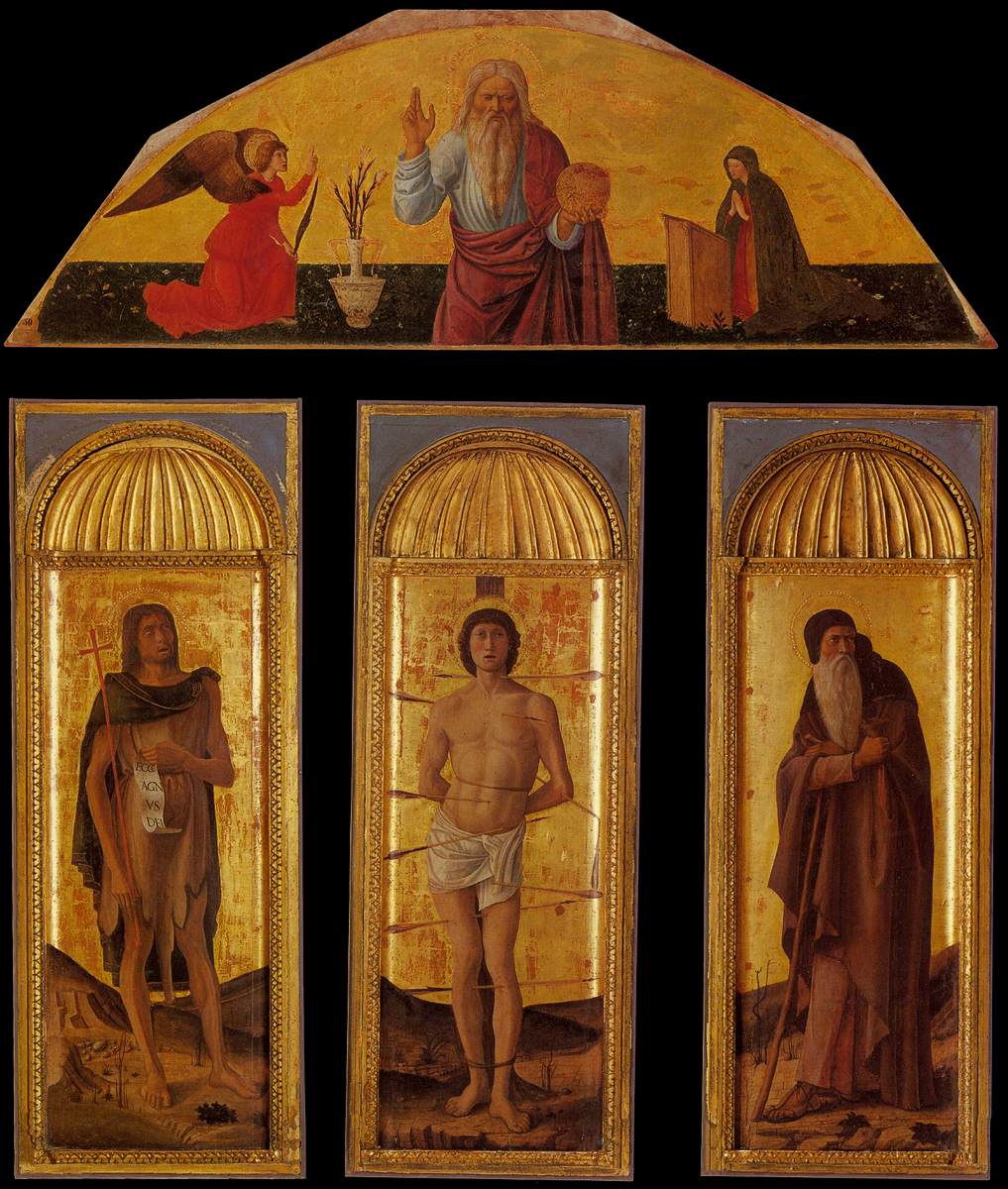
Triptych of St Sebastian
- MEDIUM
- Tempera on panel
- TYPE
- Religious
PALETTE
HOVER OR TAP A SWATCH FOR NAME, SHARE AND HEX. SAMPLED FROM THE IMAGE — INDICATIVE, NOT A PIGMENT ANALYSIS.
DEVELOPMENT BUILD — NOT FOR PUBLIC USE. CONTRIBUTE ON GITHUB.
03 — ARTWORK
PALETTE
HOVER OR TAP A SWATCH FOR NAME, SHARE AND HEX. SAMPLED FROM THE IMAGE — INDICATIVE, NOT A PIGMENT ANALYSIS.
COMMENTARY
UNDERLINED TERMS ARE DEFINED IN THE GLOSSARY.
The church Santa Maria della Carità in Venice was reconstructed in the middle of the 15th century. Various chapels were erected between 1460 and 1464 by noble families. Four chapels were decorated by altarpieces which are now associated with Jacopo Bellini and his sons: the St Sebastian TriptychA painting in three sections, usually an altarpiece, consisting of a central panel and two outer panels, or wings. In many medieval triptychs the two outer wings were hinged so that could be closed over the center panel. Early triptychs were often portable. in the St Sebastian Chapela small separate place for worship, either part of a large church or a separate building.; the St Lawrence Triptych in the Chapel of Lorenzo Dolfin; the Nativity Triptych in the Chapel of Andrea da Molin; the Madonna Triptych in the Chapel of Giacomo Zorzi. The four triptychs can still be seen in the church of the Carità, for which they were painted, now incorporated into the Gallerie dell'Accademia.
The St Sebastian Triptych consists of a lunetteIn architecture, a semicircular space, such as that over a door or window or in a vaulted roof, that may contain a window, painting or sculptural decoration. (59 x 170 cm) representing the Annunciationthe term for the event described in the Gospel according to St. Luke, when the Angel Gabriel brings the Virgin Mary the news that she is to bear her son, Jesus Christ. The Annunciation was among the most widespread pictorial subjects of European art during the Middle Ages and the Renaissance.; the left panelTerm in painting for a support of wood, metal, or other rigid substance, as distinct from canvas. Until the adoption of canvas in the 15th century nearly all the movable paintings of Europe were executed on wood, and even up to the beginning of the 17th century it is probable that as much painting was done on the one support as on the other. Painters who worked on a small scale often used copper panels (Elsheimer is a leading example), and in the colonial art of South America copper and tin and even lead and zinc were used. On a larger scale, slate has occasionally been used as a support, notably by Rubens for his altarpiece for Sta Maria in Vallicella (the Chiesa Nuova) in Rome; the picture he originally painted was said to reflect the light unpleasantly and slate was used for the replacement to produce a more matt finish. For wood panels the Italian masters of the Renaissance preferred white poplar, while oak was the most common wood used in northern Europe. Many other types were used, however; analysis of the contents of art galleries has yielded a long list, including beech, cedar, chestnut, fir, larch, linden, mahogany, olive, and walnut. In the 20th century cedar, teak, and dark walnut are favourites, and modern painters have also used plywood, fibre-board, and other synthetic materials as supports. (127 x 48 cm) representing St John the Evangelist; the central panel (103 x 45 cm) representing St Sebastian; the right panel (103 x 45 cm) representing St Anthony Abbot.
The triptych of the chapel of St Sebastian was commissioned by Zaccaria Vitturini. It also shows the influence of the vibrant energy of Donatello and the rigorous plasticity of Mantegna, made softer and more natural by Bellini's use of colour.
@online{wga-re2d30f9911406e,
  author       = {Krén, Emil and Marx, Daniel},
  title        = {Triptych of St Sebastian by BELLINI, Jacopo},
  organization = {{Web Gallery of Art}},
  date         = {2026-09-09},
  url          = {https://beta.wga.hu/artists/bellini-jacopo-r76e8919d9e8152/triptych-of-st-sebastian-re2d30f9911406e},
  urldate      = {2026-09-09},
  langid       = {english}
}
ACCESSED 2026-09-09. REPLACE THE AUTHOR FIELD WITH THE COMMENTARY AUTHOR WHERE ONE IS NAMED.


