03 — ARTWORK
Triptych (open)
- MEDIUM
- Oil on poplar panel, 69 x 35 cm (each wing)
- TYPE
- Religious
PALETTE
HOVER OR TAP A SWATCH FOR NAME, SHARE AND HEX. SAMPLED FROM THE IMAGE — INDICATIVE, NOT A PIGMENT ANALYSIS.
DEVELOPMENT BUILD — NOT FOR PUBLIC USE. CONTRIBUTE ON GITHUB.
03 — ARTWORK
PALETTE
HOVER OR TAP A SWATCH FOR NAME, SHARE AND HEX. SAMPLED FROM THE IMAGE — INDICATIVE, NOT A PIGMENT ANALYSIS.
COMMENTARY
UNDERLINED TERMS ARE DEFINED IN THE GLOSSARY.
TriptychA painting in three sections, usually an altarpiece, consisting of a central panel and two outer panels, or wings. In many medieval triptychs the two outer wings were hinged so that could be closed over the center panel. Early triptychs were often portable. (open) c. 1460 Oil on poplar panelTerm in painting for a support of wood, metal, or other rigid substance, as distinct from canvas. Until the adoption of canvas in the 15th century nearly all the movable paintings of Europe were executed on wood, and even up to the beginning of the 17th century it is probable that as much painting was done on the one support as on the other. Painters who worked on a small scale often used copper panels (Elsheimer is a leading example), and in the colonial art of South America copper and tin and even lead and zinc were used. On a larger scale, slate has occasionally been used as a support, notably by Rubens for his altarpiece for Sta Maria in Vallicella (the Chiesa Nuova) in Rome; the picture he originally painted was said to reflect the light unpleasantly and slate was used for the replacement to produce a more matt finish. For wood panels the Italian masters of the Renaissance preferred white poplar, while oak was the most common wood used in northern Europe. Many other types were used, however; analysis of the contents of art galleries has yielded a long list, including beech, cedar, chestnut, fir, larch, linden, mahogany, olive, and walnut. In the 20th century cedar, teak, and dark walnut are favourites, and modern painters have also used plywood, fibre-board, and other synthetic materials as supports., 69 x 35 cm (each wing) Musée du Petit Palais, AvignonThe decision to move the Papacy here was made in August 1308 by Pope Clement V, who had been residing in France since 1305. The actual move was made in 1309. Six pontificates later, in 1377, the Papacy was brought back to Rome by Gregory XI. All the popes elected at Avignon were French, as were 113 of the 134 cardinals appointed during this time. Yet though the period has been called one of 'captivity' to France, the Avignonese residence was not one of uninterrupted truckling to French kings. The city was not on French territory: it belonged to the Angevin princes of Naples. 'Captivity', like Petrarch's 'unholy Babylon', which he likened to the harlot of the Apocalypse 'full of abominations and the filth of her fornication', was mainly a term of abuse directed at a Papacy that had acquired security enough to revive its legal and financial pretensions and to build lavishly and live well. Between 1100 and 1309 the popes had only spent 82 years in Rome. Avignon gave them a long breathing space to assemble the machinery and the values which characterized the Renaissance Papacy after its final resettlement in Rome.
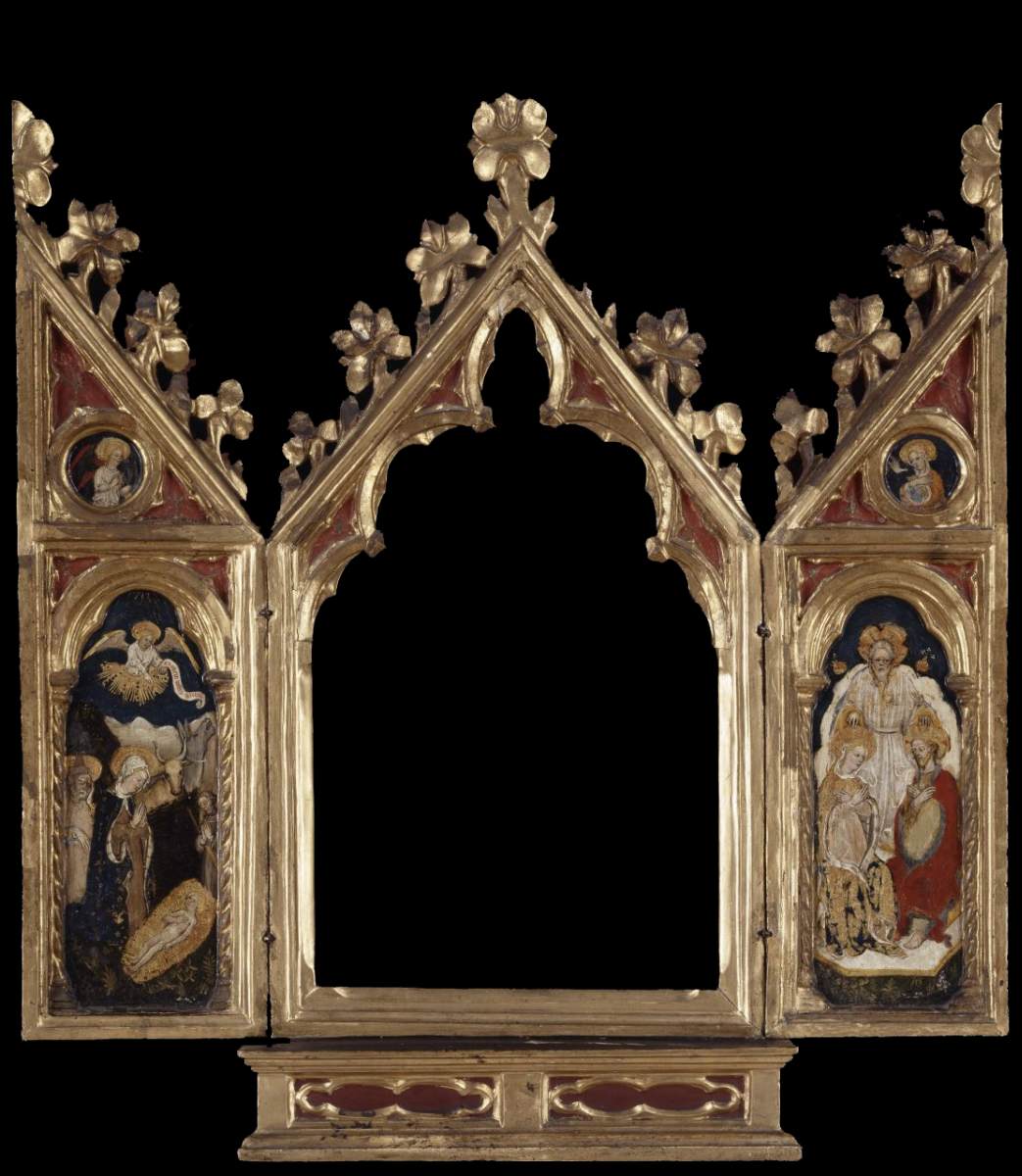
The two wings of the triptych represent The Nativity (left) and the Crowning of the Virgin and Christ (right). The central panel is missing.
@online{wga-rc75ece0ed0c27f,
  author       = {Krén, Emil and Marx, Daniel},
  title        = {Triptych (open) by BEMBO, Bonifazio},
  organization = {{Web Gallery of Art}},
  date         = {2026-09-13},
  url          = {https://beta.wga.hu/artists/bembo-bonifazio-raa2f9a5b674a58/triptych-open-rc75ece0ed0c27f},
  urldate      = {2026-09-13},
  langid       = {english}
}
ACCESSED 2026-09-13. REPLACE THE AUTHOR FIELD WITH THE COMMENTARY AUTHOR WHERE ONE IS NAMED.


