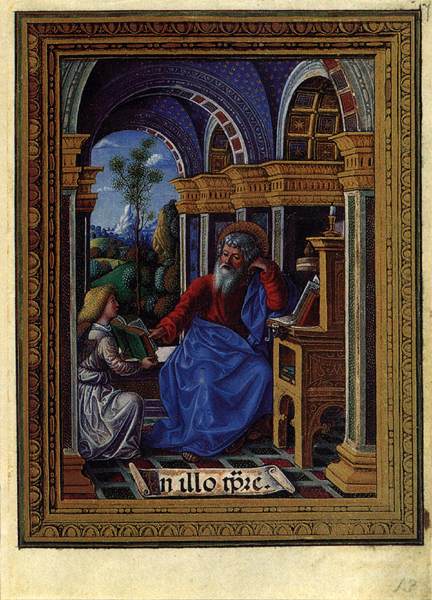
Sforza Hours c. 1490, 1517-21 Manuscriptcollective term for books or other documents written by hand; in a specific sense, the hand-written medieval book, the Codex manuscriptus, often ornamented with decorative borders, illuminated initials and miniatures, and containing works of ancient philosophy or scholarly, ecclesiastical, and literary texts. Manuscripts were usually produced on commission. At first the scriptoria (writing rooms) of monasteries transcribed the contents of famous manuscripts and made copies. Monastic communities in the Netherlands and northern Germany began producing manuscripts around 1383/84. Flanders, Burgundy, and in particular Paris became major centres for the mass production of breviaries (prayer books) and Books of Hours. (Add. Mss. 34294, 45722, 62997), 131 x 93 mm British Library, London
The Sforza Hours was commissioned around 1490 by Bona Sforza, the widow of Duke Galeazzo Maria Sforza of Milan. It is a Book of HoursA prayer book used by laymen for private devotion, containing prayers or meditations appropriate to certain hours of the day, days of the week, months, or seasons. They became so popular in the 15th century that the Book of Hours outnumbers all other categories of illuminated manuscripts; from the late 15th century there were also printed versions illustrated by woodcuts. The most famous Book of Hours and one of the most beautiful of all illuminated manuscripts is the Très Riches Heures du duc de Berry (Musée Condé, Chantilly), illuminated by the Limburg Brothers for Jean de Berry. according to the use of Rome, containing prayers and devotional texts for the private use and edification of the laity. The miniatures contributed by Giovanni Pietro Birago and belonging the oldest and most comprehensive portion of the manuscript bear testimony to the most up-to-date Renaissance ideas.
After the death of Bona Sforza, the codex entered the possession of the Habsburg princess Margaret of Austria, regent of the Spanish Netherlands. She asked her court miniaturist Gerard Horenbout to illuminate the unfinished part of the prayer book that had remained blank. This might have happened between 1517 and 1521. Horenbout miniatures greatly differed in style from those of his Italian predecessor.
The miniatureTerm originally applied to the art of manuscript illumination but later used of paintings, usually portraits, executed on a very small scale. The earliest miniaturists (16th century) continued to use the materials of the illuminators, painting in gouache on vellum or card. on folio 7r was painted by Birago. The Evangelist Matthew is placed in a scene of Renaissance architecture. The lecternA reading stand or desk, especially one at which the Bible is read. where he is working bears his initials "S. M." (Sanctus Matthaeus). In the foreground an angel - Matthew's attributeA symbolic object which is conventionally used to identify a particular person, usually a saint. In the case of martyrs, it is usually the nature of their martyrdom.- holds a book from which the mighty figure of the saint reads.