03 — ARTWORK
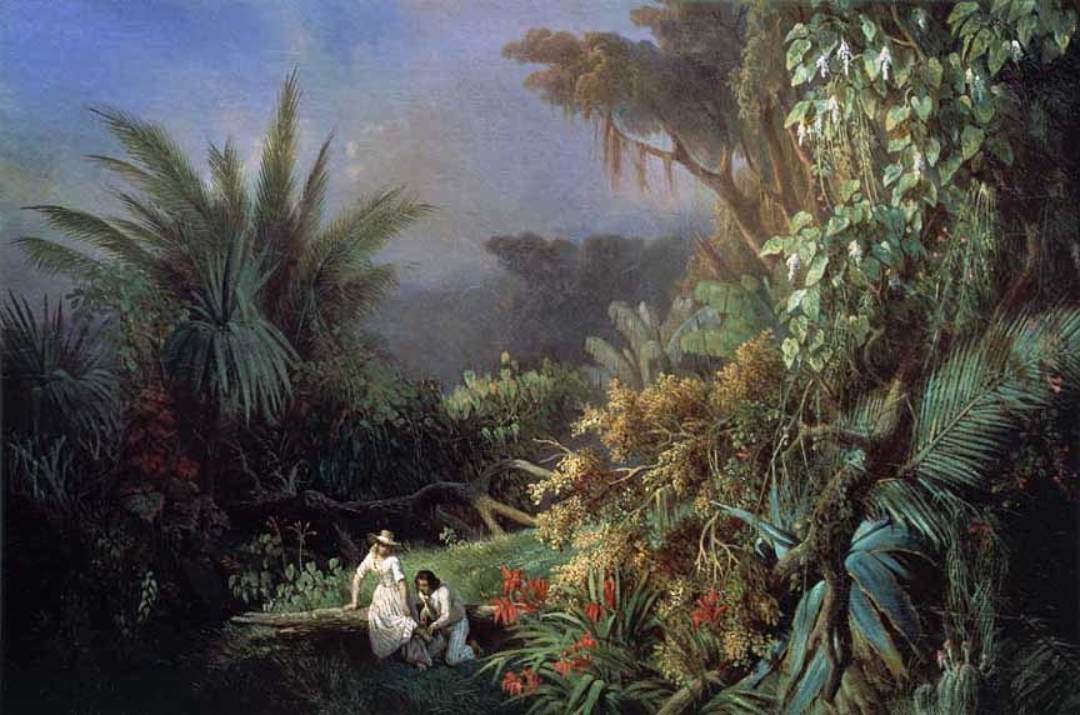
Paul and Virginia
- MEDIUM
- Oil on canvas, 41 x 60 cm
- TYPE
- Historical
PALETTE
HOVER OR TAP A SWATCH FOR NAME, SHARE AND HEX. SAMPLED FROM THE IMAGE — INDICATIVE, NOT A PIGMENT ANALYSIS.
DEVELOPMENT BUILD — NOT FOR PUBLIC USE. CONTRIBUTE ON GITHUB.
CURRENT LOCATION · Private Collection
03 — ARTWORK
PALETTE
HOVER OR TAP A SWATCH FOR NAME, SHARE AND HEX. SAMPLED FROM THE IMAGE — INDICATIVE, NOT A PIGMENT ANALYSIS.
COMMENTARY
UNDERLINED TERMS ARE DEFINED IN THE GLOSSARY.
Bernardin de St. Pierre's Paul et Virginie (first published in 1788) became an immediate bestseller and continued inspiring songs, poems, plays, ballets, operas, and pictures well into the nineteenth century. It is the sentimental story of two children of French parentage growing up on a tropical island, the Île de France (Mauritius), their love, separation, and untimely deaths. It appealed to the same readership that enjoyed historical romances and troubadour themes.
This painting is unusual in the context of literary paintings for the large proportionin painting, sculpture and architecture, the ratio between the respective parts and the whole work. The following are important: 1. the Canon of Proportion, a mathematical formula establishing ideal proportions of the various parts of the human body. The unit of measurement is usually the relationship of the head to the torso (1:7 or 1:10); 2. the golden section, a line C divided into a small section A and a larger section B, so that A:B are in the same relationship as B:C; 3. the quadrature, which uses the square as a unit of measurement; 4. triangulation, which uses an equilateral triangle in order to determine important points in the construction; and 5. harmonic proportions, an analogy with the way sounds are produced on stringed instruments, for example an octave = 1:2 (the difference in pitch between two strings, one half the length of the other), a fifth = 2:3, a fourth = 3:4. of canvasA woven cloth used as a support for painting. The best-quality canvas is made of linen; other materials used are cotton, hemp, and jute. It is now so familiar a material that the word 'canvas' has become almost a synonym for an oil painting, but it was not until around 1500 that it began to rival the wooden panel (which was more expensive and took longer to prepare) as the standard support for movable paintings (the transition came later in Northern Europe than in Italy). Canvas is not suitable for painting on until it has been coated with a ground, which isolates the fabric from the paint; otherwise it will absorb too much paint, only very rough effects will be obtainable, and parts of the fabric may be rotted by the pigments. It must also be made taut on a stretcher or by some other means. given over to landscape rather than figures. Blanchard clearly demonstrates his first hand experience of exotic tropical flora, and includes minutely observed species from palms to cacti to Spanish moss.
The archive catalogues no further works by this artist.
TRY SAME COLLECTION →@online{wga-r0f01b8b6a31d20,
author = {Krén, Emil and Marx, Daniel},
title = {Paul and Virginia by BLANCHARD, Pharamond},
organization = {{Web Gallery of Art}},
date = {2026-09-13},
url = {https://beta.wga.hu/artists/blanchard-pharamond-r7bd22367d9f22d/paul-and-virginia-r0f01b8b6a31d20},
urldate = {2026-09-13},
langid = {english}
}ACCESSED 2026-09-13. REPLACE THE AUTHOR FIELD WITH THE COMMENTARY AUTHOR WHERE ONE IS NAMED.