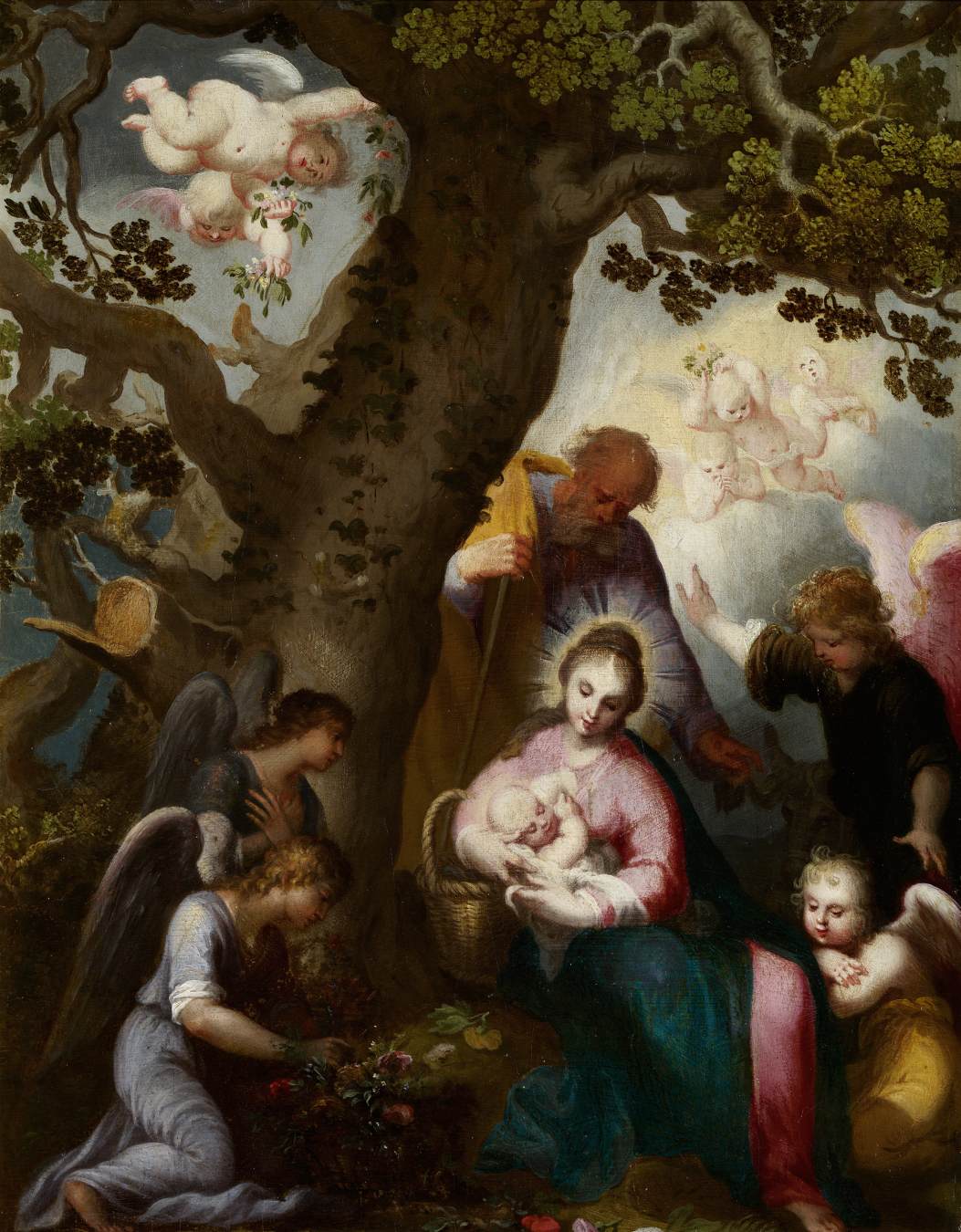
03 — ARTWORK
The Flight into Egypt
- MEDIUM
- Oil on panel, 46 x 35 cm
- TYPE
- Religious
PALETTE
HOVER OR TAP A SWATCH FOR NAME, SHARE AND HEX. SAMPLED FROM THE IMAGE — INDICATIVE, NOT A PIGMENT ANALYSIS.
DEVELOPMENT BUILD — NOT FOR PUBLIC USE. CONTRIBUTE ON GITHUB.
03 — ARTWORK
PALETTE
HOVER OR TAP A SWATCH FOR NAME, SHARE AND HEX. SAMPLED FROM THE IMAGE — INDICATIVE, NOT A PIGMENT ANALYSIS.
COMMENTARY
UNDERLINED TERMS ARE DEFINED IN THE GLOSSARY.
The Flight into Egypt c. 1615 Oil on panelTerm in painting for a support of wood, metal, or other rigid substance, as distinct from canvas. Until the adoption of canvas in the 15th century nearly all the movable paintings of Europe were executed on wood, and even up to the beginning of the 17th century it is probable that as much painting was done on the one support as on the other. Painters who worked on a small scale often used copper panels (Elsheimer is a leading example), and in the colonial art of South America copper and tin and even lead and zinc were used. On a larger scale, slate has occasionally been used as a support, notably by Rubens for his altarpiece for Sta Maria in Vallicella (the Chiesa Nuova) in Rome; the picture he originally painted was said to reflect the light unpleasantly and slate was used for the replacement to produce a more matt finish. For wood panels the Italian masters of the Renaissance preferred white poplar, while oak was the most common wood used in northern Europe. Many other types were used, however; analysis of the contents of art galleries has yielded a long list, including beech, cedar, chestnut, fir, larch, linden, mahogany, olive, and walnut. In the 20th century cedar, teak, and dark walnut are favourites, and modern painters have also used plywood, fibre-board, and other synthetic materials as supports., 46 x 35 cm Museo Carmen Thyssen, Málaga
Bloemaert's religious output was considerable, as he received numerous commissions from the Catholic circles that predominated in the city of Utrecht and he himself professed the Catholic faith. The work depicts the theme of the rest on the Flight into Egypt (Matthew 2:13-15) and shows the Virgin with the Child and St Joseph in the shade of a leafy tree and surrounded by kneeling angels that worship and appear to protect the Holy Family. The landscape is reduced to the monumental tree, the main feature of the scene, and a luminous sky in which angels and cherubim flutter in varied postures. The combination of the Gospel theme of the Flight into Egypt and the devotional image of the Mother suckling the Child was created by Flemish painters of the 15th century, and there are known examples by <a onclick="return OpenOther('/html/d/david/2/rest.html')" href="/html/d/david/2/rest.html">Gérard David</a> and <a onclick="return OpenOther('/html/p/patenier/rest_fli.html')" href="/html/p/patenier/rest_fli.html">Joachim Patenier.</a>
During his initialthe first letter of the text in medieval manuscripts and early printed books, made to stand out emphatically by its colour, size, and ornamentation. period Bloemaert painted whimsical forms and adopted the cold palette of the Haarlem Mannerists and of the school of Fontainebleau, with whose style he may have come into contact during his stay in France in the 1580s. But in the first decade of the 17th century his style evolved towards a calmer and more delicate language and a concern for the beauty of figures, chromatic harmony and luminosity. These qualities are found in the present painting, in which the figures have an endearing, gentle appearance that recalls the art of Italian painters like Correggio and Barocci, whom the artist followed chiefly through engravings. A further factor related to this development is the influence of the tempered classicism that was imported from Italy by Goltzius and which Bloemaert espoused, as may be seen in this work, before shifting in 1620 towards the tenebrist naturalismGeneric term for scientific positions supported by natural insights. In fine arts and literature between approximately 1870 and 1900, Naturalism tried to reproduce the reality comprehended through sensory experience as realistically as possible, i.e. without idealising the object, but with scientific precision. In contrast to Realism, which was also based on the accurate description of natural occurrences, Naturalism concerns itself with the sensual dimensions of observation, whereby questions of morality and social criticism come to the fore. The spokesman for literary Naturalism was Emile Zola, who believed the artistic methods provided evidence of human existence. of Caravaggio, which he learned from his own pupils, among them Van Honthorst.
@online{wga-r496567271e85ad,
  author       = {Krén, Emil and Marx, Daniel},
  title        = {The Flight into Egypt by BLOEMAERT, Abraham},
  organization = {{Web Gallery of Art}},
  date         = {2026-09-09},
  url          = {https://beta.wga.hu/artists/bloemaert-abraham-rcb490160a07500/the-flight-into-egypt-r496567271e85ad},
  urldate      = {2026-09-09},
  langid       = {english}
}
ACCESSED 2026-09-09. REPLACE THE AUTHOR FIELD WITH THE COMMENTARY AUTHOR WHERE ONE IS NAMED.


