03 — ARTWORK
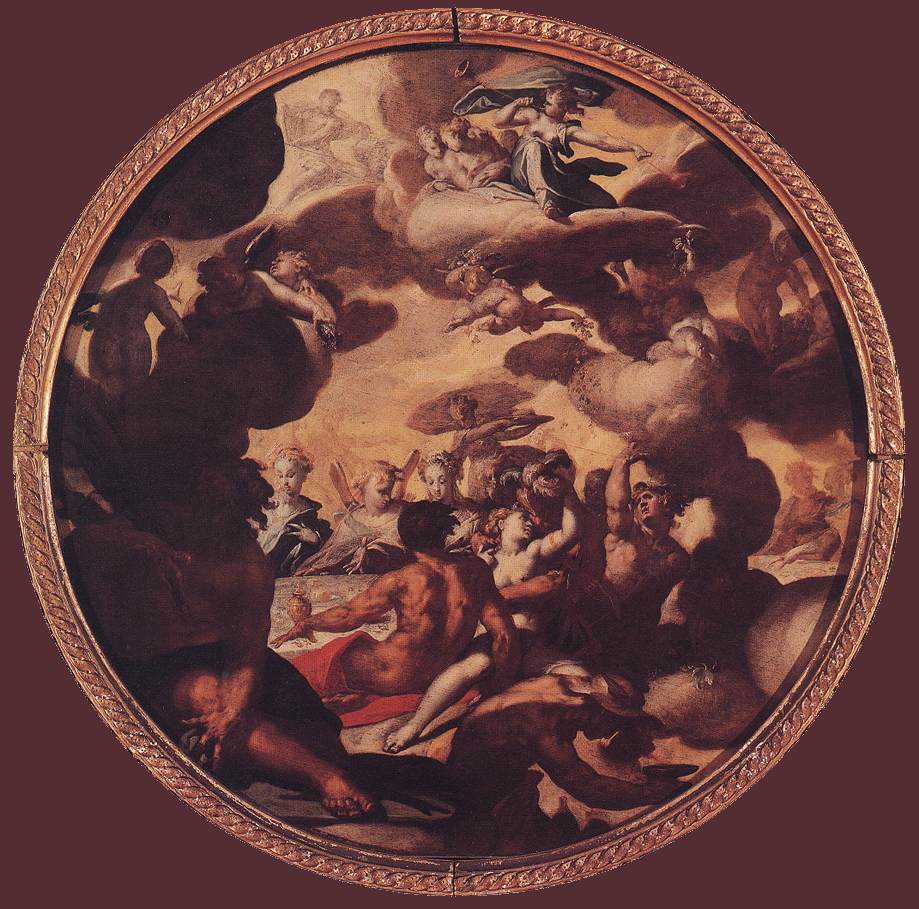
The Marriage of Cupid and Psyche
- MEDIUM
- Oil on panel, diameter: 61,6 cm
- TYPE
- Mythological
PALETTE
HOVER OR TAP A SWATCH FOR NAME, SHARE AND HEX. SAMPLED FROM THE IMAGE — INDICATIVE, NOT A PIGMENT ANALYSIS.
DEVELOPMENT BUILD — NOT FOR PUBLIC USE. CONTRIBUTE ON GITHUB.
03 — ARTWORK
PALETTE
HOVER OR TAP A SWATCH FOR NAME, SHARE AND HEX. SAMPLED FROM THE IMAGE — INDICATIVE, NOT A PIGMENT ANALYSIS.
COMMENTARY
UNDERLINED TERMS ARE DEFINED IN THE GLOSSARY.
The Marriage of Cupid and Psyche c. 1595 Oil on panelTerm in painting for a support of wood, metal, or other rigid substance, as distinct from canvas. Until the adoption of canvas in the 15th century nearly all the movable paintings of Europe were executed on wood, and even up to the beginning of the 17th century it is probable that as much painting was done on the one support as on the other. Painters who worked on a small scale often used copper panels (Elsheimer is a leading example), and in the colonial art of South America copper and tin and even lead and zinc were used. On a larger scale, slate has occasionally been used as a support, notably by Rubens for his altarpiece for Sta Maria in Vallicella (the Chiesa Nuova) in Rome; the picture he originally painted was said to reflect the light unpleasantly and slate was used for the replacement to produce a more matt finish. For wood panels the Italian masters of the Renaissance preferred white poplar, while oak was the most common wood used in northern Europe. Many other types were used, however; analysis of the contents of art galleries has yielded a long list, including beech, cedar, chestnut, fir, larch, linden, mahogany, olive, and walnut. In the 20th century cedar, teak, and dark walnut are favourites, and modern painters have also used plywood, fibre-board, and other synthetic materials as supports., diameter: 61,6 cm Royal Collection, Windsor
The subject marks the climax of the story of Cupid and Psyche as recounted by Apuleius in The Golden Ass (Books 4-6). The theme became popular with artists during the Renaissance and was also frequently depicted in the seventeenth century. The marriage of Cupid and Psyche took place in heaven on Mount Olympus after Psyche had endeavoured in vain to win back Cupid's love on earth by a series of ordeals set by Venus. The chief protagonists in this banquet of the gods are seated facing the viewer in the centre of the composition. Venus and Mars embrace with Vulcan to the left and BacchusIn Greek and Roman mythology, the god of wine and fertility. Bacchic rites were often orgiastic. to the right. The immediate foreground is dominated by Neptune and Mercury, who conveyed Psyche to heaven in order for her to be reunited with Cupid. Jupiter and Juno are set further back in the picture space on the far right. Apollo, holding a lyre, can be faintly discerned top left, while Fame accompanied by putti blows a fanfare. The story of Cupid and Psyche was not always depicted simply as a narrative, but sometimes in broad philosophical terms as an allegoryA work of art which represents some abstract quality or idea, either by means of a single figure (personification) or by grouping objects and figures together. Renaissance allegories make frequent allusions both to both Greek and Roman legends and literature, and also to the wealth of Christian allegorical stories and symbols developed during the Middle Ages. of carnal and spiritual love.
The composition of the painting is inspired by a large engravingA print made from a metal plate that has had a design cut into it with a sharp point. Ink is smeared over the plate and then wiped off, the ink remaining in the etched lines being transferred when the plate is pressed very firmly onto a sheet of paper. of the Marriage of Cupid and Psyche by Hendrik Goltzius, made after a drawing of 1587 by Bartholomeus Spranger. The rectangular format of the engraving was favoured by Bloemaert for another version of the subject now at Aschaffenburg, Bavaria. This compositional dependency on Spranger's work is echoed in the similarity of style, which in turn suggests an early date of about 1595 for the painting. Bloemaert here provides a perfect demonstration of MannerismA movement in Italian art from about 1520 to 1600. Developing out of the Renaissance, Mannerism rejected Renaissance balance and harmony in favor of emotional intensity and ambiguity. In Mannerist painting, this was expressed mainly through severe distortions of perspective and scale; complex and crowded compositions; strong, sometimes harsh or discordant colors; and elongated figures in exaggerated poses. In architecture, there was a playful exaggeration of Renaissance forms (largely in scale and proportion) and the greater use of bizarre decoration. Mannerism gave way to the Baroque. Leading Mannerists include Pontormo, Bronzino, Parmigianino, El Greco and Tintoretto. in the complicated twisting poses, the severe foreshortening, the restless movement, and the dramatic gesticulation. These stylistic tendencies are given an added visual complexity by the circular format that was also often used by Goltzius for his prints of mythological subjects.
The painting formed part of a large group of pictures sold by the dealer William Frizell to Charles II in 1660. Of these, eleven were claimed by Frizell to have been in the collections of Rudolf II in Prague and Queen Christina of Sweden, including the present picture. However, no such painting seems to have been listed in the inventories of the collections of either of these famous patrons of the arts and so Frizell's claim remains unconfirmed. <P> <TABLE ALIGN=LEFT CELLPADDING=5 BORDER=1 WIDTH=320 BGCOLOR="#99CCCC"> <TR VALIGN=MIDDLE><TD><IMG SRC="/support/gif/listen.gif" BORDER=0 VALIGN=MIDDLE> Suggested listening (streaming mp3, 4 minutes):<BR><A HREF="#" onClick="w=window.open ('/music1/17_cent/gasparini_cupid.html', 'newWin', 'scrollbars=yes,status=no,dependent=yes,screenX=0,screenY=0,width=350,height=350');w.opener=this;w.focus();return true"><B>Francesco Gasparini: The Meddlesome Cupid, aria</B></A> </TD></TR></TABLE>
@online{wga-r188f87cc0c0deb,
  author       = {Krén, Emil and Marx, Daniel},
  title        = {The Marriage of Cupid and Psyche by BLOEMAERT, Abraham},
  organization = {{Web Gallery of Art}},
  date         = {2026-09-13},
  url          = {https://beta.wga.hu/artists/bloemaert-abraham-rcb490160a07500/the-marriage-of-cupid-and-psyche-r188f87cc0c0deb},
  urldate      = {2026-09-13},
  langid       = {english}
}
ACCESSED 2026-09-13. REPLACE THE AUTHOR FIELD WITH THE COMMENTARY AUTHOR WHERE ONE IS NAMED.


