03 — ARTWORK
Paradise and Hell
- MEDIUM
- Oil on wood, 135 x 45 cm (each panel)
- TYPE
- Religious
PALETTE
HOVER OR TAP A SWATCH FOR NAME, SHARE AND HEX. SAMPLED FROM THE IMAGE — INDICATIVE, NOT A PIGMENT ANALYSIS.
DEVELOPMENT BUILD — NOT FOR PUBLIC USE. CONTRIBUTE ON GITHUB.
CURRENT LOCATION · Museo del Prado
03 — ARTWORK
PALETTE
HOVER OR TAP A SWATCH FOR NAME, SHARE AND HEX. SAMPLED FROM THE IMAGE — INDICATIVE, NOT A PIGMENT ANALYSIS.
COMMENTARY
UNDERLINED TERMS ARE DEFINED IN THE GLOSSARY.
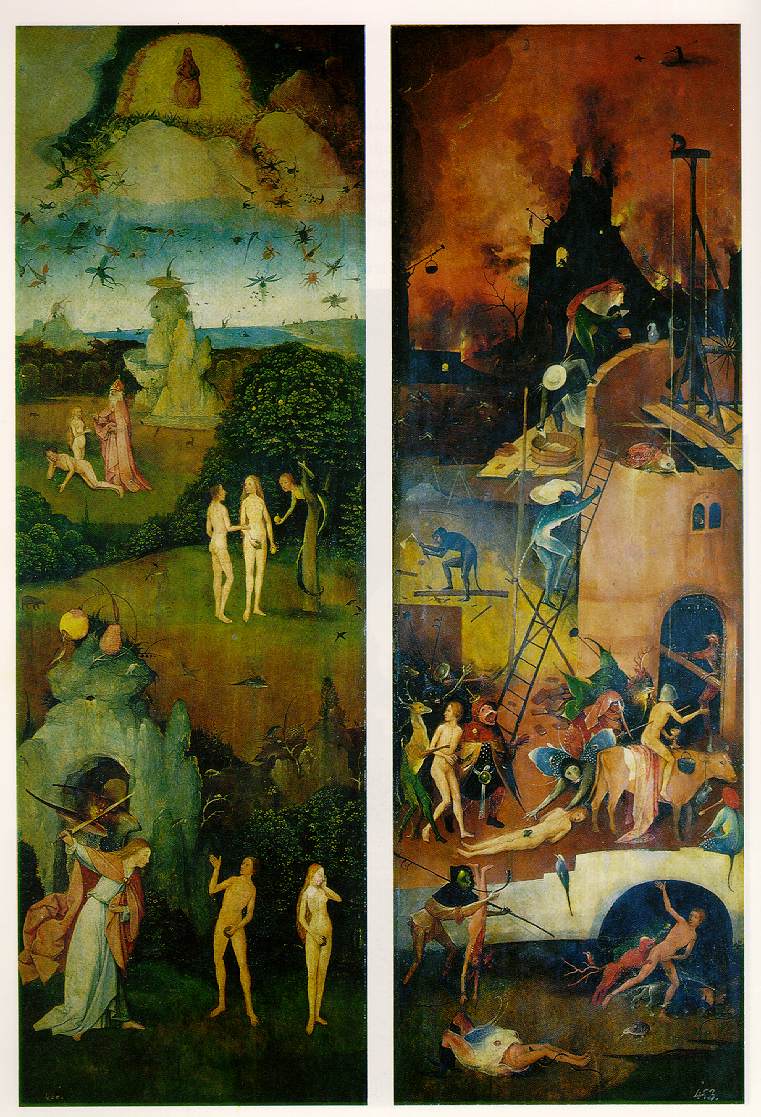
Paradise and Hell c. 1510 Oil on wood, 135 x 45 cm (each panelTerm in painting for a support of wood, metal, or other rigid substance, as distinct from canvas. Until the adoption of canvas in the 15th century nearly all the movable paintings of Europe were executed on wood, and even up to the beginning of the 17th century it is probable that as much painting was done on the one support as on the other. Painters who worked on a small scale often used copper panels (Elsheimer is a leading example), and in the colonial art of South America copper and tin and even lead and zinc were used. On a larger scale, slate has occasionally been used as a support, notably by Rubens for his altarpiece for Sta Maria in Vallicella (the Chiesa Nuova) in Rome; the picture he originally painted was said to reflect the light unpleasantly and slate was used for the replacement to produce a more matt finish. For wood panels the Italian masters of the Renaissance preferred white poplar, while oak was the most common wood used in northern Europe. Many other types were used, however; analysis of the contents of art galleries has yielded a long list, including beech, cedar, chestnut, fir, larch, linden, mahogany, olive, and walnut. In the 20th century cedar, teak, and dark walnut are favourites, and modern painters have also used plywood, fibre-board, and other synthetic materials as supports.) Museo del Prado, Madrid
The two panels once were the left and right wings of a triptychA painting in three sections, usually an altarpiece, consisting of a central panel and two outer panels, or wings. In many medieval triptychs the two outer wings were hinged so that could be closed over the center panel. Early triptychs were often portable..
The greatest Netherlandish artist of the period is not found among the adherents of the New Style but among those who, like Grunewald in Germany, refused to be drawn into the modern movement from the South. In the Dutch town of 's-Hertogenbosch there lived such a painter, who was called Hieronymous Bosch. Very little is known about him. We do not know how old he was when he died in 1516, but he must have been active for a considerable time since he became an independent master in 1486. Like Grunewald, Bosch showed that the traditions and achievements of painting which had been developed to represent reality most convincingly could be turned round, as it were, to give us an equally plausible picture of things no human eye had seen. He became famous for his terrifying representations of the powers of evil. Perhaps it is no accident that the gloomy King Philip II of Spain, later in the century, had a special predilection for this artist, who was so much concerned with man's wickedness. These two pictures show two wings from one of Bosch's triptychs Philip bought and which is therefore still in Spain.
On the left we watch evil invading the world. The creation of Eve is followed by the temptation of Adam and both are driven out of Paradise, while high above in the sky we see the fall of the rebellious angels, who are hurled from heaven as a swarm of repulsive insects. On the other wing we are shown a vision of hell. There we see horror piled upon horror, fires and torments and all manner of fearful demons, half animal, half human or half machine, who plaguePlague, which had been extinct in Italy from the 8th century, returned along eastern trade routes to strike the peninsula, and thereafter all Europe, in October 1347. During 1348 the Black Death, comprising the bubonic and still more deadly septicaemic and pneumonic forms of the disease, swept town and countryside in a series of attacks whose horror was strikingly portrayed by Boccaccio in his preface to the Decameron. Thenceforward, though in less widespread, more sporadic outbreaks, plague recurred periodically until the 18th century. Thirty per cent of the population of Venice died in the outbreak of 1575-7, for instance, which was commemorated by Palladio's church of the Redentore. Preventive measures included the boarding up of infected families, the isolation of sufferers in plague hospitals, the burning of 'infected' clothing, but none worked or mitigated the feeling of hopelessness. The plague's social effects are an object of controversy. It seems probable, however, that during the second half of the 14th century plague reduced the population of Italy by a half and at certain centres, such as Florence and Genoa, sharply accentuated an economic depression which had already set in during the 1340s. In the 15th century, despite regional variations, it is unlikely that population began to rise significantly before the 1470s. Large claims have been made in the field of the arts and of human sensibility for the influence of plague. In Florence and Siena from 1348 to 1380, religious feeling and the art which mirrors it seem to assume more sombre forms and to reflect less the human and more the divine, transcendent and threatening aspects of faith. Yet the black rat and its plague-bearing flea could find a more hospitable environment in the hovels of the poor than in the stone-built houses of wealthy patrons of the arts (who, moreover, were often able to remove themselves from areas where plague had broken out). For this reason, perhaps, it is difficult to find, outside Tuscany, evidence of cultural change which could be attributed to plague, and in the Italy of the 15th and 16th centuries the main effect of the disease in art is to be found only in the frequent portrayal of the plague saints, Rocco and Sebastian. It is none the less interesting to recall that it was against a stark background of continual menace from plague that the human achievements of the Renaissance came into being. and punish the poor sinful souls for all eternity. For the first and perhaps for the only time, an artist had succeeded in giving concrete and tangible shape to the fears that had haunted the minds of man in the Middle Ages. It was an achievement which was perhaps only possible at this very moment, when the old ideas were still vigorous and yet the modern spirit had provided the artist with methods of representing what he saw. Perhaps Hieronymus Bosch could have written on one of his paintings of hell what Jan van Eyck wrote on his peaceful scene of the Arnolfinis' betrothal: 'I was there'.
@online{wga-r51522a36c36d80,
  author       = {Krén, Emil and Marx, Daniel},
  title        = {Paradise and Hell by BOSCH, Hieronymus},
  organization = {{Web Gallery of Art}},
  date         = {2026-09-14},
  url          = {https://beta.wga.hu/artists/bosch-hieronymus-r0d0cb96519d18e/paradise-and-hell-r51522a36c36d80},
  urldate      = {2026-09-14},
  langid       = {english}
}
ACCESSED 2026-09-14. REPLACE THE AUTHOR FIELD WITH THE COMMENTARY AUTHOR WHERE ONE IS NAMED.


