03 — ARTWORK
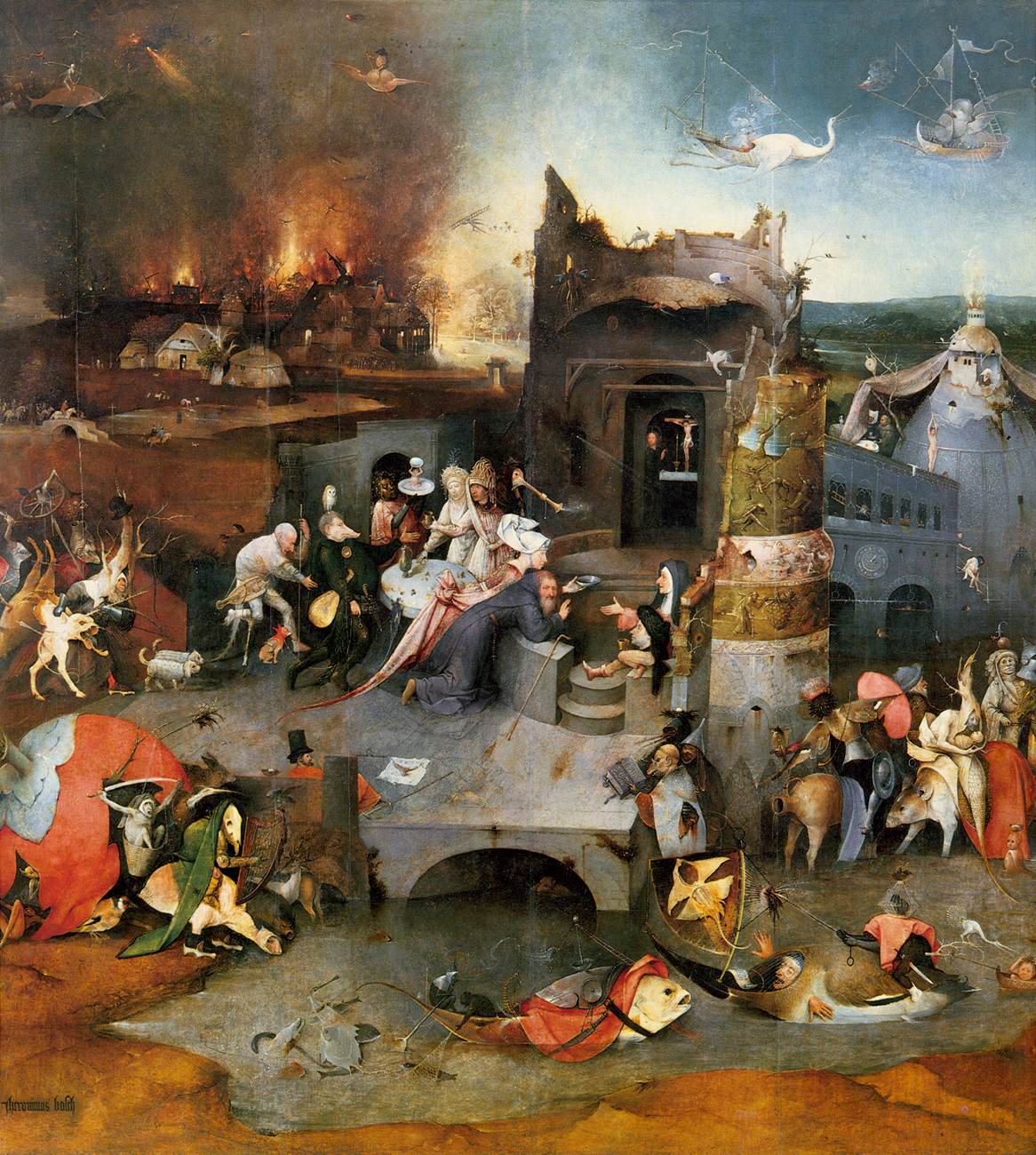
Triptych of Temptation of St Anthony (central panel)
- MEDIUM
- Oil on panel, 131 x 119 cm
- TYPE
- Religious
PALETTE
HOVER OR TAP A SWATCH FOR NAME, SHARE AND HEX. SAMPLED FROM THE IMAGE — INDICATIVE, NOT A PIGMENT ANALYSIS.
DEVELOPMENT BUILD — NOT FOR PUBLIC USE. CONTRIBUTE ON GITHUB.
03 — ARTWORK
PALETTE
HOVER OR TAP A SWATCH FOR NAME, SHARE AND HEX. SAMPLED FROM THE IMAGE — INDICATIVE, NOT A PIGMENT ANALYSIS.
COMMENTARY
UNDERLINED TERMS ARE DEFINED IN THE GLOSSARY.
The diabolic enterprises represented in the triptychA painting in three sections, usually an altarpiece, consisting of a central panel and two outer panels, or wings. In many medieval triptychs the two outer wings were hinged so that could be closed over the center panel. Early triptychs were often portable. reach a climax in the middle panelTerm in painting for a support of wood, metal, or other rigid substance, as distinct from canvas. Until the adoption of canvas in the 15th century nearly all the movable paintings of Europe were executed on wood, and even up to the beginning of the 17th century it is probable that as much painting was done on the one support as on the other. Painters who worked on a small scale often used copper panels (Elsheimer is a leading example), and in the colonial art of South America copper and tin and even lead and zinc were used. On a larger scale, slate has occasionally been used as a support, notably by Rubens for his altarpiece for Sta Maria in Vallicella (the Chiesa Nuova) in Rome; the picture he originally painted was said to reflect the light unpleasantly and slate was used for the replacement to produce a more matt finish. For wood panels the Italian masters of the Renaissance preferred white poplar, while oak was the most common wood used in northern Europe. Many other types were used, however; analysis of the contents of art galleries has yielded a long list, including beech, cedar, chestnut, fir, larch, linden, mahogany, olive, and walnut. In the 20th century cedar, teak, and dark walnut are favourites, and modern painters have also used plywood, fibre-board, and other synthetic materials as supports.. Devils of all species, human and grotesque, arrive from all directions by land, water and air, to converge upon a ruined tomb in the centre. On a platform before the tomb, an elegantly dressed pair have set up a table from which they dispense drink to their companions. Near by, a woman wearing a large headdress and a gown with an extravagantly long train kneels at a parapet to offer a bowl to a figure opposite. Kneeling beside her, almost unnoticed in the midst of this hellish activity, is St Anthony himself; he turns towards the viewer, his right hand raised in blessing. His gesture is echoed by Christ half-hidden in the depths of the tomb, which Anthony has converted into a chapela small separate place for worship, either part of a large church or a separate building.. The right wall of the sanctuarythe part of a church or temple containing the shrine; in Christian churches the choir and high altar. ends in a decaying tower covered with monochromePainted in a single color; a painting executed in a single color. scenes. Two of them, the Adoration of the Golden Calf and a group of men making offerings to an enthroned ape, are images of idolatry, while the third, the Israelites returning from Canaan with a bunch of grapes, prefigures Christ carrying the Cross on the outer wings of the triptych.
A burning village illuminates the dusky background, probably a reference to the disease of ergotism or "St Anthony's Fire", whose victims invoked the name of St Anthony for reliefA sculptural work in which all or part projects from the flat surface. There are three basic forms: low relief (bas-relief, basso rilievo), in which figures project less than half their depth from the background; medium relief (mezzo-rilievo), in which figures are seen half round; and high relief (alto rilievo), in which figures are almost detached from their background.. The ancient association of ergotism with the devil-plagued saint may have been influenced by the fact that one phase of the disease is characterized by hallucinations in which the sufferer believes that he is attacked by wild beasts or demons.
The devils who have gathered around St Anthony display a complexity of form unusual even for Bosch. In the group far right, for example, a blasted tree trunk becomes the bonnet, torso and arms of a woman whose body terminates in a scaly lizard tail; she holds a baby and is mounted on a giant rat. Near by, a jug has been transformed into another beast of burden whose wholly unsubstantial rider bears a thistle for a head. In the water below, a man has been absorbed into the interior of a gondola-fish, his hands thrust helplessly through its sides. An armoured demon with a horse's skull for a head plays a lute at lower left; he sits astride a plucked goose who wears shoes and whose neck ends in a sheep's muzzle. All these shifting forms, moreover, display a richness of colour that confers a visual beauty on even the most disgusting shape. A recent, careful cleaning of the triptych, among Bosch's best preserved works, reveals brilliant reds and greens alternating with subtly modulated passages of blue-greys and browns.
This convocation of fiends ostensibly illustrates the second attack on Anthony described in the literary accounts; the miraculous light which dispersed the devils on this occasion can be seen shining through one of the chapel windows. But the devils do not seem about to scatter "like dust in the wind", as one version has it, nor are they physically attacking Anthony. Instead, their torments must be understood in a spiritual sense. Like the monstrous creatures who confront Deguilleville's pilgrim, they are incarnations of the sinful urges with which Anthony wrestled in his desert solitude. In a drawing made around 1500, Albrecht Dürer similarly illustrated the evil thoughts of a group of people at Mass by means of little devils fluttering about their heads. A number of sins symbolized by Bosch's monsters can be identified, chief among which is Lust. Lust is also represented more overtly in the group of buildings at extreme right, where a monk and a prostitute drink together within a tent; there may be a further reference in the dark-skinned devil in the central group: the demon of unchastity, we are told, once appeared to Anthony in the form of a black boy. It should not be surprising that even the most ascetic saints were susceptible to this particular vice: as the "Malleus Maleficarum" informs us, it was through the carnal act that the Devil could most easily assail mankind.
Anthony, however, has overcome all his temptations through the strength of his faith. This faith is expressed in his gesture of benediction, thought to be particularly efficacious against the Devil; and the steady gaze which the hermit directs towards us is one of comforting assurance. While the wings of the Lisbon triptych show Anthony tempted and tormented, the central panel thus shows him triumphant.
@online{wga-r7644b8b5386ea0,
  author       = {Krén, Emil and Marx, Daniel},
  title        = {Triptych of Temptation of St Anthony (central panel) by BOSCH, Hieronymus},
  organization = {{Web Gallery of Art}},
  date         = {2026-09-09},
  url          = {https://beta.wga.hu/artists/bosch-hieronymus-r0d0cb96519d18e/triptych-of-temptation-of-st-anthony-central-panel-r7644b8b5386ea0},
  urldate      = {2026-09-09},
  langid       = {english}
}
ACCESSED 2026-09-09. REPLACE THE AUTHOR FIELD WITH THE COMMENTARY AUTHOR WHERE ONE IS NAMED.


