03 — ARTWORK
Reconstruction
- MEDIUM
- Engraving
- TYPE
- Other
PALETTE
HOVER OR TAP A SWATCH FOR NAME, SHARE AND HEX. SAMPLED FROM THE IMAGE — INDICATIVE, NOT A PIGMENT ANALYSIS.
DEVELOPMENT BUILD — NOT FOR PUBLIC USE. CONTRIBUTE ON GITHUB.
03 — ARTWORK
PALETTE
HOVER OR TAP A SWATCH FOR NAME, SHARE AND HEX. SAMPLED FROM THE IMAGE — INDICATIVE, NOT A PIGMENT ANALYSIS.
COMMENTARY
UNDERLINED TERMS ARE DEFINED IN THE GLOSSARY.
More than any of his contemporaries, Salomon de Brosse prepares the way for the next generation and the introduction of classicism. From about 1610 onwards he seems to have enjoyed considerable success as an architect. During the next few years he was commissioned to build three great châteaux: Coulommiers in 1613 for Catherine de Gonzague, Duchesse de Longueville; Blérancourt, begun by 1612 and finished before 1619 for Bernard Potier; and the Luxembourg in 1615 for Marie de' Medici.
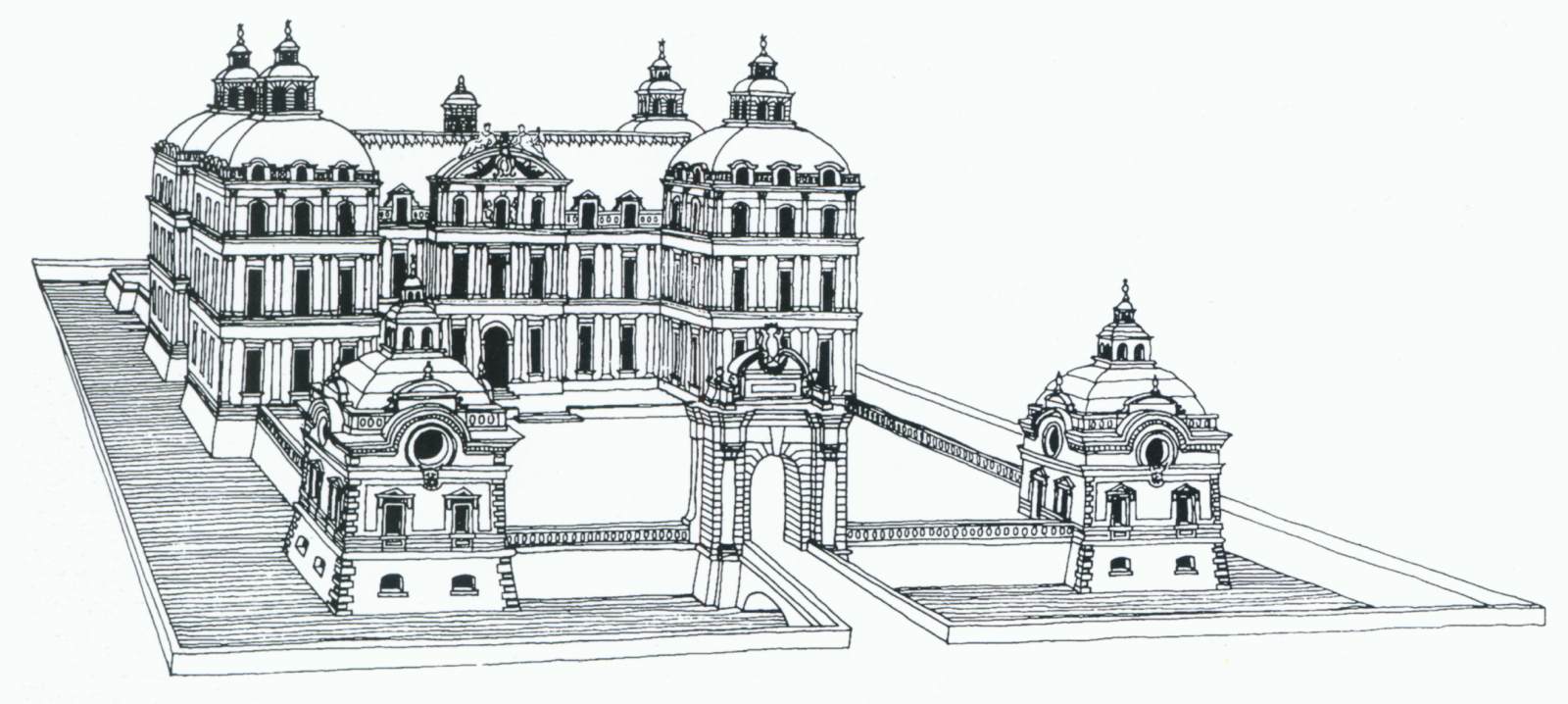
Of the three châteaux the Luxembourg and Coulommiers are in many ways traditional. In plan they are variants of the well-established form with <i>corps-de-logis,</i> two wings and a screen enclosing a court. At Blérancourt de Brosse's plastic conception is more apparent, because the château has no wings, but is reduced to a single block with four flanking pavilions. This is an important step, leading up to the classicalRelating to the culture of ancient Greece and Rome (classical Antiquity). The classical world played a profoundly important role in the Renaissance, with Italian scholars, writers, and artists seeing their own period as the rebirth (the "renaissance") of classical values after the Middle Ages. The classical world was considered the golden age for the arts, literature, philosophy, and politics. Concepts of the classical, however, changed greatly from one period to the next. Roman literature provided the starting point in the 14th century, scholars patiently finding, editing and translating a wide range of texts. In the 15th century Greek literature, philosophy and art - together with the close study of the remains of Roman buildings and sculptures-expanded the concept of the classical and ensured it remained a vital source of ideas and inspiration. conception of the chateau as it was evolved by François Mansart and bearing a closer relation to the ideals of the Italian Renaissance than any earlier buildings in France.
The engravingA print made from a metal plate that has had a design cut into it with a sharp point. Ink is smeared over the plate and then wiped off, the ink remaining in the etched lines being transferred when the plate is pressed very firmly onto a sheet of paper. shows a reproduction of the château by Peter Smith.
@online{wga-rcedc97bcb7511e,
  author       = {Krén, Emil and Marx, Daniel},
  title        = {Reconstruction by BROSSE, Salomon de},
  organization = {{Web Gallery of Art}},
  date         = {2026-09-12},
  url          = {https://beta.wga.hu/artists/brosse-salomon-de-rbddf6d399608cd/reconstruction-rcedc97bcb7511e},
  urldate      = {2026-09-12},
  langid       = {english}
}
ACCESSED 2026-09-12. REPLACE THE AUTHOR FIELD WITH THE COMMENTARY AUTHOR WHERE ONE IS NAMED.


