03 — ARTWORK
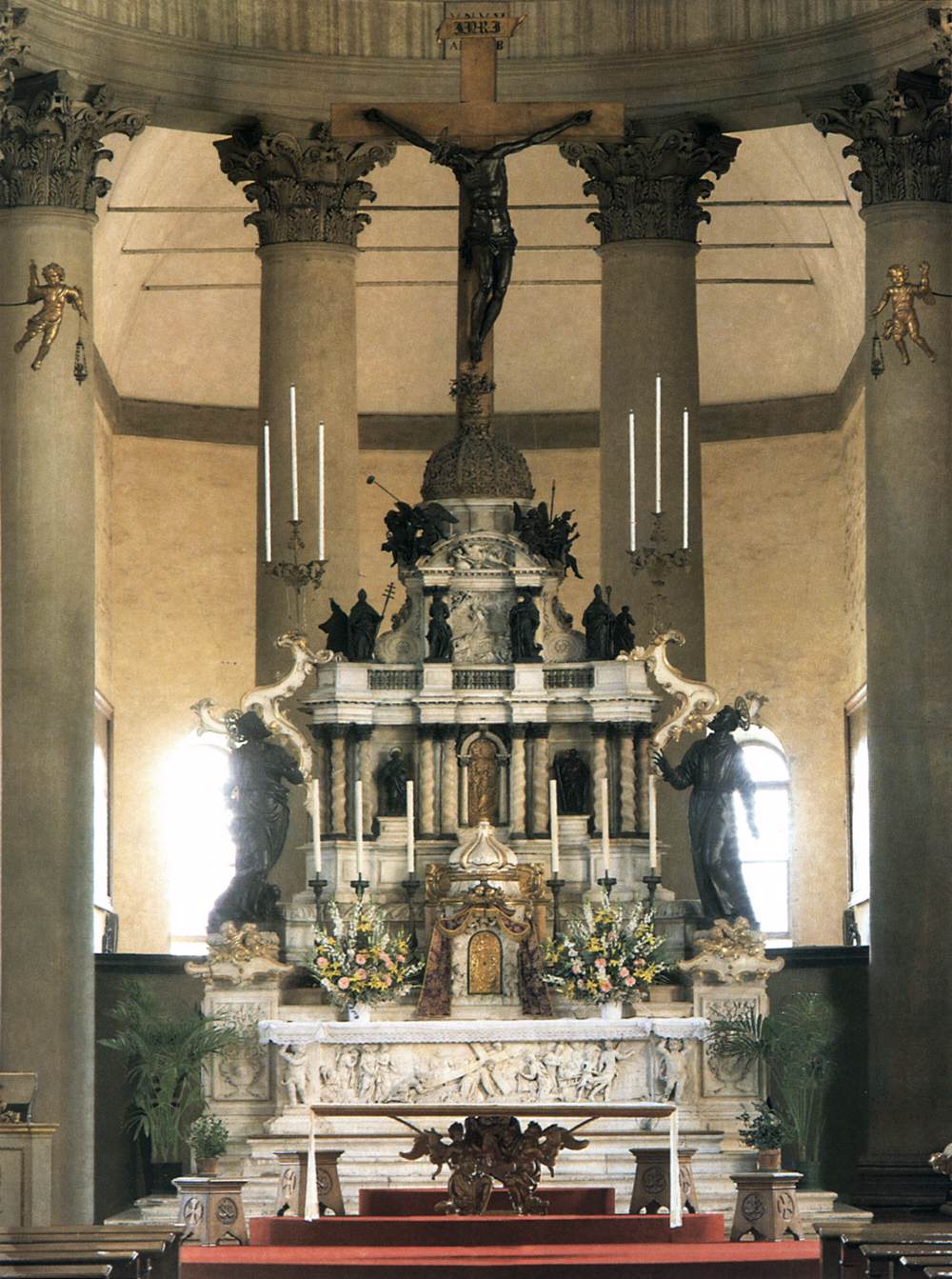
Main altar
- MEDIUM
- Bronze
- TYPE
- Religious
PALETTE
HOVER OR TAP A SWATCH FOR NAME, SHARE AND HEX. SAMPLED FROM THE IMAGE — INDICATIVE, NOT A PIGMENT ANALYSIS.
DEVELOPMENT BUILD — NOT FOR PUBLIC USE. CONTRIBUTE ON GITHUB.
03 — ARTWORK
PALETTE
HOVER OR TAP A SWATCH FOR NAME, SHARE AND HEX. SAMPLED FROM THE IMAGE — INDICATIVE, NOT A PIGMENT ANALYSIS.
COMMENTARY
UNDERLINED TERMS ARE DEFINED IN THE GLOSSARY.
Campagna received the two most important Venetian sculptural commissions of the late 16th century, for the high altars of Il Redentore and San Giorgio Maggiore. These altars represent Campagna's first known attempt at bronzeAn alloy of copper (usually about 90 per cent) and tin, often also containing small amounts of other metals such as lead or zinc. Since antiquity it has been the metal most commonly used in cast sculpture because of its strength, durability, and the fact that it is easily workable - both hot and cold - by a variety of processes. It is easier to cast than copper because it has a lower melting-point, and its great tensile strength makes possible the protrusion of unsupported parts - an advantage over marble sculpture. The colour of bronze is affected by the proportion of tin or other metals present, varying from silverish to a rich, coppery red, and its surface beauty can be enhanced when it acquires a patina. statuary and include the first monumental bronze figures cast in Venice since those for the Zen Chapela small separate place for worship, either part of a large church or a separate building. in San Marco (1504-22).
In the cases of the high altars, Campagna was called upon to design a new kind of altar, unprecedented in Venice, to meet the requirements of Counter-ReformationTerm in ecclesiastical history referring to the reform of the entire Church which was widely believed to be necessary as early as the late Middle Ages. Reform programs, such as those passed by the Councils of Constance (1414-1418) and Basle (1431-1437 and 1448) or the 5th Lateran Council (1512-1517), did not achieve any lasting results. Not until the Protestant Reformation were the Pope and Roman Curia forced to take specific action against abuse of position, declining moral standards, the selling of indulgences and excesses in the worship of saints and relics. With the Laetere Jerusalem (1544) bull. Pope Paul III (1534-1549) was responsible for the convocation of the Council of Trent which, in three separate sessions between 15445 and 1563, started the process of inner reform in the Church. architecture. Beyond that, both churches were projects by Palladio, with whose ideas Campagna had an evident sympathy. Palladio intended each church to have a free-standing altar, to be seen in the round. The altar of the Redentore was the earlier of the two, probably conceived in 1589 and finished the following year.
At the Redentore, Campagna created a variation on the medieval meditation on the CrucifixionAn important method of capital punishment, particularly among the Persians, Seleucids, Jews, Carthaginians, and Romans from about the 6th century BC to the 4th century AD. Constantine the Great, the first Christian emperor, abolished it in the Roman Empire in AD 337, out of veneration for Jesus Christ, the most famous victim of crucifixion. There were various methods of performing the execution. Usually, the condemned man, after being whipped, or "scourged," dragged the crossbeam of his cross to the place of punishment, where the upright shaft was already fixed in the ground. Stripped of his clothing either then or earlier at his scourging, he was bound fast with outstretched arms to the crossbeam or nailed firmly to it through the wrists. The crossbeam was then raised high against the upright shaft and made fast to it about 9 to 12 feet (approximately 3 metres) from the ground. Next, the feet were tightly bound or nailed to the upright shaft. A ledge inserted about halfway up the upright shaft gave some support to the body; evidence for a similar ledge for the feet is rare and late. Over the criminal's head was placed a notice stating his name and his crime. Death, apparently caused by exhaustion or by heart failure, could be hastened by shattering the legs (crurifragium) with an iron club, so that shock and asphyxiation soon ended his life., with St Mark and St Francis flanking the cross. Campagna later described the Crucifixion as 'famosissimo', and its combination of pathos and beauty must have excited admiration at the time. The sensuous treatment of the nude male figure is inspired by Donatello's bronze Christ in Il Santo in Padua. The poses of the two saints (originally placed nearer to the cross) complement its sinuous contrappostoAn asymmetrical pose in which the one part of the body is counterbalanced by another about the body's central axis. Ancient Greek sculptors developed contrapposto by creating figures who stand with their weight on one leg, the movement of the hips to one side being balanced by a counter movement of the torso. Contrapposto was revived during the Renaissance and frequently used by Mannerist artist, who developed a greater range of contrapposto poses.. The St Mark's dynamic gesture and expressive features have the proto-BaroqueThe period in art history from about 1600 to about 1750. In this sense the term covers a wide range of styles and artists. In painting and sculpture there were three main forms of Baroque: (1) sumptuous display, a style associated with the Catholic Counter Reformation and the absolutist courts of Europe (Bernini, Rubens); (2) dramatic realism (Caravaggio); and (3) everyday realism, a development seen in particular in Holland (Rembrandt, Vermeer). In architecture, there was an emphasis on expressiveness and grandeur, achieved through scale, the dramatic use of light and shadow, and increasingly elaborate decoration. In a more limited sense the term Baroque often refers to the first of these categories. The development of the Baroque reflects the period's religious tensions (Catholic versus Protestant); a new and more expansive world view based on science and exploration; and the growth of absolutist monarchies. style of many of Campagna's later figures.
@online{wga-rdc161fc576be5e,
  author       = {Krén, Emil and Marx, Daniel},
  title        = {Main altar by CAMPAGNA, Girolamo},
  organization = {{Web Gallery of Art}},
  date         = {2026-09-12},
  url          = {https://beta.wga.hu/artists/campagna-girolamo-r9f87657804b9ff/main-altar-rdc161fc576be5e},
  urldate      = {2026-09-12},
  langid       = {english}
}
ACCESSED 2026-09-12. REPLACE THE AUTHOR FIELD WITH THE COMMENTARY AUTHOR WHERE ONE IS NAMED.


