03 — ARTWORK
Exterior view
- MEDIUM
- Photo
- TYPE
- Other
PALETTE
HOVER OR TAP A SWATCH FOR NAME, SHARE AND HEX. SAMPLED FROM THE IMAGE — INDICATIVE, NOT A PIGMENT ANALYSIS.
DEVELOPMENT BUILD — NOT FOR PUBLIC USE. CONTRIBUTE ON GITHUB.
03 — ARTWORK
PALETTE
HOVER OR TAP A SWATCH FOR NAME, SHARE AND HEX. SAMPLED FROM THE IMAGE — INDICATIVE, NOT A PIGMENT ANALYSIS.
COMMENTARY
UNDERLINED TERMS ARE DEFINED IN THE GLOSSARY.
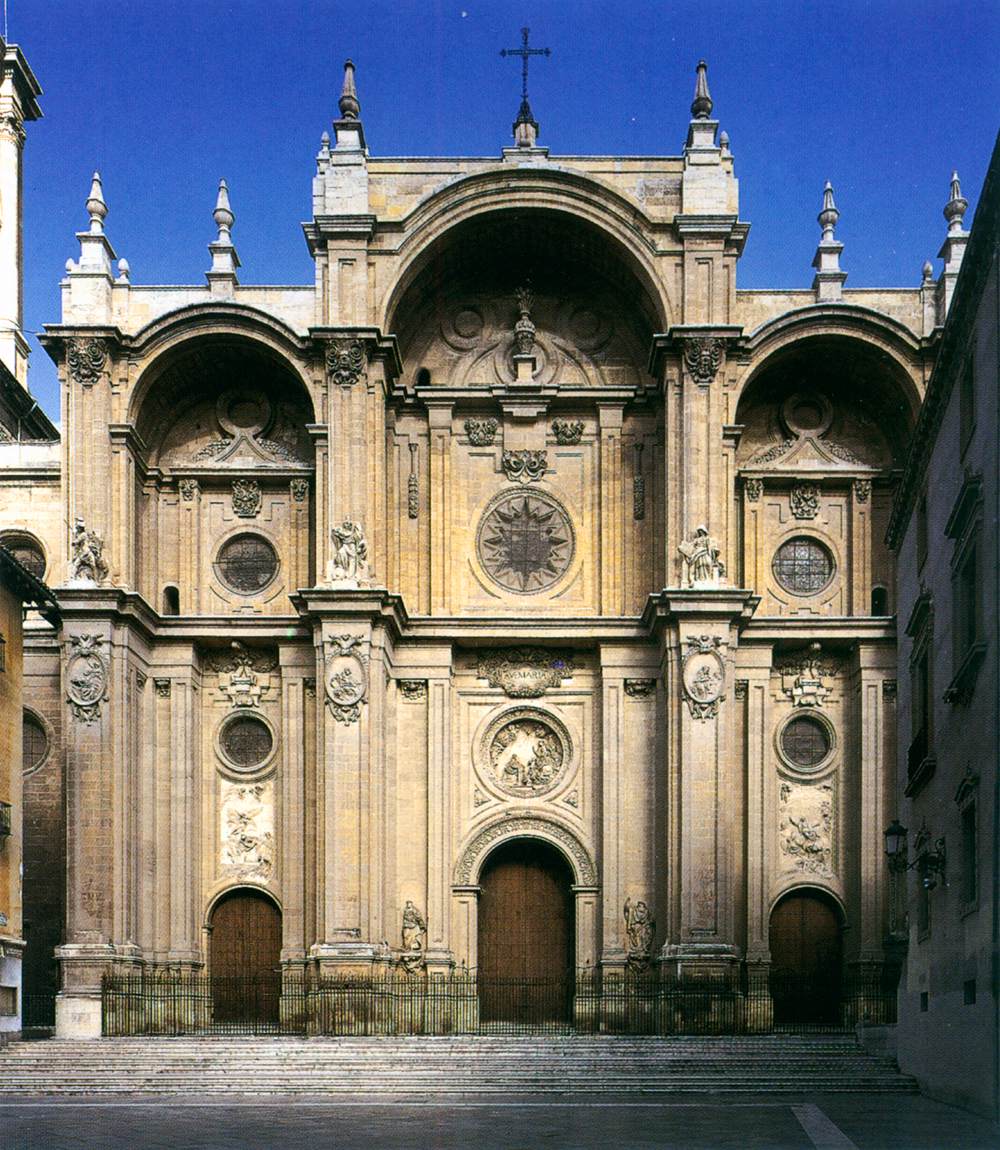
Alonso Cano was the only major all-round artist Spain produced. His most significant works were undoubtedly the paintings he made as court artist to Philip IV and drawing master to Prince Baltasar Carlos. However, the plan for the façadethe front or principal face of a building, especially one elaborately constructed; a blind façade is a façade that is purely decorative and does not relate to the structure of the building. of Granada cathedralThe principal church of a province or diocese, where the throne of the bishop is placed. For reasons lost to time and tradition, a cathedral always faces west - toward the setting sun. The altar is placed at the east end. The main body, or nave, of the cathedral is usually divided into one main and two side aisles. These lead up to the north and south transepts, or arms of the cross, the shape in which a cathedral is usually formed., which he submitted in 1644, showed at least as much inventive geniusin classical Rome, a person's invisible tutelary god. In art from the classical period onwards, the low-ranking god was depicted as a winged, usually childish figure..
Although Cano had to respect the navethe main interior space of a church building. It may have parallel aisles on each side, often separated from it by pillars, and is intersected by the transept, which cuts across it at the point where the choir begins. structure erected by Siloé, he produced a most individual design which went far beyond the other contemporary solutions to this type of problem. He selected a framework structure resembling a triumphal archIn the architecture of ancient Rome, a large and usually free-standing ceremonial archway built to celebrate a military victory. Often decorated with architectural features and relief sculptures, they usually consisted of a large archway flanked by two smaller ones. The triumphal archway was revived during the Renaissance, though usually as a feature of a building rather than as an independent structure. In Renaissance painting they appear as allusion to classical antiquity., behind which he deeply recessed the portals and wall surfaces. This structure provided a thoroughly innovative rhythm and dynamism to the façade, dominated by a round archThe pointed arch is widely regarded as the main identifiable feature of Gothic architecture (distinct from the round arch of the Romanesque period). The three most common Gothic arches are the Equilateral, Lancet and Tudor. at the top of the central section.
Cano's design, which was realized between 1667 and 1684, was imitated throughout Andalusia.
The picture shows the façade of the cathedral.
@online{wga-r1207fb27d25e6b,
  author       = {Krén, Emil and Marx, Daniel},
  title        = {Exterior view by CANO, Alonso},
  organization = {{Web Gallery of Art}},
  date         = {2026-09-13},
  url          = {https://beta.wga.hu/artists/cano-alonso-r5590e9cfecf88c/exterior-view-r1207fb27d25e6b},
  urldate      = {2026-09-13},
  langid       = {english}
}
ACCESSED 2026-09-13. REPLACE THE AUTHOR FIELD WITH THE COMMENTARY AUTHOR WHERE ONE IS NAMED.


