03 — ARTWORK
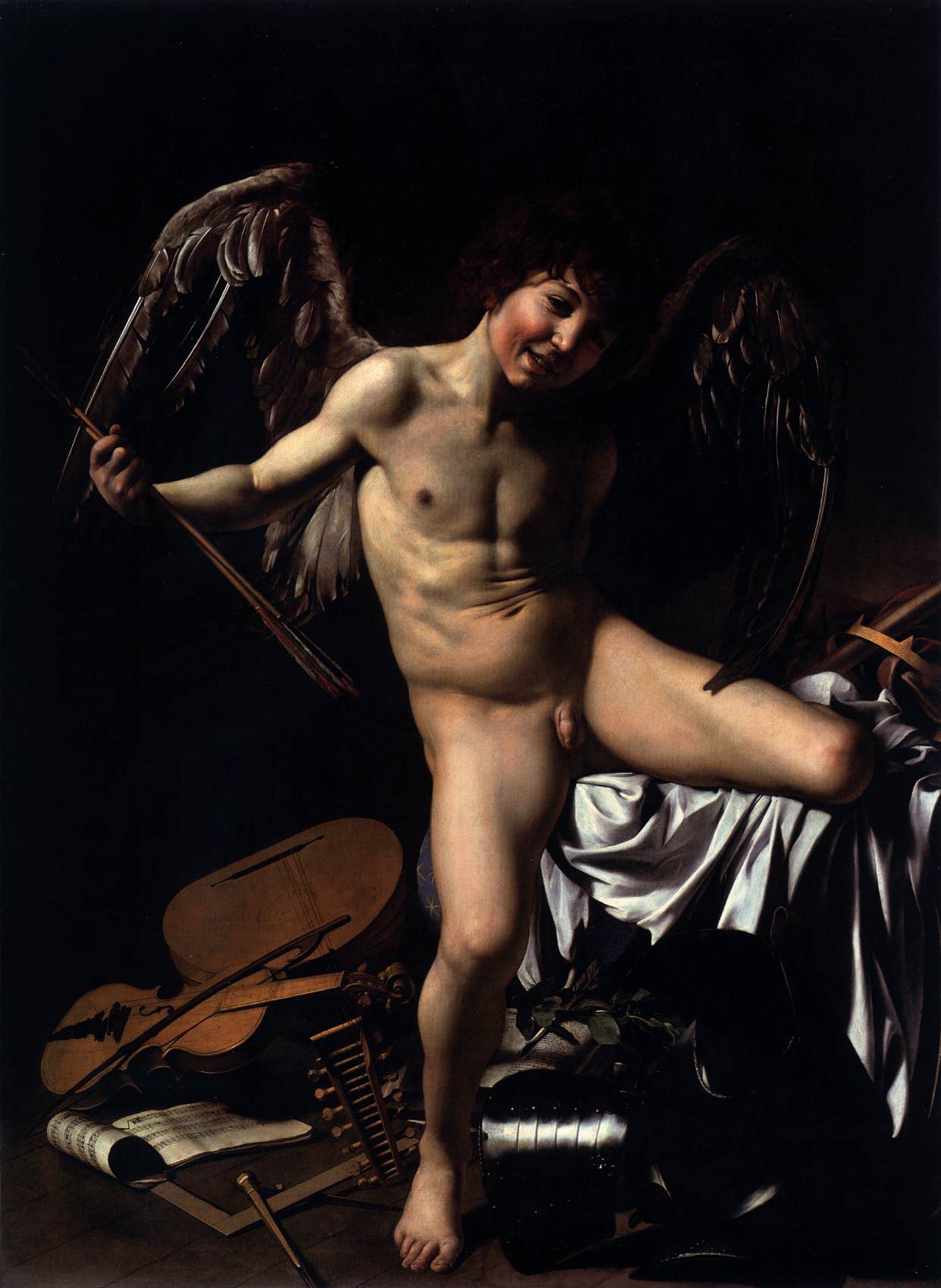
Amor Victorious
- MEDIUM
- Oil on canvas, 156 x 113 cm
- TYPE
- Mythological
PALETTE
HOVER OR TAP A SWATCH FOR NAME, SHARE AND HEX. SAMPLED FROM THE IMAGE — INDICATIVE, NOT A PIGMENT ANALYSIS.
DEVELOPMENT BUILD — NOT FOR PUBLIC USE. CONTRIBUTE ON GITHUB.
03 — ARTWORK
PALETTE
HOVER OR TAP A SWATCH FOR NAME, SHARE AND HEX. SAMPLED FROM THE IMAGE — INDICATIVE, NOT A PIGMENT ANALYSIS.
COMMENTARY
UNDERLINED TERMS ARE DEFINED IN THE GLOSSARY.
This paintings was always considered one of Caravaggio's great masterpieces. He painted it for Marchese Giustiniani. The figure sets up a direct, special and privileged relationship with the viewer, with an immediate appeal that is truly extraordinary. One is bewildered by this painting, by the absolute freedom that the subject obviously enjoys, detaching himself from mere mortals who must obey the laws of nature. The figure is in the act of mocking the world with a complete impunity, a self-assurance that produce a mixture of astonishment and envy. The figure has a torso that recalls Michelangelo's Victory.
The painting probably shows Earthly Love triumphant over the Virtues and Sciences, symbolized by the musical instruments, pen and book, compass and square, scepter, laurel, and armor at his feet.
Caravaggio's Amor, a teenager with a gloating smile, "reigns" over a pile of weapons, instruments, a book (sheet music), drawing utensils, and a laurel wreath. He places his left knee lightly over these objects, while he holds a bunch of arrows in his right hand. Since the attributes of war, military glory(1) The supernatural radiance surrounding a holy person. (2) To have the distinction of one's deeds recognized in life and to be revered for them posthumously: this was glory. The nature of true gloria was much discussed, whether it must be connected with the public good, whether the actions that led to it must conform with Christian ethics, how it differed from notoriety. The concept did not exclude religious figures (the title of the church of the Frari in Venice was S. Maria Gloriosa), but it was overwhelmingly seen in terms of secular success and subsequent recognition, as determining the lifestyles of the potent and the form of their commemoration in literature, in portraits and on tombs. As such, it has been taken as a denial of medieval religiosity ('sic transit gloria mundi'), and thus a hallmark of Renaissance individual ism; as a formidable influence on cultural patronage; and as spurring on men of action, as well as writers and artists, to surpass their rivals - including their counterparts in antiquity., science and arts are scattered at Amor's feet, the painting reminds the viewer of a VanitasA painting (or element in painting) that acts as a reminder of the inevitabiliry of death, and the pointlessness of earthly ambitions and achievements. Common vanitas-symbols include skulls, guttering candles, hour-glasses and clocks, overturned vessels, and even flowers (which will soon fade). The vanitas theme became popular during the Baroque, with the vanitas still life flourishing in Dutch art. still-life. Some objects in this still-life are emphasized: pieces of a suit of armour, a lute and a violin with a bow. These may refer to Mars and Venus, who, according to some classicalRelating to the culture of ancient Greece and Rome (classical Antiquity). The classical world played a profoundly important role in the Renaissance, with Italian scholars, writers, and artists seeing their own period as the rebirth (the "renaissance") of classical values after the Middle Ages. The classical world was considered the golden age for the arts, literature, philosophy, and politics. Concepts of the classical, however, changed greatly from one period to the next. Roman literature provided the starting point in the 14th century, scholars patiently finding, editing and translating a wide range of texts. In the 15th century Greek literature, philosophy and art - together with the close study of the remains of Roman buildings and sculptures-expanded the concept of the classical and ensured it remained a vital source of ideas and inspiration. genealogies, including that of Virgil's Aeneid I. 664, were the parents of the playful little winged deity Amor.
Thus in this painting the musical instruments represent Venus herself rather than either art in general or, through the association of fading melodies, transitoriness of human life. It is likely, of course, that the viewer of the sixteenth and seventeenth centuries may have thought of all the previous connotations, too, since he was used to the multiple meanings of symbols. <P> <TABLE ALIGN=LEFT CELLPADDING=5 BORDER=1 WIDTH=320 BGCOLOR="#99CCCC"> <TR VALIGN=MIDDLE><TD><IMG SRC="/support/gif/listen.gif" BORDER=0 VALIGN=MIDDLE> Suggested listening (streaming mp3, 4 minutes):<BR><A HREF="#" onClick="w=window.open ('/music1/17_cent/gasparini_cupid.html', 'newWin', 'scrollbars=yes,status=no,dependent=yes,screenX=0,screenY=0,width=350,height=350');w.opener=this;w.focus();return true"><B>Francesco Gasparini: The Meddlesome Cupid, aria</B></A> </TD></TR></TABLE>
@online{wga-rfc7120f208bdbb,
  author       = {Krén, Emil and Marx, Daniel},
  title        = {Amor Victorious by CARAVAGGIO},
  organization = {{Web Gallery of Art}},
  date         = {2026-09-09},
  url          = {https://beta.wga.hu/artists/caravaggio-r877ee03cc951f7/amor-victorious-rfc7120f208bdbb},
  urldate      = {2026-09-09},
  langid       = {english}
}
ACCESSED 2026-09-09. REPLACE THE AUTHOR FIELD WITH THE COMMENTARY AUTHOR WHERE ONE IS NAMED.


