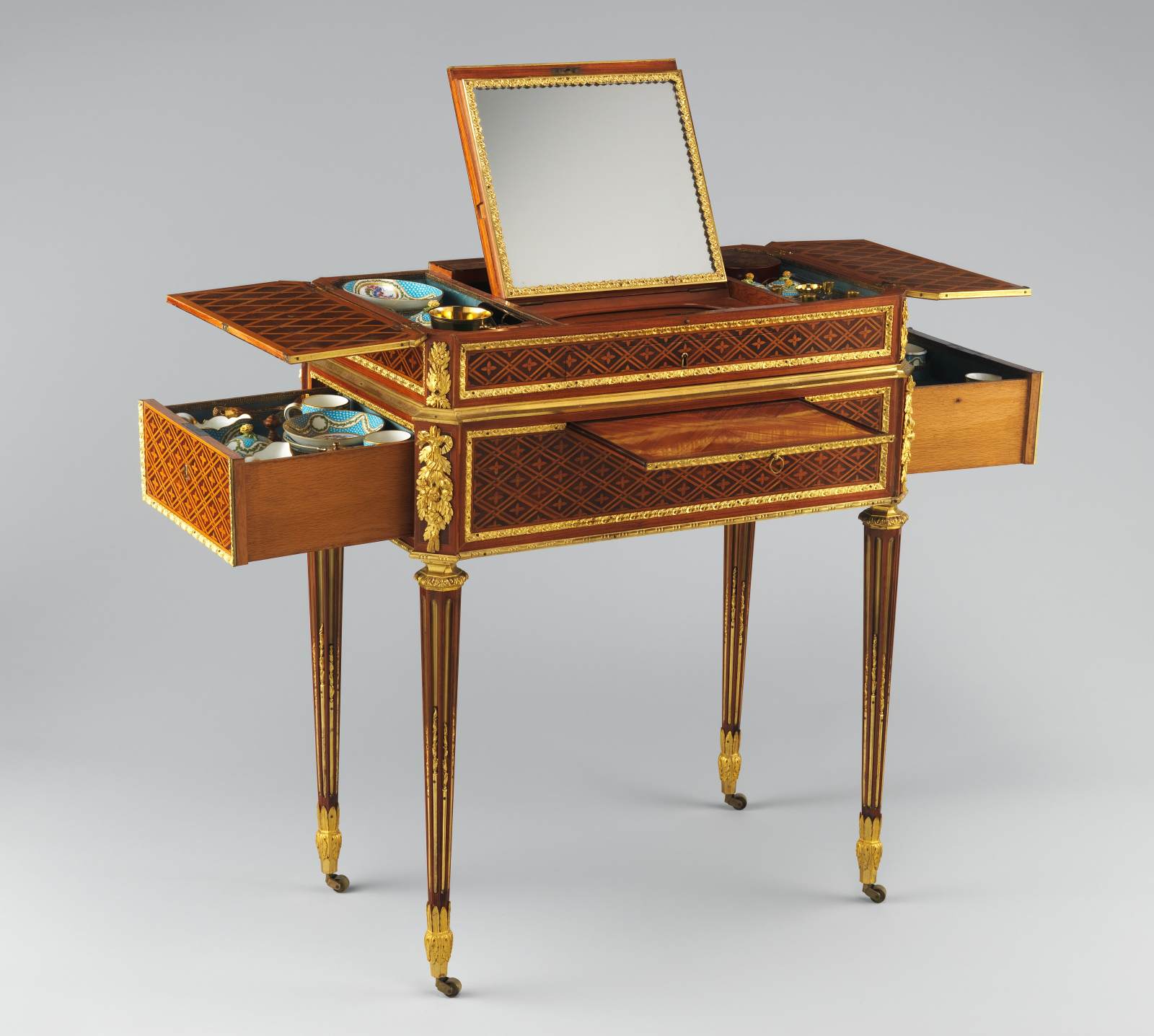
Combination table c. 1775 Oak and pine veneered with tulipwood, sycamore, holly, boxwood and ebony; Carrara marbleloosely applied to any hard limestone that can be sawn into thin slabs and will take a good polish so that it is suitable for decorative work; more strictly, it refers to metamorphosed limestones whose structure has been recrystallized by heat or pressure. Marbles are widely disseminated and occur in a great variety of colours and patterns, but certain types have been particularly prized by sculptors. The most famous of Greek white marbles in the ancient world was the close-grained Pentelic, which was quarried at Mount Pentelicon in Attica. The Elgin Marbles are carved in Pentelic. Widely used also were the somewhat coarser-grained translucent white marbles from the Aegean islands of Paros and Naxos. Parian marble was used for the celebrated Mausoleum at Halicarnassus. The pure white Carrara marble, quarried at Massa, Carrara, and Pietra Santa in Tuscany from the 3rd century BC, is the most famous of all sculptors' stones. It was used for the Apollo Belvedere, and was much favoured in the Renaissance, particularly by Michelangelo, who often visited the quarries to select material for his work. Neoclassical sculptors also favoured Carrara marble because of its ability to take a smooth, sleek surface, but it can look rather 'dead' compared with some of the finest Greek marbles.; gilt-bronzeAn alloy of copper (usually about 90 per cent) and tin, often also containing small amounts of other metals such as lead or zinc. Since antiquity it has been the metal most commonly used in cast sculpture because of its strength, durability, and the fact that it is easily workable - both hot and cold - by a variety of processes. It is easier to cast than copper because it has a lower melting-point, and its great tensile strength makes possible the protrusion of unsupported parts - an advantage over marble sculpture. The colour of bronze is affected by the proportion of tin or other metals present, varying from silverish to a rich, coppery red, and its surface beauty can be enhanced when it acquires a patina. mounts; accessories of Sèvres porcelain, rock crystal, silver gilt, and lacquer, 74 x 71 x 42 cm (overall, table) Metropolitan Museum of Art, New York
The daily ritual of dressing and grooming was taken very seriously in France, and it was not unusual for an aristocratic lady to receive visitors, who could even be called upon to assist her. Special pieces of furniture were designed for the toilette, such as this elegant marquetry table signed by Martin Carlin, which is more versatile than most dressing tables. The upper section can be removed to serve as a bed table, as it has its own short legs (24 x 68 x 40 cm). It is fitted with an adjustable mirror that can be reversed to form a book rest. A shallow drawer is provided in front, and the lidded compartments on either side are used for the storage of toilet articles. The lower section is a full size table with a marble top, pull-out shelves in front and back, and drawers on both ends holding equipment for dressing, breakfasting, and writing. A trelliswork pattern enclosing rosettes, which may have been based on designs seen in Japanese lacquerwork, embellishes the exterior of this multipurpose piece, which is further enriched with gilt-bronze mounts.
The table is a typical product of a marchand-mercier, who would have bought or ordered the various rock crystal, Sèvres porcelain, and silver accoutrements and engaged a cabinetmaker to create the wooden frame. Martin Carlin, a German-born cabinetmaker who had settled in Paris by 1759, specialized in making expensive and fashionable furniture.