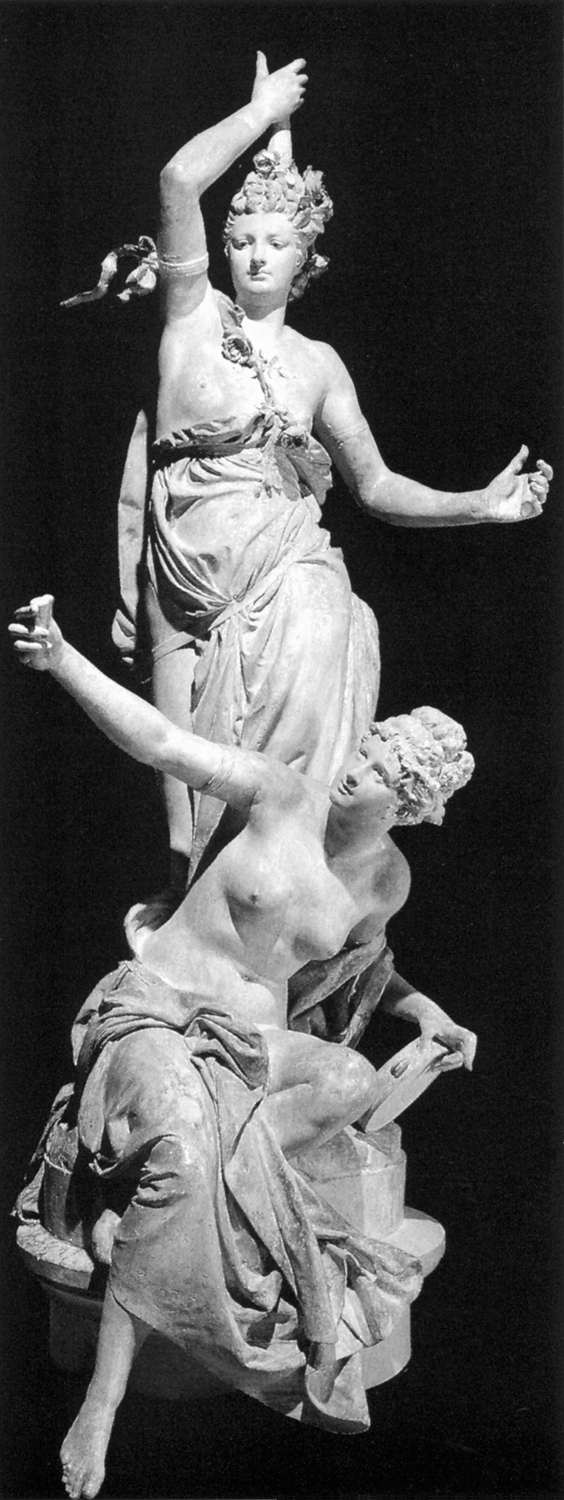
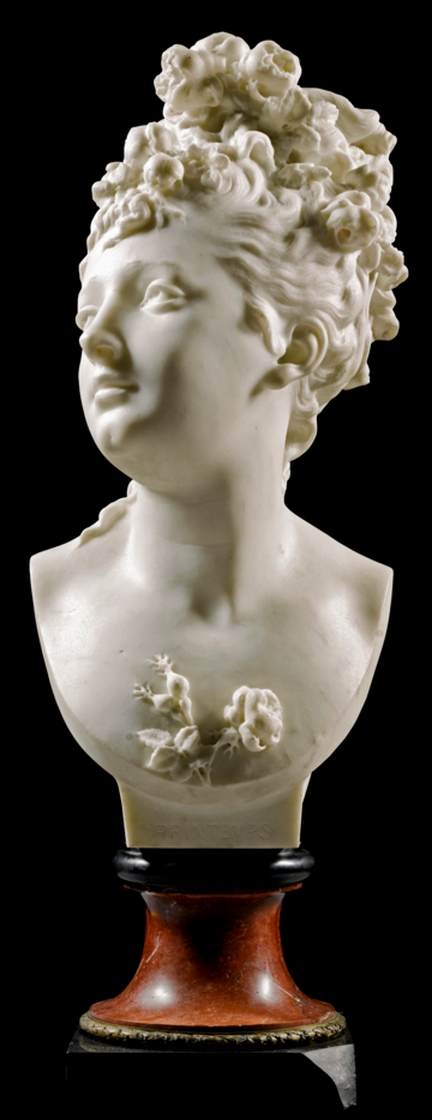
French sculptor and painter, the father of Louis-Robert Carrier-Belleuse, painter and sculptor. He began his training as a goldsmith's apprentice. In 1840 Pierre-Jean David d'Angers sponsored him for the École des Beaux-Arts. He stayed only briefly, moving to the Petite École to study decorative arts instead. Between 1850 and 1855, Carrier-Belleuse worked in England, designing ceramics and metalwork models for companies like Wedgwood. From 1857 he exhibited large-scale sculptures at the SalonGLOSSARYIn the French language of the 18th and 19th centuries it designated an actual exhibition space, as well as the academic art exhibitions staged in the Salon d'Apollon of the Louvre since 1667. From 1737, the exhibitions took place biennially and, after the French Revolution, annually in the Salon Carré of the Louvre in Paris. Towards the end of the 19th century the official Salon jury was dissolved in order to make way for a committee of state-approved artists, i.e. former Salon members, who created the highly influential Société des Artistes Français., where he garnered medalsGLOSSARYThe medal came to artistic maturity within a remarkably short time of its introduction in 15th century Italy. This was partly because ancient Roman coins, which were beginning to be reverently collected, suggested (on a smaller scale) its form: profile portrait bust on the obverse, a different design on the reverse, an inscription running round the rim. Like the finest Imperial coins, the medal's purpose was commemorative. Without monetary value, and of non-precious metal (bronze or lead), it was a way of circulating a likeness to a chosen few; it anticipated the use of miniatures and was indeed frequently worn round the neck. And while the reverse could record a historical event or make a propaganda point related to its subject's career, more commonly it bore a design that purported to convey the 'essence', as it were, of the person portrayed on the other side. Given the admiration for the men and artefacts of ancient Rome, the stress on individual character, the desire for fame and the penchant for summing up temperament in symbols and images, it is easy to understand how quickly the fashion for commissioning medals spread. Its pioneer executant was Pisanello. The precedents before he began to cast medals in 1438-39 had been few and excessively coin-like. Within 10 years he had established the form the medal was to retain until the influence was registered of the reverseless, hollow-cast and wafer-thin medals of the 1560s and 70s made by Bombarda (Andrea Cambi). Pisanello's approach was first echoed by the Veronese Matteo de' Pasti (d. 1467-688). It was, perhaps oddly, not until the works from 1485 of Niccolò Fiorentino (Niccolò di Forzore Spinelli, 1430-1514) that Florence produced a medallist of the highest calibre. Other specialists in the medium included Sperandio (Sperandio Savelli, c. 1425-1504), L'Antico (Pier Jacopo Alari Bonacolsi, c. 1460-1528), Caradosso (Cristoforo Caradosso Foppa, 1452-1526/27). The work of these men, and of the many, often anonymous, who reflected them, is still coveted because it avoided the two medallistic errors: making a medal look like either an enlarged piece of money or a small sculptured plaque. and commissions from important patrons. Emperor Napoléon III employed him in public projects during the massive rebuilding of Paris from 1851 to 1870.
Carrier-Belleuse made many terracottaGLOSSARYUnglazed fired clay. It is used for architectural features and ornaments, vessels, and sculptures. pieces, but possibly the most famous is The Abduction of Hippodameia depicting the Greek mythological scene of a centaur kidnapping Hippodameia on her wedding day.
He painted many portraits and landscapes on the Côte d'Opale, northern sea-borders facing England, chiefly in the village of Audresselles.
Carrier-Belleuse had a sharp sense of how to combine historical elements with new technologies and the process of mass production. In his workshop, students like Auguste Rodin, who worked as an assistant in between 1864 and 1870, learned the value of series, editions, and variations made alongside unique, monumental Salon submissions.