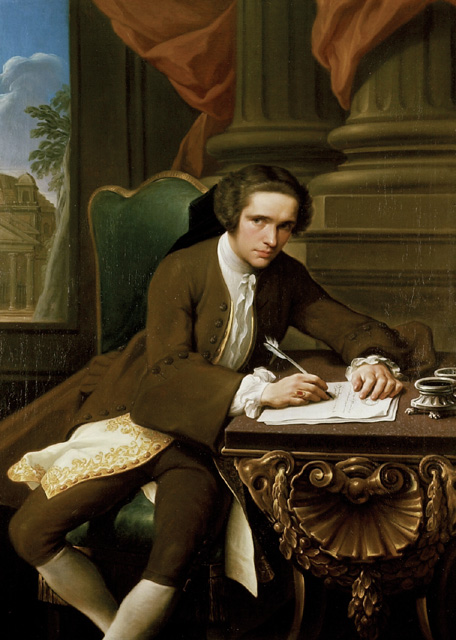
Italian painter and dealer, active in England. A pupil in turn of Sebastiano Conca and Francesco Trevisani, Casali received, in 1728, his first important commission, painting the cloisterGLOSSARYquadrilateral enclosure surrounded by covered walkways, the centre of activity for the inhabitants of a monastery. of S Sisto Vecchio, Rome, which was being restored for Benedict XIII. He was rewarded for this cycle of 32 lunettes depicting the Life of St Dominic by being made a Knight of the Golden Spur the following year.
In 1729, he painted S Filippo Neri in Ecstasy for S Gregorio della Divina Provvidenza in Rome and two oval works of Franciscan saints - Margherita da Cortona and Giacinta Marescotti - facing one another in the church of S Antonio al Monte, Rieti. Casali's commissions in the early 1730s include the Virgin in GloryGLOSSARY(1) The supernatural radiance surrounding a holy person. (2) To have the distinction of one's deeds recognized in life and to be revered for them posthumously: this was glory. The nature of true gloria was much discussed, whether it must be connected with the public good, whether the actions that led to it must conform with Christian ethics, how it differed from notoriety. The concept did not exclude religious figures (the title of the church of the Frari in Venice was S. Maria Gloriosa), but it was overwhelmingly seen in terms of secular success and subsequent recognition, as determining the lifestyles of the potent and the form of their commemoration in literature, in portraits and on tombs. As such, it has been taken as a denial of medieval religiosity ('sic transit gloria mundi'), and thus a hallmark of Renaissance individual ism; as a formidable influence on cultural patronage; and as spurring on men of action, as well as writers and artists, to surpass their rivals - including their counterparts in antiquity. (1730) at Collevecchio, the Martrydom of St Cristina (1732) for the main altar of the collegiate church at Bolsena and his work for Cardinal Pietro Ottoboni's chapelGLOSSARYa small separate place for worship, either part of a large church or a separate building. of the Holy Sacrament at S Lorenzo in Damaso, Rome. This consists of an Adoration of the Mystic Lamb in frescoGLOSSARYWall painting technique in which pigments are applied to wet (fresh) plaster (intonaco). The pigments bind with the drying plaster to form a very durable image. Only a small area can be painted in a day, and these areas, drying to a slightly different tint, can in time be seen. Small amounts of retouching and detail work could be carried out on the dry plaster, a technique known as a secco fresco. on the vaultGLOSSARYA roof or ceiling whose structure is based on the arch. There are a wide range of forms, including the barrel (or tunnel) vault, formed by a continuous semi-circular arch; the groin vault, formed when two barrel vaults intersect; and the rib vault, consistong of a framework of diagonal ribs supporting interlocking arches. The development of the various forms was of great structural and aesthetic importance in the development of church architecture during the Middle Ages., since his altarpieceGLOSSARYA picture or sculpture that stands on or is set up behind an altar. The term reredos is used for an ornamental screen or partition, not directly attached to the altar table but affixed to the wall behind it. A diptych is an altarpiece consisting of two panels, a triptych one of three panels, and a polyptych one of four or more panels. From the 14th to 16th century, the altarpiece was one of the most important commissions in European art; it was through the altarpiece that some of the most decisive developments in painting and sculpture came about. in oils of the Holy TrinityGLOSSARYin Christianity, the term used for the existence of one God in three persons: the Father, the Son and the Holy Spirit. is now untraced.
He spent many years in the middle of the 18th century in England. From 1741 to 1766 Casali worked for Sir Charles Frederick and other patrons. In 1761 his painting the Murder of St Edward Martyr (Burton Constable Hall, East Yorkshire) was exhibited at the Royal Society of Arts where it won First Prize.