02 — ARTIST
CAVALLINI, Pietro
DEVELOPMENT BUILD — NOT FOR PUBLIC USE. CONTRIBUTE ON GITHUB.
02 — ARTIST
BIOGRAPHY
Italian painter and mosaic designer, active mainly in Rome, where he must have been the leading artist of his day. He was the great representative of the Roman School slightly before Giotto.
His two major surviving works are mosaics of the Life of the Virgin (Sta Maria in Trastevere, signed and dated 1291) and a fragmentary fresco cycle, the most important part of which is a Last Judgment (Sta Cecilia in Trastevere, Rome).
In 1308 Cavallini was in Naples serving the Angevin kings, and was probably responsible for the design and possibly some of the execution of a fresco cycle in Sta Maria Donnaregina. Although he is such an obscure figure, Cavallini occupies an important place in the history of Italian painting. He was the first artist to make a significant break with the stylization of Byzantine art, and his majestic figures have a real sense of weight and three-dimensionality. His work undoubtedly influenced his great contemporary Giotto, whose Last Judgment in the Arena Chapel at Padua features Apostles enthroned exactly as in Cavallini's fresco of the subject.
21 SELECTED · 41 CATALOGUED
Santa Cecilia in Trastevere is one of the oldest titular churches in Rome. The present structure, whose interior was completely remodeled in the Baroque style, was built during the Carolingian period under Pope Paschal I (817-24). The mosaic in the apse also dates from this period. Around 1300 the interior of the church was entirely redecorated. Above the high altar Arnolfo di Cambio placed an elaborately designed Gothic ciborium with opulent figurative decoration (completed in 1293). The fresco decoration of the interior façade and the walls of the nave was added c. 1300. According to Ghiberti and Vasari, the frescoes were the work of the Roman painter Pietro Cavallini. The frescoes of the nave were largely destroyed when Cardinal Francesco Acquaviva had the interior redesigned in 1724-25.
Not until 1900, during restoration work in the church, did large sections of the old fresco decoration come to light again. The middle register of a depiction of the Last Judgment on the west wall of the basilica, fragments of the fresco of the Annunciation on the north wall, and two scenes from the story of Jacob on the south wall were uncovered. It is assumed that there were cycles of the Old and New Testament, respectively, on facing walls of the nave.
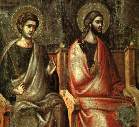
Of the paintings in Santa Cecilia, the most important is the fragment of the Last Judgment that extends the entire width of the west wall (its size is 320 x 1400 cm). In the enthroned Christ and apostles, whose rich colouristic harmonies are dominated by soft orange and green, and in the angels with feathers in graduated colours, there is a wholly new sense of real rather than schematic volumes, of surfaces, and of textures in light.
The innovations of Cavallini provided a strong incentive, perhaps even inspiration for Giotto, who must have seen and studied Cavallini's work in Rome.
Suggested listening (streaming mp3, 8 minutes):
Wolfgang Amadeus Mozart: Requiem K 626: Dies irae
15 SELECTED · 41 CATALOGUED
A number of churches were erected in Rome in the twelfth century, the largest and most important of them being the Santa Maria in Trastevere which replaced an Early Christian basilica from the fourth century. The builder of the church was pope Innocent II (1130-1143). Although the construction was completed only after the death of Innocent II in around 1148, the mosaics in the apse calotte and on the upper part of the apsidal arch were completed during his lifetime.
These mosaics were supplemented toward the end of the thirteenth century by seven more mosaics, six of them narrating the life of the Virgin. Pietro Cavallini is documented as the creator of these mosaics in the apse and on the lower part of the apsidal arch.
The six scenes are the Nativity of the Virgin, the Annunciation, the Nativity of Christ, the Adoration of the Kings, the Presentation in the Temple, and the Dormition. An additional mosaic picture was added to the life of the Virgin which portrays a layman, recommended by St Peter as intercessor, adoring the Virgin and Child.
2 SELECTED · 41 CATALOGUED
Commentary is unavailable for this selection.
OPEN SELECTION →12 OF 41 RECORDS


@online{wga-cavallini-pietro,
  author       = {Krén, Emil and Marx, Daniel},
  title        = {CAVALLINI, Pietro},
  organization = {{Web Gallery of Art}},
  date         = {2026-09-08},
  url          = {https://beta.wga.hu/artists/cavallini-pietro-r483b7ce293c993},
  urldate      = {2026-09-08},
  langid       = {english}
}
ACCESSED 2026-09-08. REPLACE THE AUTHOR FIELD WITH THE COMMENTARY AUTHOR WHERE ONE IS NAMED.


