03 — ARTWORK
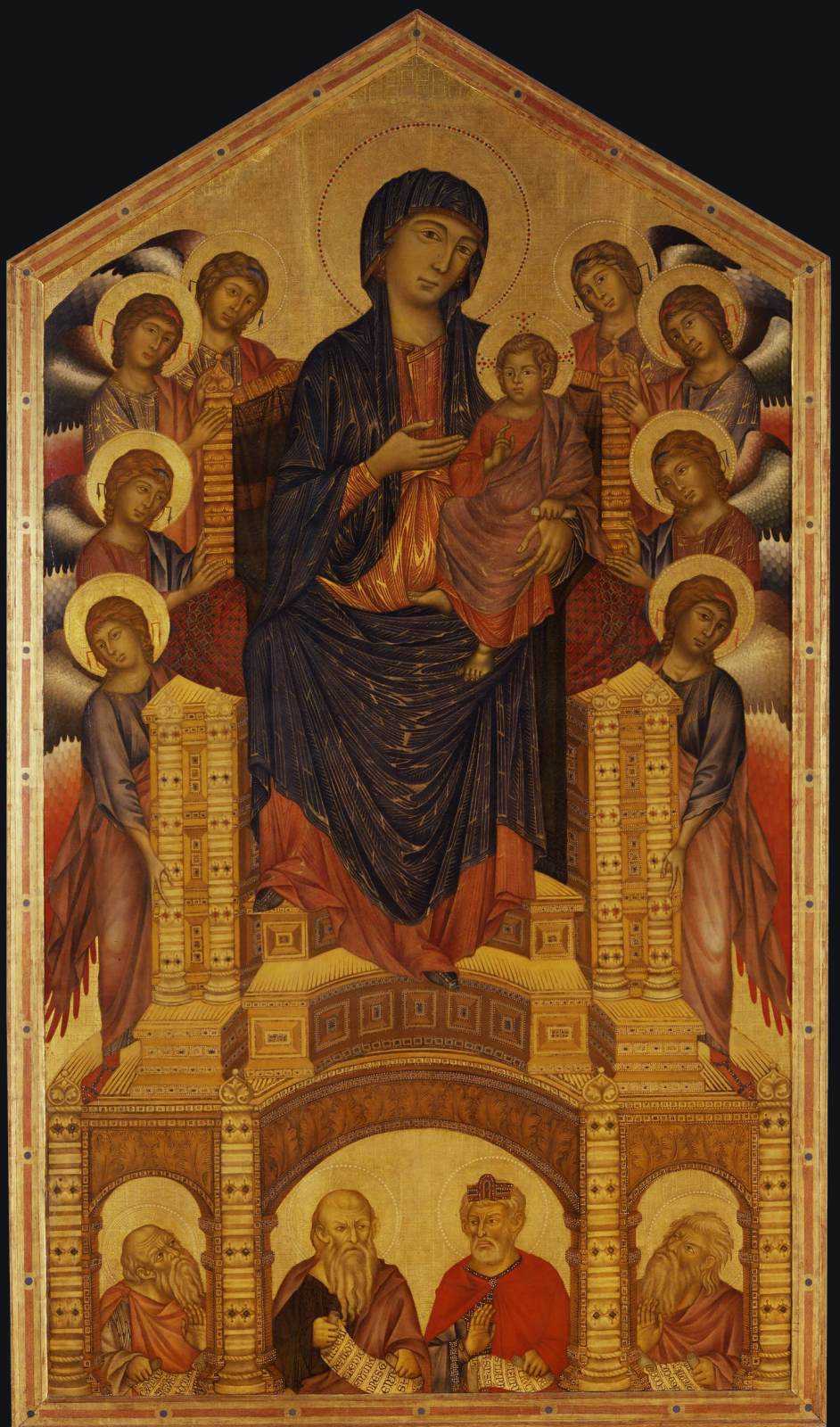
The Madonna in Majesty (Maestà)
- MEDIUM
- Tempera on wood, gold background, 384 x 223 cm
- TYPE
- Religious
PALETTE
HOVER OR TAP A SWATCH FOR NAME, SHARE AND HEX. SAMPLED FROM THE IMAGE — INDICATIVE, NOT A PIGMENT ANALYSIS.
DEVELOPMENT BUILD — NOT FOR PUBLIC USE. CONTRIBUTE ON GITHUB.
03 — ARTWORK
PALETTE
HOVER OR TAP A SWATCH FOR NAME, SHARE AND HEX. SAMPLED FROM THE IMAGE — INDICATIVE, NOT A PIGMENT ANALYSIS.
COMMENTARY
UNDERLINED TERMS ARE DEFINED IN THE GLOSSARY.
Seated on a grand, imposing ivory throne, with an articulated architectural form, the Virgin Mary is using her right hand to point to her son, whom she is holding, according to the Byzantine model of the Virgin Hodegetria, i.e. he who shows the way to salvation. Dressed like a philosopher from ancient times, Jesus is blessing and holding a rolled scroll, which is perhaps the scroll of the Law. The clothes worn by Mary and her son feature a precious golden decoration known as damascene, a characteristic of traditional Byzantine painting, which was greatly fashionable in Italian medieval painting. Around them are eight angels with splendid multi-coloured wings, gently raising the throne. What is rather unusual for the iconographyThe systematic study and identification of the subject-matter and symbolism of art works, as opposed to their style; the set of symbolic forms on which a given work is based. Originally, the study and identification of classical portraits. Renaissance art drew heavily on two iconographical traditions: Christianity, and ancient Greek and Roman art, thought and literature. of the Virgin and Child enthroned is the depiction, under the throne, of several prophets from the Old Testament (left to right: Jeremiah, Abraham, David and Isaiah) who are holding phylacteries with writings from the Holy Scriptures, alluding to the mysteries of the Incarnation and Virginity of Mary.
The painting stands out for the boldly elegant decorations, also seen on the background, which is finely decorated with geometric motifs engraved into the gold. Although the dates of this work have been the subject of much discussion, there is a tendency to date the Santa Trinita Maestà to the latter part of Cimabue's career. In this masterpieceA term now loosely applied to the finest work by a particular artist or to any work of art of acknowledged greatness or of preeminence in its field. Originally it meant the piece of work by which a craftsman, having finished his training, gained the rank of'master' in his guild., the complex division of space used for the throne, the folds of the clothing, the modulation of chiaroscuroIn painting, the modelling of form (the creation of a sense of three-dimensionality in objects) through the use of light and shade. The introduction of oil paints in the 15th century, replacing tempera, encouraged the development of chiaroscuro, for oil paint allowed a far greater range and control of tone. The term chiaroscuro is used in particular for the dramatic contrasts of light and dark introduced by Caravaggio. When the contrast of light and dark is strong, chiaroscuro becomes an important element of composition. and the good-natured expressions of the Virgin and the angels seem to be affected by the naturalismGeneric term for scientific positions supported by natural insights. In fine arts and literature between approximately 1870 and 1900, Naturalism tried to reproduce the reality comprehended through sensory experience as realistically as possible, i.e. without idealising the object, but with scientific precision. In contrast to Realism, which was also based on the accurate description of natural occurrences, Naturalism concerns itself with the sensual dimensions of observation, whereby questions of morality and social criticism come to the fore. The spokesman for literary Naturalism was Emile Zola, who believed the artistic methods provided evidence of human existence. distinguishing younger artists, such as Duccio di Buoninsegna and, above all, Cimabue's own pupil, Giotto.
The painting originally hung in the Vallombrosians church of Santa Trinita in Florence and since the 16th century it has been recorded as the work of Cimabue.
@online{wga-r1e1f0bdd2b8bf6,
  author       = {Krén, Emil and Marx, Daniel},
  title        = {The Madonna in Majesty (Maestà) by CIMABUE},
  organization = {{Web Gallery of Art}},
  date         = {2026-09-13},
  url          = {https://beta.wga.hu/artists/cimabue-ra7c02ef3068e9c/the-madonna-in-majesty-maest-r1e1f0bdd2b8bf6},
  urldate      = {2026-09-13},
  langid       = {english}
}
ACCESSED 2026-09-13. REPLACE THE AUTHOR FIELD WITH THE COMMENTARY AUTHOR WHERE ONE IS NAMED.


