03 — ARTWORK
The Farnese Hours
- MEDIUM
- Manuscript (M. 69), 172 x 108 mm (each page)
- TYPE
- Religious
PALETTE
HOVER OR TAP A SWATCH FOR NAME, SHARE AND HEX. SAMPLED FROM THE IMAGE — INDICATIVE, NOT A PIGMENT ANALYSIS.
DEVELOPMENT BUILD — NOT FOR PUBLIC USE. CONTRIBUTE ON GITHUB.
CURRENT LOCATION · The Morgan Library and Museum
03 — ARTWORK
PALETTE
HOVER OR TAP A SWATCH FOR NAME, SHARE AND HEX. SAMPLED FROM THE IMAGE — INDICATIVE, NOT A PIGMENT ANALYSIS.
COMMENTARY
UNDERLINED TERMS ARE DEFINED IN THE GLOSSARY.
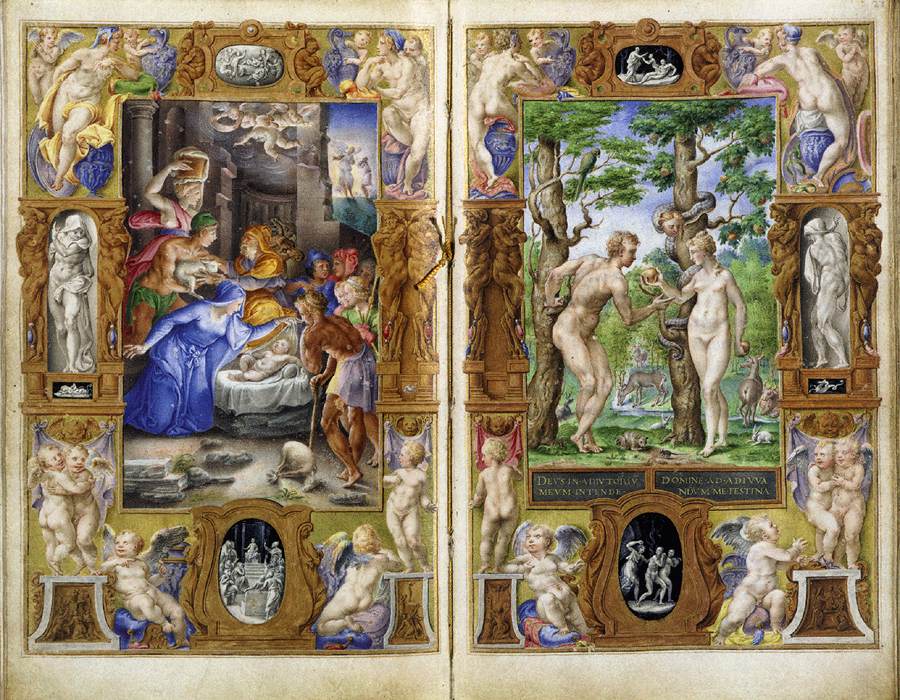
The Farnese Hours 1537-46 Manuscriptcollective term for books or other documents written by hand; in a specific sense, the hand-written medieval book, the Codex manuscriptus, often ornamented with decorative borders, illuminated initials and miniatures, and containing works of ancient philosophy or scholarly, ecclesiastical, and literary texts. Manuscripts were usually produced on commission. At first the scriptoria (writing rooms) of monasteries transcribed the contents of famous manuscripts and made copies. Monastic communities in the Netherlands and northern Germany began producing manuscripts around 1383/84. Flanders, Burgundy, and in particular Paris became major centres for the mass production of breviaries (prayer books) and Books of Hours. (M. 69), 172 x 108 mm (each page) The Morgan Library and Museum, New York
The double page (folios 27v and 28r) shows the Adoration of the Shepherds and the Fall of Man in an elaborate formal richness, using the frequently mannered and exaggerated stylistic vocabulary of the late Renaissance. The architectonicRelating to structure, design, or organization. frame is packed with muscular nudes, putti and atlases. The small pictures treated like cameos show on the left-hand page the Annunciationthe term for the event described in the Gospel according to St. Luke, when the Angel Gabriel brings the Virgin Mary the news that she is to bear her son, Jesus Christ. The Annunciation was among the most widespread pictorial subjects of European art during the Middle Ages and the Renaissance. to the Shepherds (above) and the Presentation of Christ in the Temple (below); on the right-hand page the Creation of Eve (above) and the Expulsion from Paradise (below).
@online{wga-r74113157c76e40,
  author       = {Krén, Emil and Marx, Daniel},
  title        = {The Farnese Hours by CLOVIO, Giulio},
  organization = {{Web Gallery of Art}},
  date         = {2026-09-13},
  url          = {https://beta.wga.hu/artists/clovio-giulio-r9bafc993b96d59/the-farnese-hours-r74113157c76e40},
  urldate      = {2026-09-13},
  langid       = {english}
}
ACCESSED 2026-09-13. REPLACE THE AUTHOR FIELD WITH THE COMMENTARY AUTHOR WHERE ONE IS NAMED.


