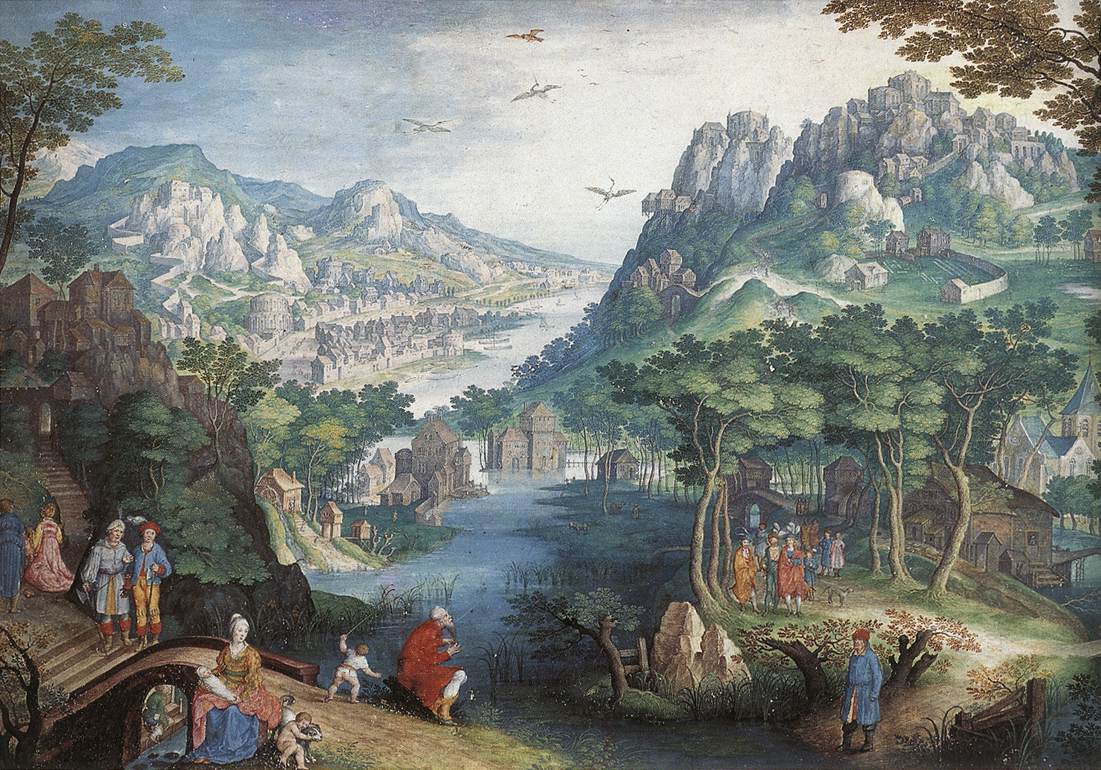
The subject of this landscape is a moralistic one with a reference to a passage from the Bible, more specifically the Old Testament book of Hosea. The drawing is believed to have been done in Frankenthal, a small town in the Pfalz mountains where an important artists' colony sprang up after the fall of Antwerp to the Spanish in 1585. Many of the artists who settled there were Flemings sympathetic to the Reformation, who had been forced into exile because of their Protestant faith. Some years later, a number of them, including Gillis van Coninxloo, moved to Amsterdam. Protestant artists worked in Frankenthal in a reformed environment, which was naturally reflected in the subjects they chose to paint. That is certainly the case with this drawing. The Prophet Hosea opposed what he saw as abuses in the field of worship, making him a symbolic precursor of early Protestant leaders.
Gillis van Coninxloo is viewed as an innovator in Flemish landscape painting. Above all, he represents the transition from the Mannerist to the BaroqueThe period in art history from about 1600 to about 1750. In this sense the term covers a wide range of styles and artists. In painting and sculpture there were three main forms of Baroque: (1) sumptuous display, a style associated with the Catholic Counter Reformation and the absolutist courts of Europe (Bernini, Rubens); (2) dramatic realism (Caravaggio); and (3) everyday realism, a development seen in particular in Holland (Rembrandt, Vermeer). In architecture, there was an emphasis on expressiveness and grandeur, achieved through scale, the dramatic use of light and shadow, and increasingly elaborate decoration. In a more limited sense the term Baroque often refers to the first of these categories. The development of the Baroque reflects the period's religious tensions (Catholic versus Protestant); a new and more expansive world view based on science and exploration; and the growth of absolutist monarchies. landscape. The watercolourPigment ground in gum, usually gum arabic, and applied with brush and water to a painting surface, usually paper; the term also denotes a work of art executed in this medium. The pigment is ordinarily transparent but can be made opaque by mixing with a whiting and in this form is known as body colour, or gouache; it can also be mixed with casein, a phosphoprotein of milk. Watercolour compares in range and variety with any other painting method. Transparent watercolour allows for a freshness and luminosity in its washes and for a deft calligraphic brushwork that makes it a most alluring medium. There is one basic difference between transparent watercolour and all other heavy painting mediums - its transparency. The oil painter can paint one opaque colour over another until he has achieved his desired result. The whites are created with opaque white. The watercolourist's approach is the opposite. In essence, instead of building up he leaves out. The white paper creates the whites. The darkest accents may be placed on the paper with the pigment as it comes out of the tube or with very little water mixed with it. Otherwise the colours are diluted with water. The more water in the wash, the more the paper affects the colours; for example, vermilion, a warm red, will gradually turn into a cool pink as it is thinned with more water. The dry-brush technique - the use of the brush containing pigment but little water, dragged over the rough surface of the paper - creates various granular effects similar to those of crayon drawing. Whole compositions can be made in this way. This technique also may be used over dull washes to enliven them. of the prophet Hosea is still done entirely in his early Mannerist style. Van Coninxloo went on to master and develop a variety of styles in his life. His influence on his contemporaries was crucial, and was felt by both Flemish and Dutch painters. In many ways, he helped Northern Netherlandish art embark on its search for a new, distinct identity.