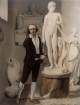
Domenico Conti (Domenico Bazzani-Conti), Italian painter. He was trained as an artist in his native Mantua by Giuseppe Bazzani, whose surname he subsequently appended to his own. By the time of his apprenticeship to Bazzani, the latter's style had moved away from the classicalGLOSSARYRelating to the culture of ancient Greece and Rome (classical Antiquity). The classical world played a profoundly important role in the Renaissance, with Italian scholars, writers, and artists seeing their own period as the rebirth (the "renaissance") of classical values after the Middle Ages. The classical world was considered the golden age for the arts, literature, philosophy, and politics. Concepts of the classical, however, changed greatly from one period to the next. Roman literature provided the starting point in the 14th century, scholars patiently finding, editing and translating a wide range of texts. In the 15th century Greek literature, philosophy and art - together with the close study of the remains of Roman buildings and sculptures-expanded the concept of the classical and ensured it remained a vital source of ideas and inspiration. style which he had learnt from the exemplars of Mantegna in Mantua, and had adopted a more exotic style typified by the "Lunar" canvases, moonlit and atmospheric pieces with silver tonality. Bazzani had become Director of the Mantua Accademia whilst the teacher of Conti (1767) and his style reverted to a more sombre and spiritual manner which was followed by his pupil.
In 1770, Conti moved to Rome, working largely as a portraitGLOSSARYThe Roman portrait bust survived in the form of life-sized reliquaries of saints, but it was in 15th century Florence that the individual features and character of a contemporary sitter were accurately recorded by sculptors such as Donatello, Desiderio da Settignano, Mino da Fiesole and the Rossellino. A similar degree of realism occurs in 15th century tomb sculpture. The equestrian portrait, based on antique statues such as the Marcus Aurelius monument (Rome, Campidoglio), was revived in the 14th century. Two examples in fresco are Simone Martini's Guidoriccio (c. 1328; Siena, Palazzo Pubblico) and the posthumous portrait of Sir John Hawkwood (1436; Florence, Cathedral) by Uccello, which gives the illusion of a 3-dimensional statue seen from below. The Venetian Republic ordered imposing monuments from Donatello (1447; Gattarnelata, Padua) and Verrocchio (14799; Colleoni, Venice), whilst other statesmen ordered their own images to be erected in public places, directly relating themselves to the military heroes of ancient Rome. Another form of political portraiture derived from antiquity was the commemorative portrait medal designed by artists such as Pisanello. The carved or painted profile portrait became popular in the 1450s. The realism of the clear, flattened image, painted under the influence of Flemish examples by the Pollaiuolo brothers, Piero della Francesca and Botticelli, was superseded by the three-quarter and frontal portrait, psychologically more complex, such as Leonardo's enigmatic Mona Lisa (Paris, Louvre) with her momentary smile or Andrea del Sarto's arresting Portrait of a Man (London, National Gallery). The 16th century portrait became generalized, Lotto's Andrea Odoni (1527; Royal Collection) being an idealized concept of a collector rather than an individual. Group portraits, decorating whole rooms, include the narrative scenes of the Gonzaga court painted by Mantegna (completed 1474; Mantua, Palazzo Ducale) and the elaborate schemes commissioned by the Farnese family in Rome from Vasari (1546; Palazzo della Cancelleria) and Salviati (after 1553; Palazzo Farnese). Portraits were also incorporated into religious narratives, as in Ghirlandaio's fresco cycle painted for Giovanni Tornabuoni in S. Maria Novella, Florence (1486-90). painter in the service of the PapacyGLOSSARYPapal rule had three aspects. As successors to St Peter, the disciple charged with the fulfilment of Christ's mission on earth, and as men uniquely privileged to interpret and develop Christian doctrine, the popes were both the leaders and the continuators of a faith. Then, thanks to their possession of the Papal State, the.popes were the rulers of a large part of Italy. To maintain their authority, enforce law and order; extract taxes and check incursions from rival territories they had to act like other, secular rulers, becoming fully enmeshed in diplomacy and war. The third aspect was administrative. The popes were the heads of the largest bureaucracy in Europe, maintaining contact with local churches through the making or licensing of appointments, the management of clerical dues and taxation, the receipt of appeals in lawsuits conducted in terms of the Church's own canon law. A number of matters, notably the making of appointments to especially wealthy sees and abbacies, or the incidence of taxation, could lead to conflict with secular authorities. This in turn led to the practice whereby monarchs retained the services of cardinals sympathetic to their national policies, so that they might have a voice at court, as it were, to influence popes in their favour. The choice of popes became increasingly affected by the known political sympathies of cardinals, and the pressure and temptations that could be applied to them. So onerous, various and inevitably politicized an office was not for a saint. The pious hermit Celestine V had in 1294 crumpled under its burden after only a few months. The identification of the Papacy with Rome, which seems so inevitable, was long in doubt. The insecurity of the shabby and unpopulous medieval city, prey to the feuds of baronial families like the Orsini, Colonna and Caetani, had already forced the popes from time to time to set up their headquarters elsewhere in Italy. For the greater part of the 14th century (1309-77) the Papacy funetioned out of Italy altogether, at Avignon, building there (especially the huge Palace of the Popes) on a scale that suggested permanence. Though they were by no means in the pockets of their neighbours the kings of France, criticism of undue influence steadily mounted. Provence ceased to be a comfortingly secure region as the Hundred Years War between England and France proceeded. Finally the breakdown of central authority in the Papal State, despite the efforts there of such strenuous papal lieutenants as Cardinal Albornoz (in 1353-67), prompted Gregory XI to return to Rome in 1377. The period of authority and cultivated magnificence associated with the Renaissance Papacy was, however, to be long delayed. The return to Rome was challenged by a group of cardinals faithful to France. On Gregory's death in 1378 their election of a rival or antipope opened a period of divided authority, further complicated in 1409 by the election of yet a third pope. This situation deepened the politicization of the papal office (for support to the rivals was given purely on the basis of the dynastic conflicts in Europe) and confused the minds, if it did no serious damage to the faith, of individuals. But the remedy was another blow to the recovery of papal confidence and power. To resolve the problem of divided authority, protect the faith from the extension of heresy (especially in the case of the Bohemian followers of John Huss), and bring about an improvement in the standards of education and deportment among the Church's personnel, it was at last resolved to call together a General Council of the Church. It was argued that such a council, which met at Constance 1414-18, would, by being representative of the Christian faithful as a whole; possess an authority which, in the eyes of God, could supersede that of a pope. In this spirit Huss was tried and executed, a number of reforms relating to the clergy were passed and, above all (for this was the only measure with permanent consequences), two of the rival popes were deposed and the other forced to abdicate; Martin V being elected by a fairly united body of cardinals. There remained; however, the challenge to his authority represented by the conciliar theory itself: that final authority could be vested as well in a group (if properly constituted) as in an individual. This view was expressed again by the Council of Basle, which lasted from 1431 until as late as 1449. Not until 1460 did a pope feel strong enough to make rejection of the theory an article of faith, as Pius II did in his bull 'Execrabilis'. By then, however, in spite of further absences from Rome, notably that of Eugenius IV (1431-40), who governed the Church chiefly from Florence, the acceptance of the city as the most practical - as well, from the point of view of its religious associations, the most appropriate - base for the Papacy had been made clear in the plans of Nicholas V for improving it. Thenceforward the creation of a capital commensurate with the authority of the institution it housed continued steadily. As at Avignon, fine buildings and a luxurious style of life were, as such, considered perfectly suitable for the role played by the head of the Church: a view exemplified in episcopal and archiepiscopal palaces all over Europe. However, the creation of a cultural capital, through lavish patronage of artists, scholars and men of letters, as well as a governmental one, not only contributed to an atmosphere of worldliness that aroused criticism, but may also have diverted the popes from registering the true import of the spiritual movements that were to cause the Reformation conflict of faiths. The fortunes of the Papacy from its return to Rome can be followed in the biographies of its outstanding representatives., and lived there for the remainder of his life. He adopted the new conventions of Neo-Classicism as did so many of his fellow artists in the Rome of the last quarter of the 18th century. He became professor of painting at Rome and was the teacher of Giuseppe Tominz who lived and studied with him until Conti's death in Rome in 1817.