03 — ARTWORK
Interior view
- MEDIUM
- Photo
- TYPE
- Other
PALETTE
HOVER OR TAP A SWATCH FOR NAME, SHARE AND HEX. SAMPLED FROM THE IMAGE — INDICATIVE, NOT A PIGMENT ANALYSIS.
DEVELOPMENT BUILD — NOT FOR PUBLIC USE. CONTRIBUTE ON GITHUB.
03 — ARTWORK
PALETTE
HOVER OR TAP A SWATCH FOR NAME, SHARE AND HEX. SAMPLED FROM THE IMAGE — INDICATIVE, NOT A PIGMENT ANALYSIS.
COMMENTARY
UNDERLINED TERMS ARE DEFINED IN THE GLOSSARY.
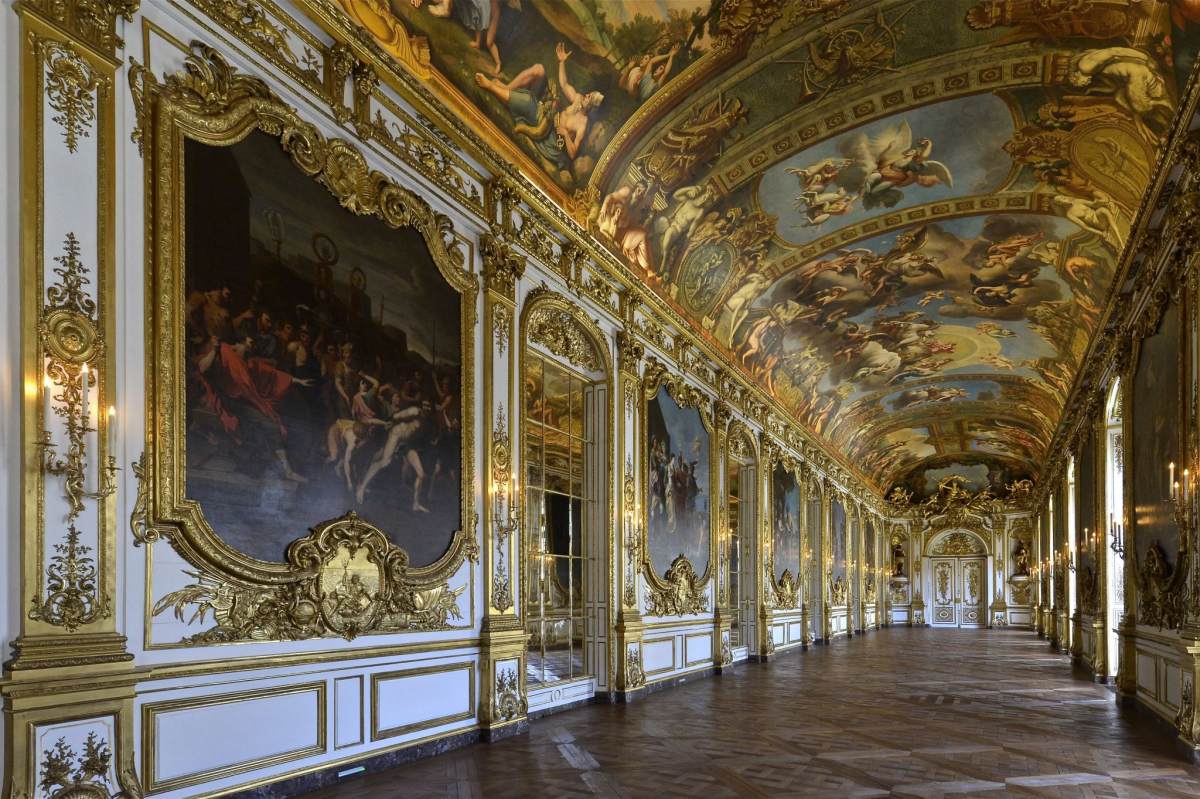
In 1635, the lord of the Vrilliere - Louis Phélipeaux, acquired a small ground left vacant by Richelieu. He decided to build a mansion under the direction of François Mansart. One of the rooms - the large galleryan upper story, similar to a tribune, running along the side of a building and open on one side to the interior; in a church (basilica) above the side aisles, over the ambulatory (central-plan building) and also over the west end. The gallery was used to keep certain groups of worshippers apart (women, noblemen). on the first floor with the imposing dimensions (40 x 6.5 m) - was to serve as a room to exhibit his exceptional collection of Italian paintings. The vaultA roof or ceiling whose structure is based on the arch. There are a wide range of forms, including the barrel (or tunnel) vault, formed by a continuous semi-circular arch; the groin vault, formed when two barrel vaults intersect; and the rib vault, consistong of a framework of diagonal ribs supporting interlocking arches. The development of the various forms was of great structural and aesthetic importance in the development of church architecture during the Middle Ages. was painted in 1645 by François Perrier, and ten paintings by the greatest masters, such as Poussin, Guercino, Pietro da Cortona) were placed in white paneling enhanced with gold.
In 1713, the Count of Toulouse acquired the house which was renamed Hôtel de Toulouse. The new owner, who was the illegitimate son of Louis XIV and Madame de Montespan, appealed to Robert de Cotte, the king's first architect, to arrange the place as a princely residence.
In the pure Regency spirit, gold invades the large gallery (the Galerie Dorée) and its decorative elements were reviewed to illustrate the themes dear to the Count of Toulouse: hunting and fishing. In 1793, after the Revolution, these properties were declared national property and the works were scattered among various museums. The Galerie Dorée then served as a paper store for the Imprimerie Nationale. The Banque de France bought the hotel in 1808. In 1870, the state of the Gallery required a complete restoration, the frescoWall painting technique in which pigments are applied to wet (fresh) plaster (intonaco). The pigments bind with the drying plaster to form a very durable image. Only a small area can be painted in a day, and these areas, drying to a slightly different tint, can in time be seen. Small amounts of retouching and detail work could be carried out on the dry plaster, a technique known as a secco fresco. of the vault was then copied and the regency woodwork reinstated in the decor.
@online{wga-r1f3784b0d65c49,
  author       = {Krén, Emil and Marx, Daniel},
  title        = {Interior view by COTTE, Robert de},
  organization = {{Web Gallery of Art}},
  date         = {2026-09-09},
  url          = {https://beta.wga.hu/artists/cotte-robert-de-r7c2883e0035504/interior-view-r1f3784b0d65c49},
  urldate      = {2026-09-09},
  langid       = {english}
}
ACCESSED 2026-09-09. REPLACE THE AUTHOR FIELD WITH THE COMMENTARY AUTHOR WHERE ONE IS NAMED.


