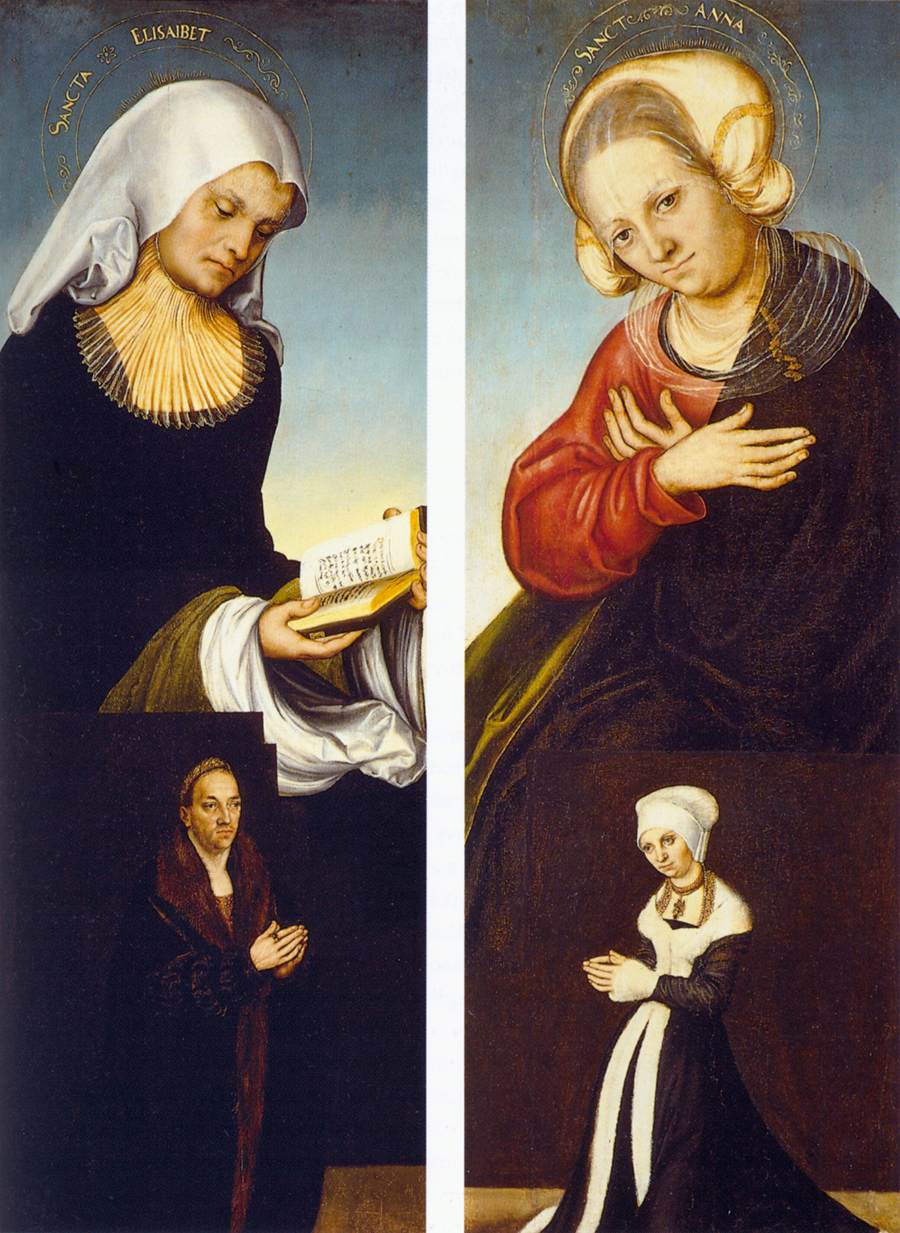
Sts Elizabeth and Anne (inside) c. 1514 Oil on panelTerm in painting for a support of wood, metal, or other rigid substance, as distinct from canvas. Until the adoption of canvas in the 15th century nearly all the movable paintings of Europe were executed on wood, and even up to the beginning of the 17th century it is probable that as much painting was done on the one support as on the other. Painters who worked on a small scale often used copper panels (Elsheimer is a leading example), and in the colonial art of South America copper and tin and even lead and zinc were used. On a larger scale, slate has occasionally been used as a support, notably by Rubens for his altarpiece for Sta Maria in Vallicella (the Chiesa Nuova) in Rome; the picture he originally painted was said to reflect the light unpleasantly and slate was used for the replacement to produce a more matt finish. For wood panels the Italian masters of the Renaissance preferred white poplar, while oak was the most common wood used in northern Europe. Many other types were used, however; analysis of the contents of art galleries has yielded a long list, including beech, cedar, chestnut, fir, larch, linden, mahogany, olive, and walnut. In the 20th century cedar, teak, and dark walnut are favourites, and modern painters have also used plywood, fibre-board, and other synthetic materials as supports., 85 x 31 cm (each wing) Fundación Colección Thyssen-Bornemisza, Pedralbes
These two panels, painted on both sides, depict a total of four saints. The panels are probably the wings of a triptychA painting in three sections, usually an altarpiece, consisting of a central panel and two outer panels, or wings. In many medieval triptychs the two outer wings were hinged so that could be closed over the center panel. Early triptychs were often portable. whose central panel is now lost. It was commissioned by the Duke of Saxony, who is portrayed with his wife in the lower half of the panels. One of the inside panels depicts St Elizabeth, Mary's cousin and the mother of St John the Baptist. Below her and shown praying in much less than life-size proportions, is the Duke. The other panel depicts St Anne, the Virgin's mother, with the Duchess. The saints are identified by their names written in their haloes. The outer side of the wings (not shown here) depicts St Christopher with the Christ Child on his shoulders, and St George and the Dragon.