03 — ARTWORK
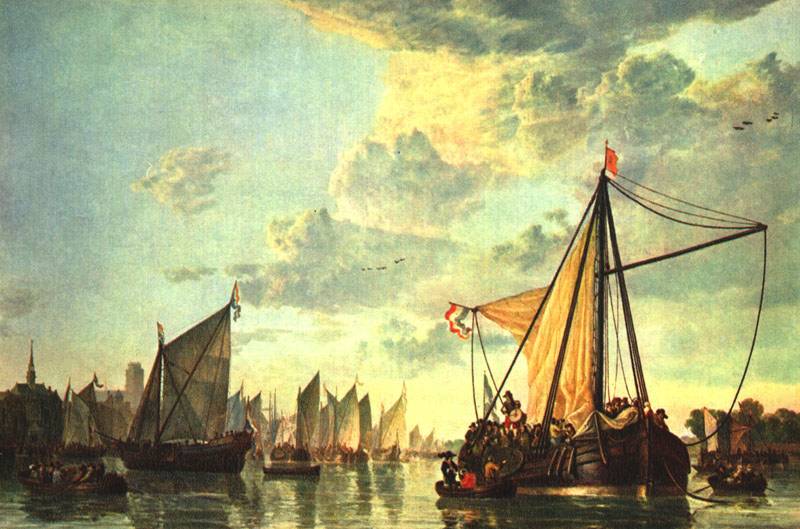
The Maas at Dordrecht
- MEDIUM
- Oil on canvas, 114,9 x 170,2 cm
- TYPE
- Landscape
PALETTE
HOVER OR TAP A SWATCH FOR NAME, SHARE AND HEX. SAMPLED FROM THE IMAGE — INDICATIVE, NOT A PIGMENT ANALYSIS.
DEVELOPMENT BUILD — NOT FOR PUBLIC USE. CONTRIBUTE ON GITHUB.
03 — ARTWORK
PALETTE
HOVER OR TAP A SWATCH FOR NAME, SHARE AND HEX. SAMPLED FROM THE IMAGE — INDICATIVE, NOT A PIGMENT ANALYSIS.
COMMENTARY
UNDERLINED TERMS ARE DEFINED IN THE GLOSSARY.
The Maas at Dordrecht c. 1660 Oil on canvasA woven cloth used as a support for painting. The best-quality canvas is made of linen; other materials used are cotton, hemp, and jute. It is now so familiar a material that the word 'canvas' has become almost a synonym for an oil painting, but it was not until around 1500 that it began to rival the wooden panel (which was more expensive and took longer to prepare) as the standard support for movable paintings (the transition came later in Northern Europe than in Italy). Canvas is not suitable for painting on until it has been coated with a ground, which isolates the fabric from the paint; otherwise it will absorb too much paint, only very rough effects will be obtainable, and parts of the fabric may be rotted by the pigments. It must also be made taut on a stretcher or by some other means., 114,9 x 170,2 cm National Galleryan upper story, similar to a tribune, running along the side of a building and open on one side to the interior; in a church (basilica) above the side aisles, over the ambulatory (central-plan building) and also over the west end. The gallery was used to keep certain groups of worshippers apart (women, noblemen). of Art, Washington
Holland’s Maas river flows through France and Belgium, where it is known as the Meuse. In Aelbert Cuyp’s radiant vista over the Maas’ ocean port at Dordrecht, crowds jam the docks, bugles and drums sound fanfares, and cannons fire salutes. Near the end of the Thirty Years’ War, Dordrecht hosted a two-week festival in honor of 30,000 soldiers. On 12 July 1646, a huge fleet of merchant and navy ships set sail to end the happy furlough and return the men home.
This vast, sunny composition specifically accents one figure: the young man standing in the dinghy beside the large ship. The anchored ships at the left create a wedge-shaped mass that points toward him, as do some rigging lines. His head lies directly before the horizon, and his stark black outfit is silhouetted dramatically against the palest area of the picture, the morning mist over the far shore. Because he wears a sash with Dordrecht’s city colors of red and white, he may be the festival’s master of ceremonies and is probably the patron who commissioned Cuyp to document this historic event.
*** Keywords: *************
Author: CUYP, Aelbert Title: The Maas at Dordrecht Time-line: 1651-1700 School: Dutch Form: painting Type: landscape
@online{wga-r2003de5ac3a420,
  author       = {Krén, Emil and Marx, Daniel},
  title        = {The Maas at Dordrecht by CUYP, Aelbert},
  organization = {{Web Gallery of Art}},
  date         = {2026-09-13},
  url          = {https://beta.wga.hu/artists/cuyp-aelbert-rd69beb87e1753c/the-maas-at-dordrecht-r2003de5ac3a420},
  urldate      = {2026-09-13},
  langid       = {english}
}
ACCESSED 2026-09-13. REPLACE THE AUTHOR FIELD WITH THE COMMENTARY AUTHOR WHERE ONE IS NAMED.


