03 — ARTWORK
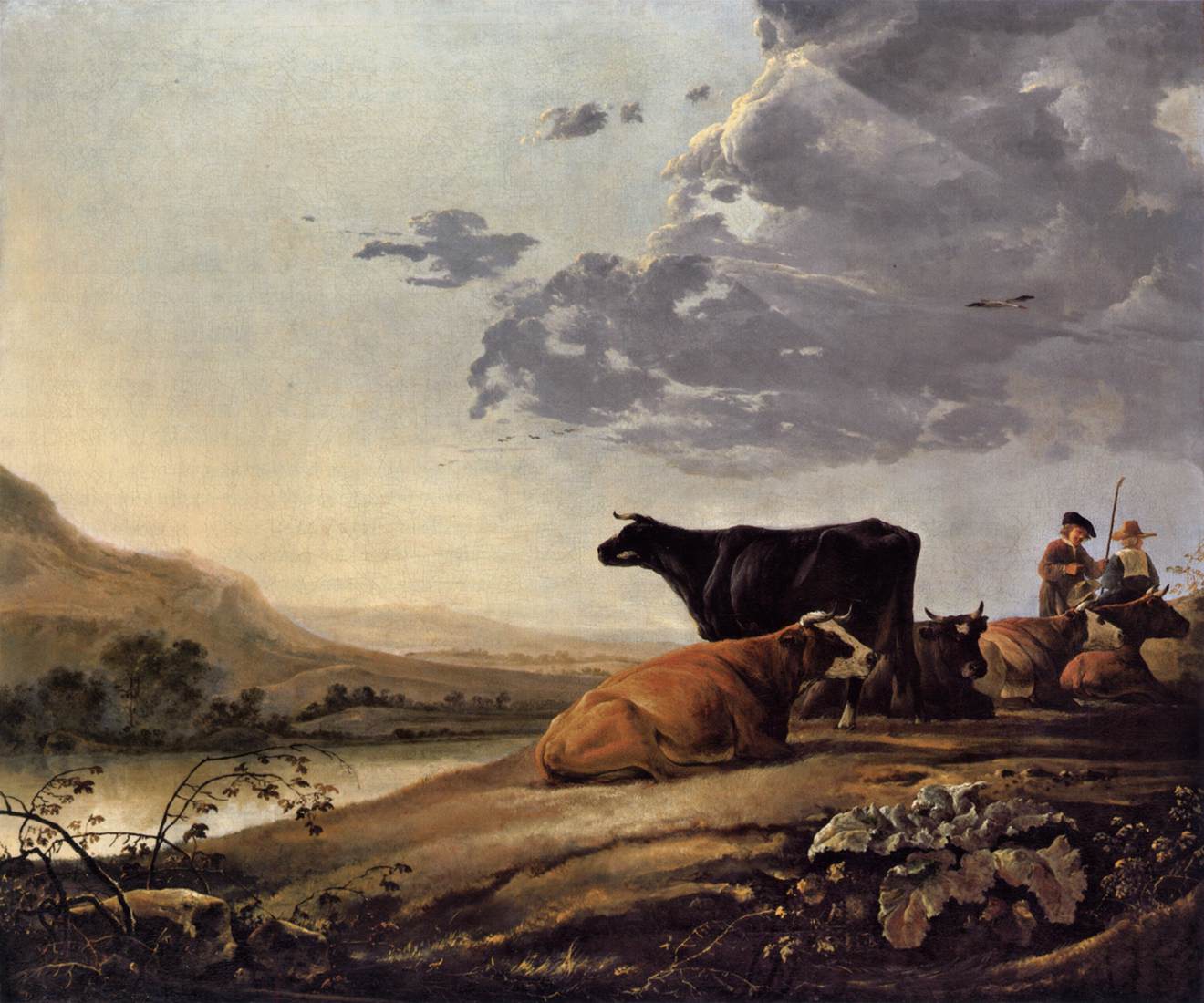
Young Herdsman with Cows
- MEDIUM
- Oil on canvas, 112 x 132 cm
- TYPE
- Landscape
PALETTE
HOVER OR TAP A SWATCH FOR NAME, SHARE AND HEX. SAMPLED FROM THE IMAGE — INDICATIVE, NOT A PIGMENT ANALYSIS.
DEVELOPMENT BUILD — NOT FOR PUBLIC USE. CONTRIBUTE ON GITHUB.
CURRENT LOCATION · Metropolitan Museum of Art
03 — ARTWORK
PALETTE
HOVER OR TAP A SWATCH FOR NAME, SHARE AND HEX. SAMPLED FROM THE IMAGE — INDICATIVE, NOT A PIGMENT ANALYSIS.
COMMENTARY
UNDERLINED TERMS ARE DEFINED IN THE GLOSSARY.
In this painting the strong horizontal of the standing cow is echoed in the hazy distance of the rolling country and lends firmness and structure to the whole design. As in Rembrandt's mature phase, which is approximately contemporaneous, this landscape shows classicalRelating to the culture of ancient Greece and Rome (classical Antiquity). The classical world played a profoundly important role in the Renaissance, with Italian scholars, writers, and artists seeing their own period as the rebirth (the "renaissance") of classical values after the Middle Ages. The classical world was considered the golden age for the arts, literature, philosophy, and politics. Concepts of the classical, however, changed greatly from one period to the next. Roman literature provided the starting point in the 14th century, scholars patiently finding, editing and translating a wide range of texts. In the 15th century Greek literature, philosophy and art - together with the close study of the remains of Roman buildings and sculptures-expanded the concept of the classical and ensured it remained a vital source of ideas and inspiration. elements which strengthen the compositional power. Horizontals and verticals are coordinated with the BaroqueThe period in art history from about 1600 to about 1750. In this sense the term covers a wide range of styles and artists. In painting and sculpture there were three main forms of Baroque: (1) sumptuous display, a style associated with the Catholic Counter Reformation and the absolutist courts of Europe (Bernini, Rubens); (2) dramatic realism (Caravaggio); and (3) everyday realism, a development seen in particular in Holland (Rembrandt, Vermeer). In architecture, there was an emphasis on expressiveness and grandeur, achieved through scale, the dramatic use of light and shadow, and increasingly elaborate decoration. In a more limited sense the term Baroque often refers to the first of these categories. The development of the Baroque reflects the period's religious tensions (Catholic versus Protestant); a new and more expansive world view based on science and exploration; and the growth of absolutist monarchies. diagonals, which are still alive and help to create a mighty spaciousness. The atmospheric quality is as important as ever in uniting the whole impression. Light breaks now with greater intensity through the clouds and the clouds themselves gain in substance and volume. The sky forms a gigantic vaultA roof or ceiling whose structure is based on the arch. There are a wide range of forms, including the barrel (or tunnel) vault, formed by a continuous semi-circular arch; the groin vault, formed when two barrel vaults intersect; and the rib vault, consistong of a framework of diagonal ribs supporting interlocking arches. The development of the various forms was of great structural and aesthetic importance in the development of church architecture during the Middle Ages. above the earth.
@online{wga-r547129c253079d,
  author       = {Krén, Emil and Marx, Daniel},
  title        = {Young Herdsman with Cows by CUYP, Aelbert},
  organization = {{Web Gallery of Art}},
  date         = {2026-09-13},
  url          = {https://beta.wga.hu/artists/cuyp-aelbert-rd69beb87e1753c/young-herdsman-with-cows-r547129c253079d},
  urldate      = {2026-09-13},
  langid       = {english}
}
ACCESSED 2026-09-13. REPLACE THE AUTHOR FIELD WITH THE COMMENTARY AUTHOR WHERE ONE IS NAMED.


