03 — ARTWORK
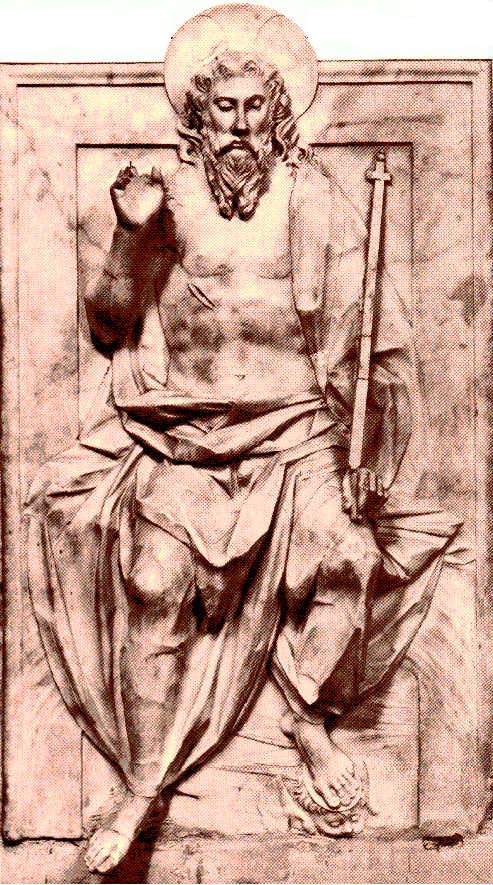
Relief with the Blessing Christ
- MEDIUM
- Marble, height 130.8 cm, width 71 cm
- TYPE
- Religious
PALETTE
HOVER OR TAP A SWATCH FOR NAME, SHARE AND HEX. SAMPLED FROM THE IMAGE — INDICATIVE, NOT A PIGMENT ANALYSIS.
DEVELOPMENT BUILD — NOT FOR PUBLIC USE. CONTRIBUTE ON GITHUB.
CURRENT LOCATION · Musei Vaticani
03 — ARTWORK
PALETTE
HOVER OR TAP A SWATCH FOR NAME, SHARE AND HEX. SAMPLED FROM THE IMAGE — INDICATIVE, NOT A PIGMENT ANALYSIS.
COMMENTARY
UNDERLINED TERMS ARE DEFINED IN THE GLOSSARY.
ReliefA sculptural work in which all or part projects from the flat surface. There are three basic forms: low relief (bas-relief, basso rilievo), in which figures project less than half their depth from the background; medium relief (mezzo-rilievo), in which figures are seen half round; and high relief (alto rilievo), in which figures are almost detached from their background. with the Blessing Christ c. 1479 Marbleloosely applied to any hard limestone that can be sawn into thin slabs and will take a good polish so that it is suitable for decorative work; more strictly, it refers to metamorphosed limestones whose structure has been recrystallized by heat or pressure. Marbles are widely disseminated and occur in a great variety of colours and patterns, but certain types have been particularly prized by sculptors. The most famous of Greek white marbles in the ancient world was the close-grained Pentelic, which was quarried at Mount Pentelicon in Attica. The Elgin Marbles are carved in Pentelic. Widely used also were the somewhat coarser-grained translucent white marbles from the Aegean islands of Paros and Naxos. Parian marble was used for the celebrated Mausoleum at Halicarnassus. The pure white Carrara marble, quarried at Massa, Carrara, and Pietra Santa in Tuscany from the 3rd century BC, is the most famous of all sculptors' stones. It was used for the Apollo Belvedere, and was much favoured in the Renaissance, particularly by Michelangelo, who often visited the quarries to select material for his work. Neoclassical sculptors also favoured Carrara marble because of its ability to take a smooth, sleek surface, but it can look rather 'dead' compared with some of the finest Greek marbles., height 130.8 cm, width 71 cm Musei Vaticani, Vatican
*** Keywords: *************
Author: DALMATA, Giovanni Title: Relief with the Blessing Christ Time-line: 1451-1500 School: Italian Form: sculpture Type: religious
@online{wga-r4b8c00309a391d,
  author       = {Krén, Emil and Marx, Daniel},
  title        = {Relief with the Blessing Christ by DALMATA, Giovanni},
  organization = {{Web Gallery of Art}},
  date         = {2026-09-13},
  url          = {https://beta.wga.hu/artists/dalmata-giovanni-r3e8a4d31055c85/relief-with-the-blessing-christ-r4b8c00309a391d},
  urldate      = {2026-09-13},
  langid       = {english}
}
ACCESSED 2026-09-13. REPLACE THE AUTHOR FIELD WITH THE COMMENTARY AUTHOR WHERE ONE IS NAMED.


