03 — ARTWORK
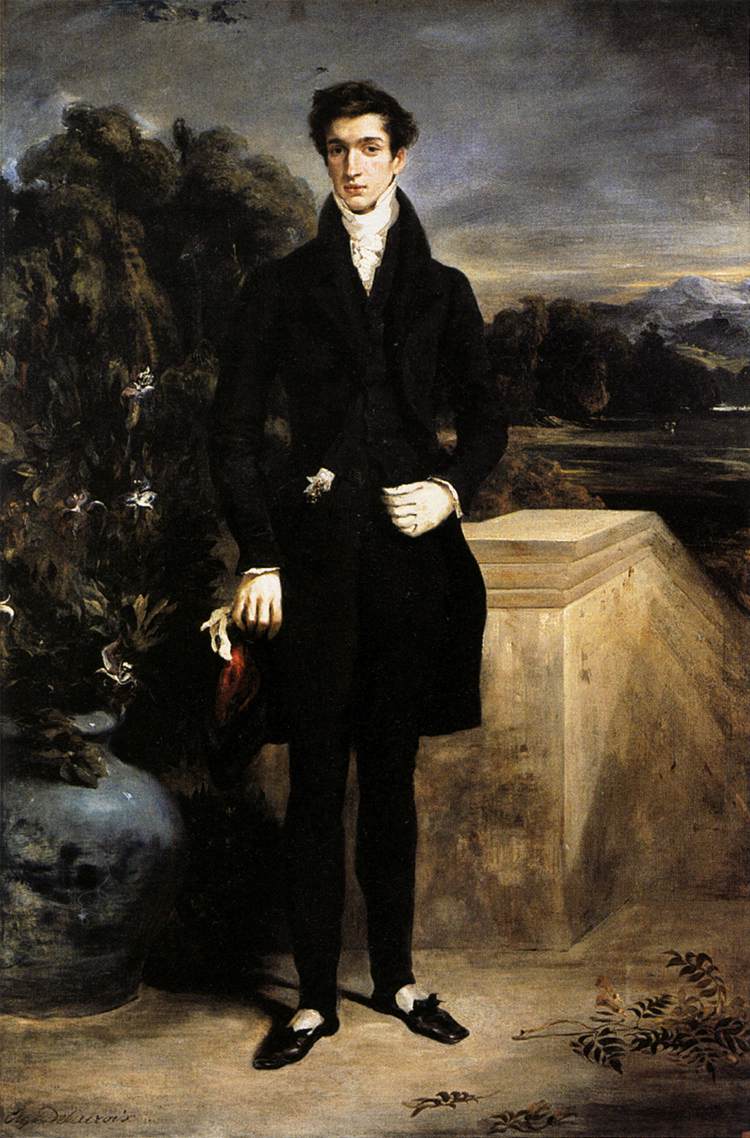
Louis-Auguste Schwiter
- MEDIUM
- Oil on canvas, 218 x 144 cm
- TYPE
- Portrait
PALETTE
HOVER OR TAP A SWATCH FOR NAME, SHARE AND HEX. SAMPLED FROM THE IMAGE — INDICATIVE, NOT A PIGMENT ANALYSIS.
DEVELOPMENT BUILD — NOT FOR PUBLIC USE. CONTRIBUTE ON GITHUB.
03 — ARTWORK
PALETTE
HOVER OR TAP A SWATCH FOR NAME, SHARE AND HEX. SAMPLED FROM THE IMAGE — INDICATIVE, NOT A PIGMENT ANALYSIS.
COMMENTARY
UNDERLINED TERMS ARE DEFINED IN THE GLOSSARY.
Delacroix's grandest pictures have never left their country of origin. Only in Paris can we fully appreciate the bold reconciliation of beauty with cruelty, sensuality with control, fantasy with observation, modernity with tradition that characterises the art of this influential painter.'
As Byron signifies Romantic poetry, so Romantic French art means above all Delacroix. Like Byron he achieved his flamboyantstyle flamboyant (French), the last major style of French Gothic architecture, so called because of its highly elaborate "flame-like" tracery. It followed the Rayonnant. artistic effects through intense intellectual application and a firm grasp of technique. Pupil of an academic artist, he was essentially self-taught through the study of the great Renaissance and seventeenth-century colourists in the Louvre. He was fascinated by the vibrant brushwork of the Venetians and their Flemish heir Rubens, imitating their capacity to simulate brilliant daylight even in the shadows, their use of colour instead of line as the primary structural element. It was precisely these effects which, as employed by Constable in the Hay-Wain exhibited at the Paris SalonIn the French language of the 18th and 19th centuries it designated an actual exhibition space, as well as the academic art exhibitions staged in the Salon d'Apollon of the Louvre since 1667. From 1737, the exhibitions took place biennially and, after the French Revolution, annually in the Salon Carré of the Louvre in Paris. Towards the end of the 19th century the official Salon jury was dissolved in order to make way for a committee of state-approved artists, i.e. former Salon members, who created the highly influential Société des Artistes Français. in 1824, caused a sensation and further exacerbated Delacroix's fashionable Anglomania. In 1825, having sold his picture of the Massacre of Chios to the French State, he set out for London with two English friends, the watercolourists Richard Bonington and Thales Fielding. They visited galleries and the theatre and read English poets. Delacroix met other English artists, including Thomas Lawrence. Appropriately for a painting in an English collection, the lifesize likeness of Louis-Auguste Schwiter, painted after Delacroix's return to Paris, is an essay in the portraitThe Roman portrait bust survived in the form of life-sized reliquaries of saints, but it was in 15th century Florence that the individual features and character of a contemporary sitter were accurately recorded by sculptors such as Donatello, Desiderio da Settignano, Mino da Fiesole and the Rossellino. A similar degree of realism occurs in 15th century tomb sculpture. The equestrian portrait, based on antique statues such as the Marcus Aurelius monument (Rome, Campidoglio), was revived in the 14th century. Two examples in fresco are Simone Martini's Guidoriccio (c. 1328; Siena, Palazzo Pubblico) and the posthumous portrait of Sir John Hawkwood (1436; Florence, Cathedral) by Uccello, which gives the illusion of a 3-dimensional statue seen from below. The Venetian Republic ordered imposing monuments from Donatello (1447; Gattarnelata, Padua) and Verrocchio (14799; Colleoni, Venice), whilst other statesmen ordered their own images to be erected in public places, directly relating themselves to the military heroes of ancient Rome. Another form of political portraiture derived from antiquity was the commemorative portrait medal designed by artists such as Pisanello. The carved or painted profile portrait became popular in the 1450s. The realism of the clear, flattened image, painted under the influence of Flemish examples by the Pollaiuolo brothers, Piero della Francesca and Botticelli, was superseded by the three-quarter and frontal portrait, psychologically more complex, such as Leonardo's enigmatic Mona Lisa (Paris, Louvre) with her momentary smile or Andrea del Sarto's arresting Portrait of a Man (London, National Gallery). The 16th century portrait became generalized, Lotto's Andrea Odoni (1527; Royal Collection) being an idealized concept of a collector rather than an individual. Group portraits, decorating whole rooms, include the narrative scenes of the Gonzaga court painted by Mantegna (completed 1474; Mantua, Palazzo Ducale) and the elaborate schemes commissioned by the Farnese family in Rome from Vasari (1546; Palazzo della Cancelleria) and Salviati (after 1553; Palazzo Farnese). Portraits were also incorporated into religious narratives, as in Ghirlandaio's fresco cycle painted for Giovanni Tornabuoni in S. Maria Novella, Florence (1486-90). style of Lawrence.
Schwiter, a lifelong friend of Delacroix, was himself a painter. He is presented here, however, as a gentleman, dressed in elegant black and hat in hand, standing on what appears to be the terrace of a great country house, as if waiting to be admitted. The blue Chinese vase with its heavily paint-textured flowers contrasts with the red lining of his hat. Like the trumpet vine clippings on the paving, these touches of colour serve to relate the foreground to the brooding sunset landscape (said to have been painted in part by Paul Huet, another artist friend), thus counteracting the isolation of Schwiter's monochromePainted in a single color; a painting executed in a single color. silhouette.
The portrait is lit from the right, a reversal of the more usual illuminationThe decoration of manuscripts, one of the most common forms of medieval art; because of its monastic origins, usually of religious texts. The practice extends from heavy decorations of initial letters and inter-woven margin patterns (as in Celtic examples) to miniatures and and full-page illuminations, often of a formal and grandiose kind (as in Byzantine manuscripts). Rich colors are a common feature, in particular a luxirious use of gold and silver. Illuminations survived the advent of printing for some time and only died out with the rise of printed illustration in the 16 century. from the left, highlighting the left side of the sitter's face and perhaps helping to account for the curiously tentative impression he gives, despite his firm stance in the centre of the picture and his direct gaze. The unemphatic 'modern' pose, with its hint of English-style reserve, and the free 'unfinished' brushwork made this full-length portrait, at once so formal and so unconventional, unacceptable to the judges of the 1827 Paris Salon exhibition, and it was rejected. Delacroix later reworked the painting, finally completing it in 1830.
@online{wga-rc522d57bc6d739,
  author       = {Krén, Emil and Marx, Daniel},
  title        = {Louis-Auguste Schwiter by DELACROIX, Eugène},
  organization = {{Web Gallery of Art}},
  date         = {2026-09-13},
  url          = {https://beta.wga.hu/artists/delacroix-eugne-r44dd9951dc0def/louis-auguste-schwiter-rc522d57bc6d739},
  urldate      = {2026-09-13},
  langid       = {english}
}
ACCESSED 2026-09-13. REPLACE THE AUTHOR FIELD WITH THE COMMENTARY AUTHOR WHERE ONE IS NAMED.


