03 — ARTWORK
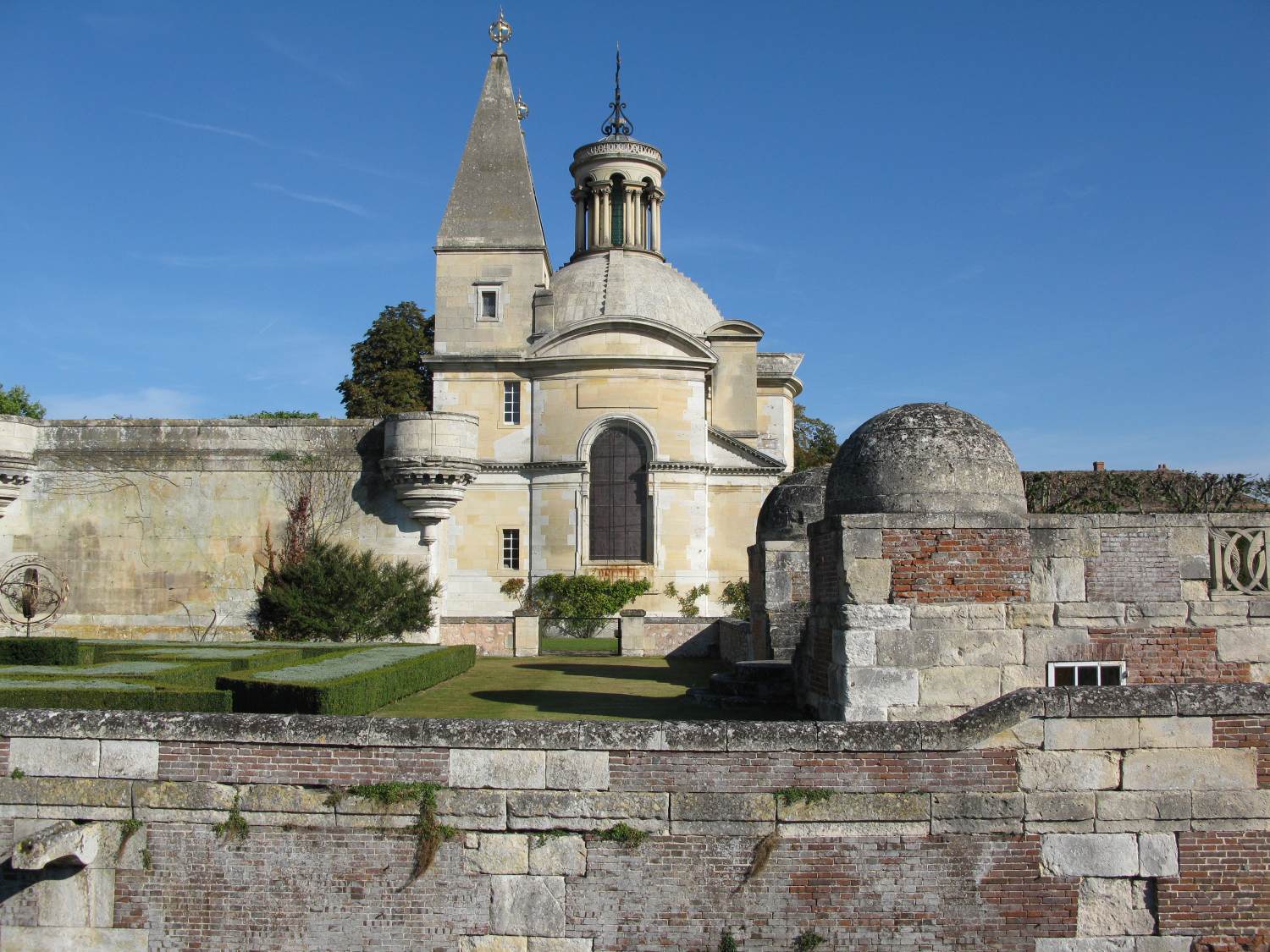
Exterior view
- MEDIUM
- Photo
- TYPE
- Other
PALETTE
HOVER OR TAP A SWATCH FOR NAME, SHARE AND HEX. SAMPLED FROM THE IMAGE — INDICATIVE, NOT A PIGMENT ANALYSIS.
DEVELOPMENT BUILD — NOT FOR PUBLIC USE. CONTRIBUTE ON GITHUB.
03 — ARTWORK
PALETTE
HOVER OR TAP A SWATCH FOR NAME, SHARE AND HEX. SAMPLED FROM THE IMAGE — INDICATIVE, NOT A PIGMENT ANALYSIS.
COMMENTARY
UNDERLINED TERMS ARE DEFINED IN THE GLOSSARY.
Philibert Delorme is the first French architect to have something of the universality of the great Italians. He combines the engineering skill of the French mason with the learning of the Italian artist. He is classicalRelating to the culture of ancient Greece and Rome (classical Antiquity). The classical world played a profoundly important role in the Renaissance, with Italian scholars, writers, and artists seeing their own period as the rebirth (the "renaissance") of classical values after the Middle Ages. The classical world was considered the golden age for the arts, literature, philosophy, and politics. Concepts of the classical, however, changed greatly from one period to the next. Roman literature provided the starting point in the 14th century, scholars patiently finding, editing and translating a wide range of texts. In the 15th century Greek literature, philosophy and art - together with the close study of the remains of Roman buildings and sculptures-expanded the concept of the classical and ensured it remained a vital source of ideas and inspiration. without being merely an imitator of the Italians. Unfortunately almost all that he built has been destroyed, and apart from sections of Château d'Anet and the tomb of Francis I, we have to rely on engravings.
Though the greater part of Anet has been destroyed, its three essential features have survived: the frontispiece (avant-corps) from the main block, which now stands in the court of the École des Beaux-Arts; and the chapela small separate place for worship, either part of a large church or a separate building. and entrance gate, which are still in situ.
The chapel of Château d'Anet is still in situ, though it now stands free instead of being, as it originally was, veiled by the porticoed east wing of the court. It is the first chapel in France in which is applied the Renaissance principle that the circle is the perfect figure, and therefore suitable for the house of God. It is applied, moreover, with great originality. Not only is the central domed space circular, but the side chapels are so shaped that the outer contoura line around a shape in a work of art, its nature depending on the artist's concept and intention. In medieval painting, contours were initially regular, flat outlines; in the course of the 14th century they acquired more sense of spatial effect, and appear to be alternately more and less emphatic. Later, the effect of contour in painting and graphic art became particularly important to artistic movements in which line and draughtsmanship was a prominent factor. of the whole building is a circle, interrupted only by the right angles of the two sacristies. Further, the marbleloosely applied to any hard limestone that can be sawn into thin slabs and will take a good polish so that it is suitable for decorative work; more strictly, it refers to metamorphosed limestones whose structure has been recrystallized by heat or pressure. Marbles are widely disseminated and occur in a great variety of colours and patterns, but certain types have been particularly prized by sculptors. The most famous of Greek white marbles in the ancient world was the close-grained Pentelic, which was quarried at Mount Pentelicon in Attica. The Elgin Marbles are carved in Pentelic. Widely used also were the somewhat coarser-grained translucent white marbles from the Aegean islands of Paros and Naxos. Parian marble was used for the celebrated Mausoleum at Halicarnassus. The pure white Carrara marble, quarried at Massa, Carrara, and Pietra Santa in Tuscany from the 3rd century BC, is the most famous of all sculptors' stones. It was used for the Apollo Belvedere, and was much favoured in the Renaissance, particularly by Michelangelo, who often visited the quarries to select material for his work. Neoclassical sculptors also favoured Carrara marble because of its ability to take a smooth, sleek surface, but it can look rather 'dead' compared with some of the finest Greek marbles. pavement is made up entirely of arcs of circles, forming a pattern which is the direct projection of the cofferingAn ornamental system of deep panels recessed into a vault, arch or ceiling. Coffered ceilings, occasionally made of wood, were frequently used in Renaissance palaces. in the domein architecture, hemispherical structure evolved from the arch, usually forming a ceiling or roof.. The emphasis on the circle is in accordance with the practice of Bramante (see his <a onclick="return OpenOther('/html/b/bramante/1archite/2/tempiet1.html')" href="/html/b/bramante/1archite/2/tempiet1.html">Tempietto</a>).
View the <a href="#" onClick="w=window.open ('/support/plans/d/delorme/anet.html', 'newWin', 'scrollbars=yes,status=no,dependent=yes,screenX=0,screenY=0,width=400,height=600');w.opener=this;w.focus();return false">ground plan</a> of the chapel.
@online{wga-r6fdf266dbbb0b7,
  author       = {Krén, Emil and Marx, Daniel},
  title        = {Exterior view by DELORME, Philibert},
  organization = {{Web Gallery of Art}},
  date         = {2026-09-12},
  url          = {https://beta.wga.hu/artists/delorme-philibert-r823191bcadd0d3/exterior-view-r6fdf266dbbb0b7},
  urldate      = {2026-09-12},
  langid       = {english}
}
ACCESSED 2026-09-12. REPLACE THE AUTHOR FIELD WITH THE COMMENTARY AUTHOR WHERE ONE IS NAMED.


