03 — ARTWORK
Caring for the Sick
- MEDIUM
- Fresco, height c. 450 cm
- TYPE
- Religious
PALETTE
HOVER OR TAP A SWATCH FOR NAME, SHARE AND HEX. SAMPLED FROM THE IMAGE — INDICATIVE, NOT A PIGMENT ANALYSIS.
DEVELOPMENT BUILD — NOT FOR PUBLIC USE. CONTRIBUTE ON GITHUB.
CURRENT LOCATION · Pellegrinaio
03 — ARTWORK
PALETTE
HOVER OR TAP A SWATCH FOR NAME, SHARE AND HEX. SAMPLED FROM THE IMAGE — INDICATIVE, NOT A PIGMENT ANALYSIS.
COMMENTARY
UNDERLINED TERMS ARE DEFINED IN THE GLOSSARY.
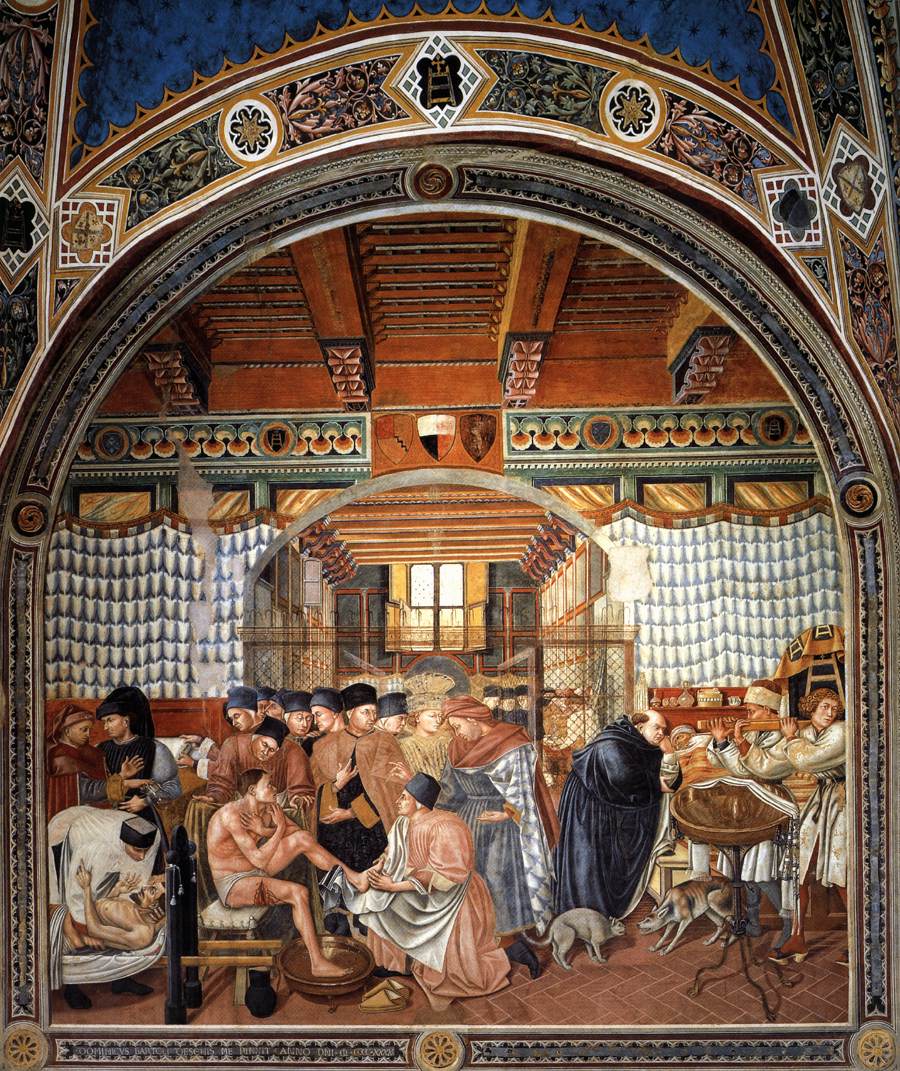
Caring for the Sick 1440 FrescoWall painting technique in which pigments are applied to wet (fresh) plaster (intonaco). The pigments bind with the drying plaster to form a very durable image. Only a small area can be painted in a day, and these areas, drying to a slightly different tint, can in time be seen. Small amounts of retouching and detail work could be carried out on the dry plaster, a technique known as a secco fresco., height c. 450 cm Pellegrinaio, Spedale di Santa Maria della Scala, Siena
This fresco is located in the 5th baya vaulted division of a nave, aisle, choir, or transept along its longitudinal axis. on the west wall of the Pellegrinaio in the Spedale di Santa Maria della Scala. The Pellegrinaio, situated on the ground floor of the hospital, is a fourteenth-century room which took the form of a long vaulted hall.
In the four scenes on the west wall, painted by Domenico di Bartolo, we find large numbers of figures gathered in a stagelike foreground and engaged in the various good works assigned to the hospital by statute in 1305. The settings for these depictions of everyday work of the hospital may reproduce actual spaces within the complex. For all their realismRealism (with an upper case "R"), also known as the Realist school, denotes a mid-nineteenth century art movement and style in which artists discarded the formulas of Neoclassicism and the theatrical drama of Romanticism to paint familiar scenes and events as they actually looked. Typically it involved some sort of sociopolitical or moral message, in the depiction of ugly or commonplace subjects. One of the main representatives and spokesmen was the painter Gustave Courbet. In the dispute about ways to represent reality, Realism rebelled against the idealistic and classicist tendencies in painting., the scenes are highly idealised.
In the Caring for the Sick Domenico combines specific portraiture with a sensitive treatment of the nude figure. The unidealized bodies of the sick man being placed in bed and the wounded man being washed rank among the most naturalistic figures in QuattrocentoThe 15th century in Italian art. The term is often used of the new style of art that was characteristic of the Early Renaissance, in particular works by Masaccio, Brunelleschi, Donatello, Botticelli, Fra Angelico and others. It was preceded by the Trecento and followed by the Cinquecento. painting.
@online{wga-rfa0c0ac8cb9d9e,
  author       = {Krén, Emil and Marx, Daniel},
  title        = {Caring for the Sick by DOMENICO DI BARTOLO},
  organization = {{Web Gallery of Art}},
  date         = {2026-09-13},
  url          = {https://beta.wga.hu/artists/domenico-di-bartolo-rfaf64660ab83c6/caring-for-the-sick-rfa0c0ac8cb9d9e},
  urldate      = {2026-09-13},
  langid       = {english}
}
ACCESSED 2026-09-13. REPLACE THE AUTHOR FIELD WITH THE COMMENTARY AUTHOR WHERE ONE IS NAMED.


