Early Italian Renaissance painter (full name: Domenico di Bartolomeo da Venezia), one of the founders of the 15th-century Florentine school of painting.
We know very little about the life and work of this painter; and even Vasari knew very little, so that he filled his biography of Domenico with complicated theories and colourful anecdotes. Vasari not only recounts the invented story of Domenico being murdered by Andrea del Castagno (actually Andrea died before Domenico), but also praises Veneziano as the artist who first introduced oil painting to Tuscany. Historically wrong and not justified by any of Domenico's works, this statement is used by Vasari in order to back up his description of the artist as the master of the typically Venetian use of colour, as opposed to Andrea del Castagno, the master of the Florentine art of disegnoGLOSSARYIn Renaissance art theory, the design of a painting seen in terms of drawing, which was help to be the basis of all art. The term stresses not the literal drawing, but the concept behind an art work. With the Mannerists the term came to mean an ideal image that a work attempts to embody but can in fact never fully realize. As disegno appeals to the intellect, it was considered far more important that coloure (colour), which was seen as appealing to the senses and emotions..
Domenico was probably first trained in the International GothicGLOSSARYEuropean art was characteristic of a rare uniformity for 60-70 years around 1400. Art historians have still not been able to come to an agreement on an appropriate name for it. The term "art around 1400" suits the style best which, because of its prevalence is referred to as international Gothic. The terms court style, soft style, beautiful style, trecento rococo and lyrical style, etc. are also used in art literature. Elements of style which were generally wide-spread, did not belong to any particular country and were characteristic of art in courts. In the second half of the 14th century, models appeared in court art in the circle of French-Flemish artists serving at French courts and Bohemian regions of the Emperor's Court which determined works of art all over Europe at the end of the century. Human figures, landscapes and spaces in a realistic approach were accompanied by a peculiar quality of dreams, decorative dynamism and deep emotional charge. It is called as a soft style on the basis of lyrical expressions and drapes: it is more than a simple system of formal motifs, it denominates a kind of behaviour. Artists of the period were engaged in learning the human soul until their attention was attracted to the world (e.g. Donatallo, Masaccio and Jan van Eyck). manner in Venice, where it is likely he saw paintings by northern European artists. He settled in Florence about 1439 and, except for brief periods, worked there until his death.
Two signed works by Domenico survive. The first, a much-damaged frescoGLOSSARYWall painting technique in which pigments are applied to wet (fresh) plaster (intonaco). The pigments bind with the drying plaster to form a very durable image. Only a small area can be painted in a day, and these areas, drying to a slightly different tint, can in time be seen. Small amounts of retouching and detail work could be carried out on the dry plaster, a technique known as a secco fresco. of the Virgin and Child enthroned and two damaged heads of saints (National GalleryGLOSSARYan upper story, similar to a tribune, running along the side of a building and open on one side to the interior; in a church (basilica) above the side aisles, over the ambulatory (central-plan building) and also over the west end. The gallery was used to keep certain groups of worshippers apart (women, noblemen)., London), formed part of the Carnesecchi TabernacleGLOSSARYa small canopied recess or container in which the Eucharist or a holy relic is kept. and may have been the first work Domenico executed in Florence. Its accurate perspectiveGLOSSARYThe method of representing three-dimensional objects on a flat surface. Perspective gives a picture a sense of depth. The most important form of perspective in the Renaissance was linear perspective (first formulated by the architect Brunelleschi in the early 15th century), in which the real or suggested lines of objects converge on a vanishing point on the horizon, often in the middle of the composition (centralized perspective). The first artist to make a systematic use of linear perspective was Masaccio, and its principles were set out by the architect Alberti in a book published in 1436. The use of linear perspective had a profound effect on the development of Western art and remained unchallenged until the 20th century. and the sculptural quality of the figures suggest he was influenced by Masaccio.
The first document concerning Domenico Veneziano we have is the letter that he himself wrote in April 1438 from Perugia (where he was working for the Baglioni family, as Vasari tells us) to Piero de' Medici, asking him for help in obtaining the commission for a painting from Cosimo the Elder, Piero's father. In 1439 Domenico returned to Florence from Perugia in 1439 and he is documented as working on the frescoes of stories from the life of the Virgin in the church of Sant'Egidio inside the Hospital of Santa Maria Nuova. On this project he was working in collaboration with Piero della Francesca. After he had painted the scenes of the Meeting at the Golden Gate and the Birth of the Virgin, in 1445 Domenico suddenly stopped working; we do not know what caused this interruption, but he left the fresco of the Wedding of the Virgin unfinished (it was completed later, in 1461, by Alesso Baldovinetti). The rest of the stories were painted by Andrea del Castagno between 1451 and 1453. The entire cycle was destroyed in the 18th century.
Between 1445 and 1447 Domenico painted his second surviving signed work: an altarpieceGLOSSARYA picture or sculpture that stands on or is set up behind an altar. The term reredos is used for an ornamental screen or partition, not directly attached to the altar table but affixed to the wall behind it. A diptych is an altarpiece consisting of two panels, a triptych one of three panels, and a polyptych one of four or more panels. From the 14th to 16th century, the altarpiece was one of the most important commissions in European art; it was through the altarpiece that some of the most decisive developments in painting and sculpture came about. for the Church of Santa Lucia dei Magnoli, usually called the Magnoli, or St Lucy, altarpiece. The central panelGLOSSARYTerm in painting for a support of wood, metal, or other rigid substance, as distinct from canvas. Until the adoption of canvas in the 15th century nearly all the movable paintings of Europe were executed on wood, and even up to the beginning of the 17th century it is probable that as much painting was done on the one support as on the other. Painters who worked on a small scale often used copper panels (Elsheimer is a leading example), and in the colonial art of South America copper and tin and even lead and zinc were used. On a larger scale, slate has occasionally been used as a support, notably by Rubens for his altarpiece for Sta Maria in Vallicella (the Chiesa Nuova) in Rome; the picture he originally painted was said to reflect the light unpleasantly and slate was used for the replacement to produce a more matt finish. For wood panels the Italian masters of the Renaissance preferred white poplar, while oak was the most common wood used in northern Europe. Many other types were used, however; analysis of the contents of art galleries has yielded a long list, including beech, cedar, chestnut, fir, larch, linden, mahogany, olive, and walnut. In the 20th century cedar, teak, and dark walnut are favourites, and modern painters have also used plywood, fibre-board, and other synthetic materials as supports., the Virgin and Child with four saints (Uffizi, Florence), is one of the outstanding paintings produced in Florence in the middle of the 15th century. The five panels of the predellaGLOSSARYAn Italian word for the small strip of paintings which forms the lower edge or socle of a large altarpiece (pala). Such a polyptych consists of a principal, central panel with subsidiary side and/or top panels, and a predella: the predella usually has narrative scenes from the lives of the Saints who are represented in the panels above. Because of the small size of predelle - they are not usually more than 25-30 cm high, though often relatively very wide - they were frequently used for pictorial experiments that the painter did not wish to risk making in the larger panels. The first datable example seems to be that in Simone Martini's S. Louis of Toulouse (1317, Naples). are now dispersed, they are now in the museums of Washington, Cambridge and Berlin.
A tondoGLOSSARYA circular painting or relief sculpture. The tondo derives from classical medallions and was used in the Renaissance as a compositional device for creating an ideal visual harmony. It was particularly popular in Florence and was often used for depictions of the Madonna and Child. of the Adoration of the Magi (Staatliche Museen, Berlin) is of uncertain date. It combines gay colour with careful realismGLOSSARYRealism (with an upper case "R"), also known as the Realist school, denotes a mid-nineteenth century art movement and style in which artists discarded the formulas of Neoclassicism and the theatrical drama of Romanticism to paint familiar scenes and events as they actually looked. Typically it involved some sort of sociopolitical or moral message, in the depiction of ugly or commonplace subjects. One of the main representatives and spokesmen was the painter Gustave Courbet. In the dispute about ways to represent reality, Realism rebelled against the idealistic and classicist tendencies in painting. and has an expansive and accurately drawn landscape background.
As we learn from Vasari, as soon as he had finished the Magnoli Altarpiece Domenico went to the Marches, in 1447, to fresco the ceiling of the church of Santa Maria in Loreto. Once again he was working together with Piero della Francesca. The cycle was never completed because an epidemic of plagueGLOSSARYPlague, which had been extinct in Italy from the 8th century, returned along eastern trade routes to strike the peninsula, and thereafter all Europe, in October 1347. During 1348 the Black Death, comprising the bubonic and still more deadly septicaemic and pneumonic forms of the disease, swept town and countryside in a series of attacks whose horror was strikingly portrayed by Boccaccio in his preface to the Decameron. Thenceforward, though in less widespread, more sporadic outbreaks, plague recurred periodically until the 18th century. Thirty per cent of the population of Venice died in the outbreak of 1575-7, for instance, which was commemorated by Palladio's church of the Redentore. Preventive measures included the boarding up of infected families, the isolation of sufferers in plague hospitals, the burning of 'infected' clothing, but none worked or mitigated the feeling of hopelessness. The plague's social effects are an object of controversy. It seems probable, however, that during the second half of the 14th century plague reduced the population of Italy by a half and at certain centres, such as Florence and Genoa, sharply accentuated an economic depression which had already set in during the 1340s. In the 15th century, despite regional variations, it is unlikely that population began to rise significantly before the 1470s. Large claims have been made in the field of the arts and of human sensibility for the influence of plague. In Florence and Siena from 1348 to 1380, religious feeling and the art which mirrors it seem to assume more sombre forms and to reflect less the human and more the divine, transcendent and threatening aspects of faith. Yet the black rat and its plague-bearing flea could find a more hospitable environment in the hovels of the poor than in the stone-built houses of wealthy patrons of the arts (who, moreover, were often able to remove themselves from areas where plague had broken out). For this reason, perhaps, it is difficult to find, outside Tuscany, evidence of cultural change which could be attributed to plague, and in the Italy of the 15th and 16th centuries the main effect of the disease in art is to be found only in the frequent portrayal of the plague saints, Rocco and Sebastian. It is none the less interesting to recall that it was against a stark background of continual menace from plague that the human achievements of the Renaissance came into being. broke out in the Marches and Domenico returned to Florence. The parts that had been painted were later destroyed.
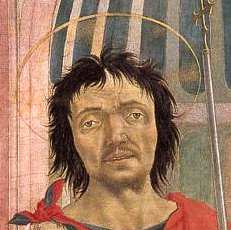
The fresco representing Saints John the Baptist and Francis is the artist's last known painting. Originally in the Cavalcanti ChapelGLOSSARYa small separate place for worship, either part of a large church or a separate building., next to the choirGLOSSARYthe part of a church interior, usually raised and set apart from the rest of the church, reserved for the clergy to pray together, or for choral singing. Since Carolingian times, "choir" has been the word for the part of the central nave of the church extending over the crossing (the place where nave and transept intersect), and including the apse (a niche in the wall, roofed with a half dome) that often stands at the end of this area. in the church of Santa Croce, the fresco was removed from the wall in 1566, when the choir was torn down as part of the modernization project directed by Vasari.
After he had finished the frescoes in Santa Croce, as we learn from a document dated 1454, Domenico was called to Perugia; together with Angelico and Lippi, his opinion was asked on the frescoes that Bonfigli had painted in the Chapel of the Priors. Domenico is also mentioned in the expenditure ledger of the church of Santa Trinità in Pistoia, who paid him for a consultancy concerning the altarpiece of the TrinityGLOSSARYin Christianity, the term used for the existence of one God in three persons: the Father, the Son and the Holy Spirit. by Pesellino and Filippo Lippi in 1457 (today the altarpiece is in the National Gallery, London). If in 1457 Domenico was still so widely respected as to be called upon to judge such an important work, we can suppose that he remained active until the year of his death, 1461, even though no works dating from the decade preceding his death survive.