03 — ARTWORK
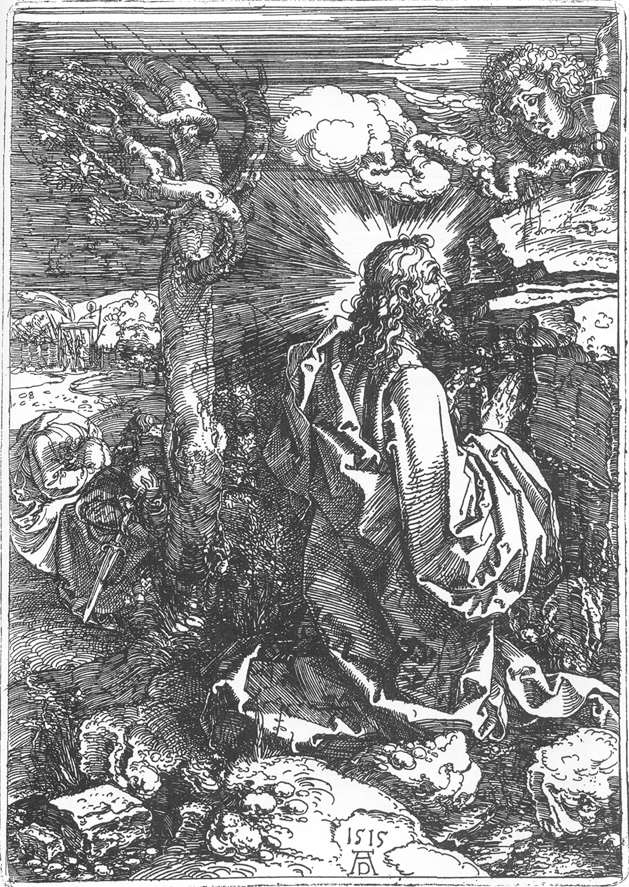
Agony in the Garden
- MEDIUM
- Etching, 221 x 156 mm
- TYPE
- Religious
PALETTE
HOVER OR TAP A SWATCH FOR NAME, SHARE AND HEX. SAMPLED FROM THE IMAGE — INDICATIVE, NOT A PIGMENT ANALYSIS.
DEVELOPMENT BUILD — NOT FOR PUBLIC USE. CONTRIBUTE ON GITHUB.
CURRENT LOCATION · Metropolitan Museum of Art
03 — ARTWORK
PALETTE
HOVER OR TAP A SWATCH FOR NAME, SHARE AND HEX. SAMPLED FROM THE IMAGE — INDICATIVE, NOT A PIGMENT ANALYSIS.
COMMENTARY
UNDERLINED TERMS ARE DEFINED IN THE GLOSSARY.
This etching differs considerably from the remaining preparatory studies. Christ's struggle is already over. He seems to be staring at the cup. The disciples are far in the background. The Saviour kneels, untouched by the raging storm; only His hands, ready to receive the chaliceA cup used in the celebration of the Christian Eucharist. Both the statement of St. Paul about "the cup of blessing which we bless" (1 Corinthians 10:16) and the accounts of the institution of the Eucharist in the first three Gospels indicate that special rites of consecration attended the use of the chalice from the beginning. It was not until the recognition of Christianity by the Roman Empire in the 4th century that silver and gold became the usual materials for the chalice. In the Middle Ages the legend of the Holy Grail surrounded the origins of the eucharistic chalice with a magical aura. The precious stones and elaborate carvings employed for the embellishment of chalices have made them an important part of the history of ecclesiastical art., reveal emotion. Dürer is as inventive as ever. This drawing too gives the impression of a tough and impetuous pen drawing rather than an engravingA print made from a metal plate that has had a design cut into it with a sharp point. Ink is smeared over the plate and then wiped off, the ink remaining in the etched lines being transferred when the plate is pressed very firmly onto a sheet of paper. and already takes advantage of the etching technique in order to blend the clair-obscurwoodcut technique based on the reproduction of light and dark in drawings, where the effect depends on using the base of the drawing in the design of the image. In clair-obscur prints the light areas are carved out of the printing plate, in order to allow the white of the paper to take effect. In coloured prints the coloured areas are printed with clay plates, the black contours usually with a special line plate, except in cases where - as in Italy these were dispensed with. effects of the preceding phase with the expressive literalism and grand pathos of the Large PassionThe events leading up to Good Friday, beginning with Christ's arrest and ending with his burial. Portrayals of the Passion, which focus on the Suffering Christ, include depictions of Judas betraying Christ with a kiss, Peter cutting off Malchus's ear, the crown of thorns, and so on.. The plate of this etching is preserved at the Staatsbibliothek in Bamberg.
@online{wga-rc60c8a58427754,
  author       = {Krén, Emil and Marx, Daniel},
  title        = {Agony in the Garden by DÜRER, Albrecht},
  organization = {{Web Gallery of Art}},
  date         = {2026-09-13},
  url          = {https://beta.wga.hu/artists/drer-albrecht-r9b10ff91cb62c2/agony-in-the-garden-rc60c8a58427754},
  urldate      = {2026-09-13},
  langid       = {english}
}
ACCESSED 2026-09-13. REPLACE THE AUTHOR FIELD WITH THE COMMENTARY AUTHOR WHERE ONE IS NAMED.