03 — ARTWORK
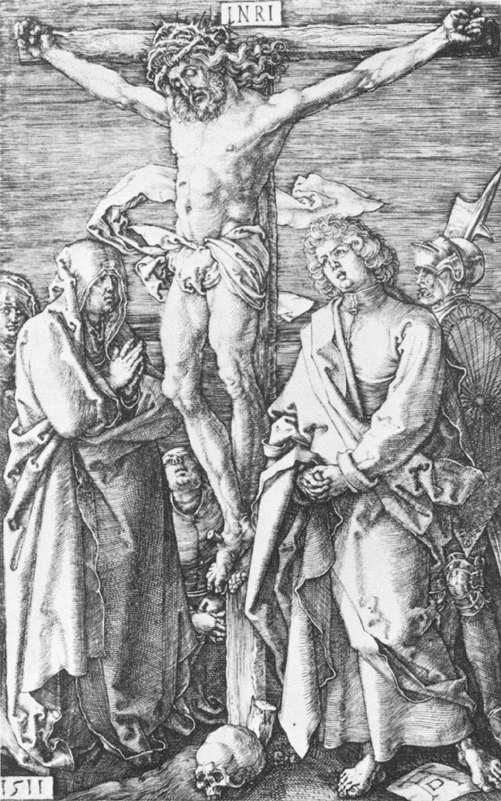
Crucifixion (No. 11)
- MEDIUM
- Engraving, 118 x 74 mm
- TYPE
- Religious
PALETTE
HOVER OR TAP A SWATCH FOR NAME, SHARE AND HEX. SAMPLED FROM THE IMAGE — INDICATIVE, NOT A PIGMENT ANALYSIS.
DEVELOPMENT BUILD — NOT FOR PUBLIC USE. CONTRIBUTE ON GITHUB.
CURRENT LOCATION · Metropolitan Museum of Art
03 — ARTWORK
PALETTE
HOVER OR TAP A SWATCH FOR NAME, SHARE AND HEX. SAMPLED FROM THE IMAGE — INDICATIVE, NOT A PIGMENT ANALYSIS.
COMMENTARY
UNDERLINED TERMS ARE DEFINED IN THE GLOSSARY.
CrucifixionAn important method of capital punishment, particularly among the Persians, Seleucids, Jews, Carthaginians, and Romans from about the 6th century BC to the 4th century AD. Constantine the Great, the first Christian emperor, abolished it in the Roman Empire in AD 337, out of veneration for Jesus Christ, the most famous victim of crucifixion. There were various methods of performing the execution. Usually, the condemned man, after being whipped, or "scourged," dragged the crossbeam of his cross to the place of punishment, where the upright shaft was already fixed in the ground. Stripped of his clothing either then or earlier at his scourging, he was bound fast with outstretched arms to the crossbeam or nailed firmly to it through the wrists. The crossbeam was then raised high against the upright shaft and made fast to it about 9 to 12 feet (approximately 3 metres) from the ground. Next, the feet were tightly bound or nailed to the upright shaft. A ledge inserted about halfway up the upright shaft gave some support to the body; evidence for a similar ledge for the feet is rare and late. Over the criminal's head was placed a notice stating his name and his crime. Death, apparently caused by exhaustion or by heart failure, could be hastened by shattering the legs (crurifragium) with an iron club, so that shock and asphyxiation soon ended his life. (No. 11) 1511 EngravingA print made from a metal plate that has had a design cut into it with a sharp point. Ink is smeared over the plate and then wiped off, the ink remaining in the etched lines being transferred when the plate is pressed very firmly onto a sheet of paper., 118 x 74 mm Metropolitan Museum of Art, New York
Sheet No. 11 of the Engraved PassionThe events leading up to Good Friday, beginning with Christ's arrest and ending with his burial. Portrayals of the Passion, which focus on the Suffering Christ, include depictions of Judas betraying Christ with a kiss, Peter cutting off Malchus's ear, the crown of thorns, and so on..
Probably the moment is pictured when Christ commends his mother to St John. The feeling of this engraving is statuesque rather than passionate. The principals are here joined in a triad, almost like a restful pause in the flow of the series. Dürer's rendering, in this instance, is considerably more restrained than the version of 1508. It is based on a preparatory drawing.
@online{wga-rc6fd34f0abf299,
  author       = {Krén, Emil and Marx, Daniel},
  title        = {Crucifixion (No. 11) by DÜRER, Albrecht},
  organization = {{Web Gallery of Art}},
  date         = {2026-09-13},
  url          = {https://beta.wga.hu/artists/drer-albrecht-r9b10ff91cb62c2/crucifixion-no-11-rc6fd34f0abf299},
  urldate      = {2026-09-13},
  langid       = {english}
}
ACCESSED 2026-09-13. REPLACE THE AUTHOR FIELD WITH THE COMMENTARY AUTHOR WHERE ONE IS NAMED.


