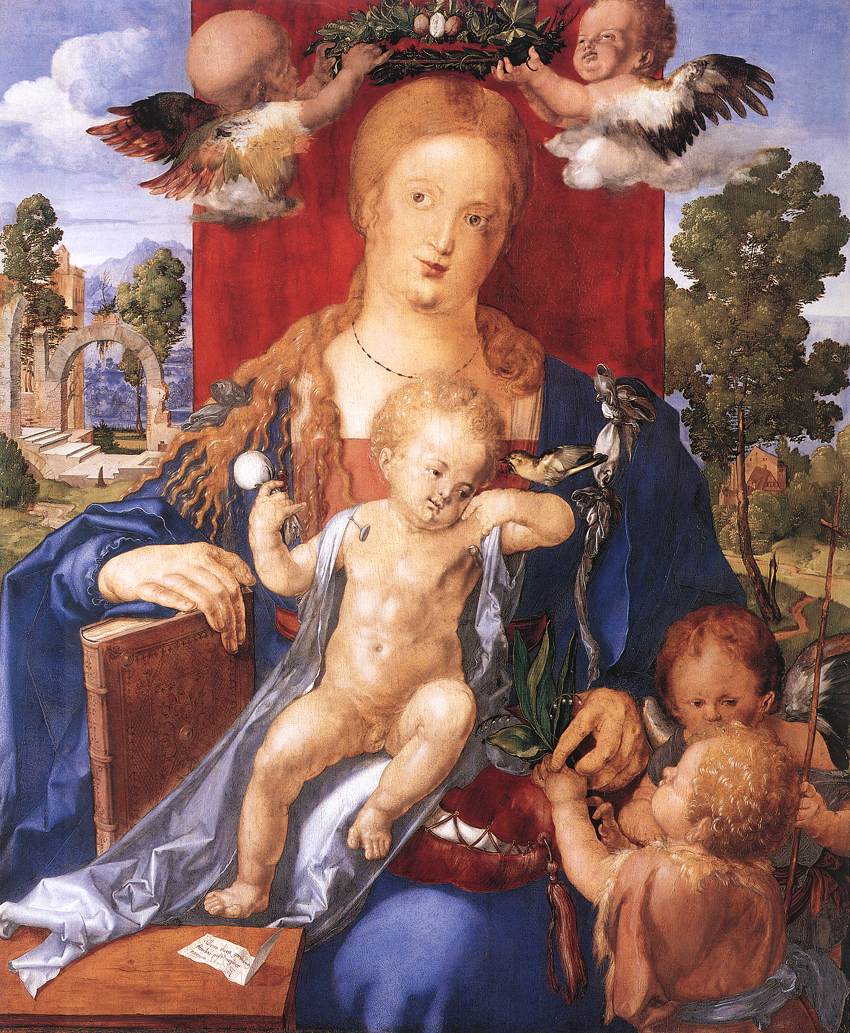
03 — ARTWORK
Madonna with the Siskin
- MEDIUM
- Oil on poplar panel, 91 x 76 cm
- TYPE
- Religious
PALETTE
HOVER OR TAP A SWATCH FOR NAME, SHARE AND HEX. SAMPLED FROM THE IMAGE — INDICATIVE, NOT A PIGMENT ANALYSIS.
DEVELOPMENT BUILD — NOT FOR PUBLIC USE. CONTRIBUTE ON GITHUB.
CURRENT LOCATION · Staatliche Museen (Berlin)
03 — ARTWORK
PALETTE
HOVER OR TAP A SWATCH FOR NAME, SHARE AND HEX. SAMPLED FROM THE IMAGE — INDICATIVE, NOT A PIGMENT ANALYSIS.
COMMENTARY
UNDERLINED TERMS ARE DEFINED IN THE GLOSSARY.
In the second half of the sixteenth century, this painting was in Nuremberg; in 1600, it was part of the collection of Rudolph II. In the 1860s, it reappeared and became the property of the marquis of Lothian of Edinburgh, from whom the Berlin museum acquired it in 1893.
In a letter of 23 September 1506 from Venice addressed to Willibald Pirckheimer, in which Dürer writes that he has completed the Feast of the Rose Garlands (Národní Galerie, Prague), he also speaks of having just finished another painting. It would most likely be the Madonna with the Siskin, which the artist brought back to Nuremberg with him. It is astonishing that Dürer does not mention any patrons for this large painting, full of iconographical references. He created it simply by drawing on his own culture and experience.
The work is conceived following the dictates of Venetian painting: a monumental Madonna, with the red gown covered by an azure cloak, who sits enthroned before a curtain that is also red, in a landscape pervaded by an especially clear light. A Florentine trademark is represented in the presence of Saint John, even if this detail was also rather common in the Venetian painting by this time. The Madonna's rapt gaze is directed slightly off to the side, while her right hand rests on the Old Testament, in which is prophesied the birth of the new king. She almost unconsciously accepts a lily of the valley (convallaris majalis) from Saint John with her other hand. It is the flower symbolic of the Immaculate Conception and the Incarnation of Christ. The small saint, however, does not look at her; his gaze is directed to Jesus, whose divine nature Saint John is the first to recognize.
The infant Jesus is seated in his mother's lap on a rich red cushion. With his right hand, he elegantly lifts a sort of soother - a tiny pouch, apparently filled with poppy seeds, on which babies would suck and be calmed. His left hand, which holds the edge of his little shirt, probably just unfastened (see the open clasp), comes toward his face. In the preparatory drawing, Dürer had represented him with a more solemn expression, while he raised the cross staff; but perhaps in changing the staff, the symbol of the PassionThe events leading up to Good Friday, beginning with Christ's arrest and ending with his burial. Portrayals of the Passion, which focus on the Suffering Christ, include depictions of Judas betraying Christ with a kiss, Peter cutting off Malchus's ear, the crown of thorns, and so on., with the poppy-seed soother - poppy seeds symbolic of sleep and death, if this is actually what it contains - the artist wanted to preserve the childlike manner of the infant Jesus, without altering the symbolismAn artistic movement that arose in France toward the end of the nineteenth century, primarily in literature, in opposition to the reigning schools of Realism and Impressionism. Symbolism rejected objectivity in favour of the subjective, and turned away from the direct representation of reality in favour of a synthesis of many different aspects of it, aiming to suggest ideas by means of ambiguous yet powerful symbols. Among the artists associated with the movement were Odilon Redon, Gustave Moreau and Puvis de Chavannes in France, Fernand Khnopff in Belgium, Jan Toorop in Holland, Ferdinand Hodler in Switzerland, Gustave Klimt in Austria, and Giovanni Segantini in Italy..
The siskin - in the place of the goldfinch - perched on his arm points his beak toward his head, where one day the crown of thorns will be; the child smiles affectionately at Saint John below him, to whom a little angel, with a meaningful gaze, is holding the cross staff out to him, though the saint and child do not take notice.
To the ruins represented in perspectiveThe method of representing three-dimensional objects on a flat surface. Perspective gives a picture a sense of depth. The most important form of perspective in the Renaissance was linear perspective (first formulated by the architect Brunelleschi in the early 15th century), in which the real or suggested lines of objects converge on a vanishing point on the horizon, often in the middle of the composition (centralized perspective). The first artist to make a systematic use of linear perspective was Masaccio, and its principles were set out by the architect Alberti in a book published in 1436. The use of linear perspective had a profound effect on the development of Western art and remained unchallenged until the 20th century. on the left corresponds a tree in bloom growing from a fallen trunk on the right. The former is a symbol of the fall of the Old Covenant, or perhaps an image of the ruins of David's palace, where, according to the legend, the nativity stable stood. The latter is a sign of life and of the New Covenant.
Two cherubs crown the Madonna with a garland of vine shoots of roses, in which are woven a white rose, symbol of her joy, and two red roses, symbol of her sufferings.
Dürer's main accomplishment in this painting is in the perfect combination of form and content. Each of the characters expresses his or her own emotion, yet everyone together is composed in a convincing, unified story, the symbols included. Unfortunately, the poor state of preservation greatly disturbs the impression of overall harmony that characterizes the panelTerm in painting for a support of wood, metal, or other rigid substance, as distinct from canvas. Until the adoption of canvas in the 15th century nearly all the movable paintings of Europe were executed on wood, and even up to the beginning of the 17th century it is probable that as much painting was done on the one support as on the other. Painters who worked on a small scale often used copper panels (Elsheimer is a leading example), and in the colonial art of South America copper and tin and even lead and zinc were used. On a larger scale, slate has occasionally been used as a support, notably by Rubens for his altarpiece for Sta Maria in Vallicella (the Chiesa Nuova) in Rome; the picture he originally painted was said to reflect the light unpleasantly and slate was used for the replacement to produce a more matt finish. For wood panels the Italian masters of the Renaissance preferred white poplar, while oak was the most common wood used in northern Europe. Many other types were used, however; analysis of the contents of art galleries has yielded a long list, including beech, cedar, chestnut, fir, larch, linden, mahogany, olive, and walnut. In the 20th century cedar, teak, and dark walnut are favourites, and modern painters have also used plywood, fibre-board, and other synthetic materials as supports..
@online{wga-rcb2a153727b8eb,
  author       = {Krén, Emil and Marx, Daniel},
  title        = {Madonna with the Siskin by DÜRER, Albrecht},
  organization = {{Web Gallery of Art}},
  date         = {2026-09-13},
  url          = {https://beta.wga.hu/artists/drer-albrecht-r9b10ff91cb62c2/madonna-with-the-siskin-rcb2a153727b8eb},
  urldate      = {2026-09-13},
  langid       = {english}
}
ACCESSED 2026-09-13. REPLACE THE AUTHOR FIELD WITH THE COMMENTARY AUTHOR WHERE ONE IS NAMED.


