03 — ARTWORK
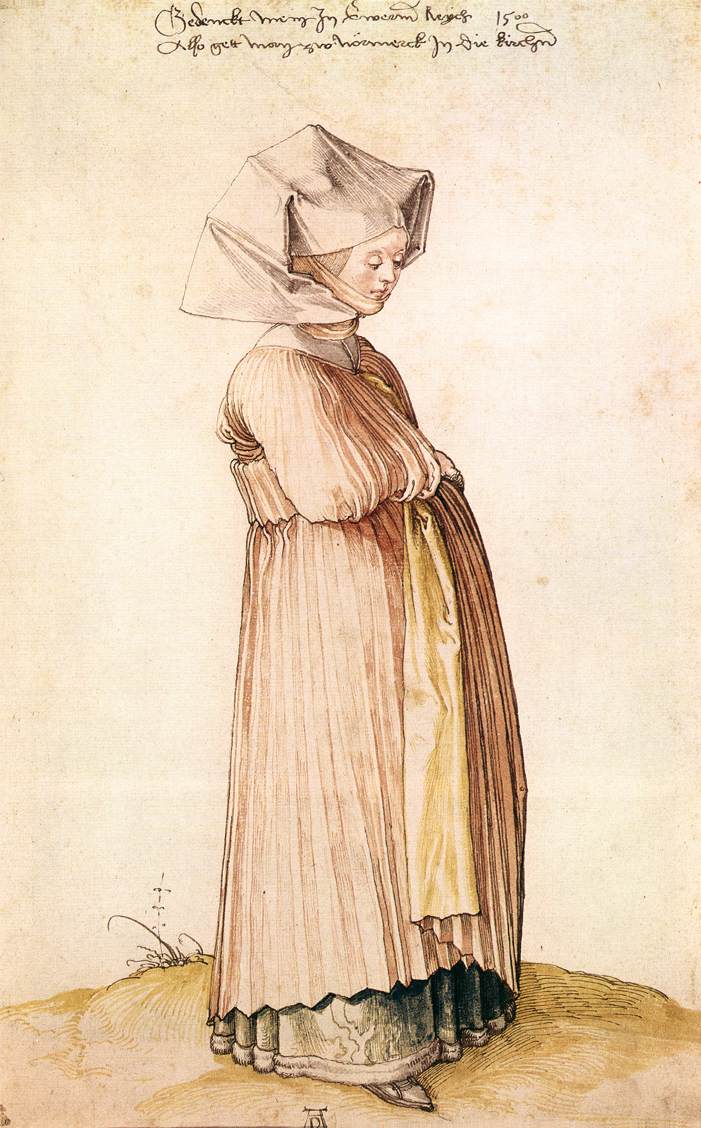
Nuremberg Woman Dressed for Church
- MEDIUM
- Pen and ink and watercolour on paper, 325 x 218 mm
- TYPE
- Other
PALETTE
HOVER OR TAP A SWATCH FOR NAME, SHARE AND HEX. SAMPLED FROM THE IMAGE — INDICATIVE, NOT A PIGMENT ANALYSIS.
DEVELOPMENT BUILD — NOT FOR PUBLIC USE. CONTRIBUTE ON GITHUB.
03 — ARTWORK
PALETTE
HOVER OR TAP A SWATCH FOR NAME, SHARE AND HEX. SAMPLED FROM THE IMAGE — INDICATIVE, NOT A PIGMENT ANALYSIS.
COMMENTARY
UNDERLINED TERMS ARE DEFINED IN THE GLOSSARY.
Dürer, who seems to have dressed well himself, was always interested in depicting clothing and he produced some of the earliest known costume studies in European art. This is one of a set of four costume studies of Nuremberg women, two of them in dancing dresses and one in everyday attire. The artist's wife Agnes; then in her mid-twenties, was probably the model.
The watercolourPigment ground in gum, usually gum arabic, and applied with brush and water to a painting surface, usually paper; the term also denotes a work of art executed in this medium. The pigment is ordinarily transparent but can be made opaque by mixing with a whiting and in this form is known as body colour, or gouache; it can also be mixed with casein, a phosphoprotein of milk. Watercolour compares in range and variety with any other painting method. Transparent watercolour allows for a freshness and luminosity in its washes and for a deft calligraphic brushwork that makes it a most alluring medium. There is one basic difference between transparent watercolour and all other heavy painting mediums - its transparency. The oil painter can paint one opaque colour over another until he has achieved his desired result. The whites are created with opaque white. The watercolourist's approach is the opposite. In essence, instead of building up he leaves out. The white paper creates the whites. The darkest accents may be placed on the paper with the pigment as it comes out of the tube or with very little water mixed with it. Otherwise the colours are diluted with water. The more water in the wash, the more the paper affects the colours; for example, vermilion, a warm red, will gradually turn into a cool pink as it is thinned with more water. The dry-brush technique - the use of the brush containing pigment but little water, dragged over the rough surface of the paper - creates various granular effects similar to those of crayon drawing. Whole compositions can be made in this way. This technique also may be used over dull washes to enliven them. is inscribed: `This is how people dress for church in Nuremberg' along with the text `Think of me in Thy Realm'. Dressed in her best clothes for church, the demure young woman wears a red cloak with a green lining and beneath this is a blue-green dress fringed with white fur. She has a starched linen headdress. Her eyes look down at the ground, in a contemplative pose. Four years later Dürer used this study in his woodcutA print made from a wood block. The design is drawn on a smooth block of wood and then cut out, leaving the design standing up in relief the design to be printed. The person who carved the woodcut often worked to a design by another artist. of the Marriage of the Virgin. The Nuremberg woman appears at the right of the print, in reverse, as one of the seven virgins who were Mary's companions.
@online{wga-rf51eb42c2ccc09,
  author       = {Krén, Emil and Marx, Daniel},
  title        = {Nuremberg Woman Dressed for Church by DÜRER, Albrecht},
  organization = {{Web Gallery of Art}},
  date         = {2026-09-13},
  url          = {https://beta.wga.hu/artists/drer-albrecht-r9b10ff91cb62c2/nuremberg-woman-dressed-for-church-rf51eb42c2ccc09},
  urldate      = {2026-09-13},
  langid       = {english}
}
ACCESSED 2026-09-13. REPLACE THE AUTHOR FIELD WITH THE COMMENTARY AUTHOR WHERE ONE IS NAMED.


