02 — ARTIST
EISENLOEFFEL, Jan
b. 1876 Amsterdam · d. 1957 Laren

DEVELOPMENT BUILD — NOT FOR PUBLIC USE. CONTRIBUTE ON GITHUB.
02 — ARTIST
b. 1876 Amsterdam · d. 1957 Laren
BIOGRAPHY
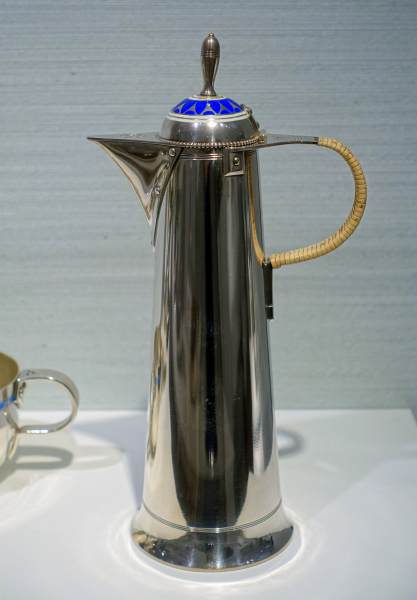
Dutch silversmith and designer. After studying at the Rijksnormaalschool from 1892 to 1896, Eisenloffel joined the silversmiths Hoeker & Son, Amsterdam, designing works in revivalist styles. Following eight months in St Petersburg, where he learnt enamelling and niello techniques, Eisenloffel developed his own style. In 1900 he became artistic director of the newly installed metal workshop at the Amstelhoek factory, working in his new style for the first time. The Amstelhoek factory was founded in 1897 by W.C. Hoeker (of Hoeker & Son), initially as a ceramic factory, the metalwork and furniture departments being later additions. Hoeker wished to produce modern designs in non-precious metals such as copper and brass; the production of silver at Amstelhoek was always associated with his family's firm. The factory name was derived from the telegraphic address: Amsterdam-Hoeker.
In September 1900, on the initiative of the architect Hendrik Petrus Berlage and the designer Jacob van den Bosch (1868-1948), a new design gallery, het Binnenhuis, opened in Amsterdam as a retail outlet for the applied arts, with Eisenloffel among the collaborators. Eisenloffel's metalwork enjoyed wide distribution through Amstelhoek displays at het Binnenhuis, but in January 1902, he left Amstelhoek and het Binnenhuis to run his own workshop, designing copper and brass objects for machine production. In 1903 he founded a rival interior design firm, De Woning, together with Willem Penaat (1875-1957), who had directed the furniture department at Amstelhoek.
Eissenloef designed numerous utility objects, including dinnerware, lamps, clocks and candlesticks. Besides everyday and luxury articles, he also undertook larger items such as wall fountains, fireplaces, and grandfather clocks. His pieces won awards at arts and crafts exhibitions in Turin (1902), Dresden (1904) and Munich (1908).
His later work shows influences from Eastern cultures, in line with the international Art Deco style.
4 RECORDS
@online{wga-eisenloeffel-jan,
  author       = {Krén, Emil and Marx, Daniel},
  title        = {EISENLOEFFEL, Jan},
  organization = {{Web Gallery of Art}},
  date         = {2026-09-09},
  url          = {https://beta.wga.hu/artists/eisenloeffel-jan-r308ebe5d9510f7},
  urldate      = {2026-09-09},
  langid       = {english}
}
ACCESSED 2026-09-09. REPLACE THE AUTHOR FIELD WITH THE COMMENTARY AUTHOR WHERE ONE IS NAMED.