03 — ARTWORK
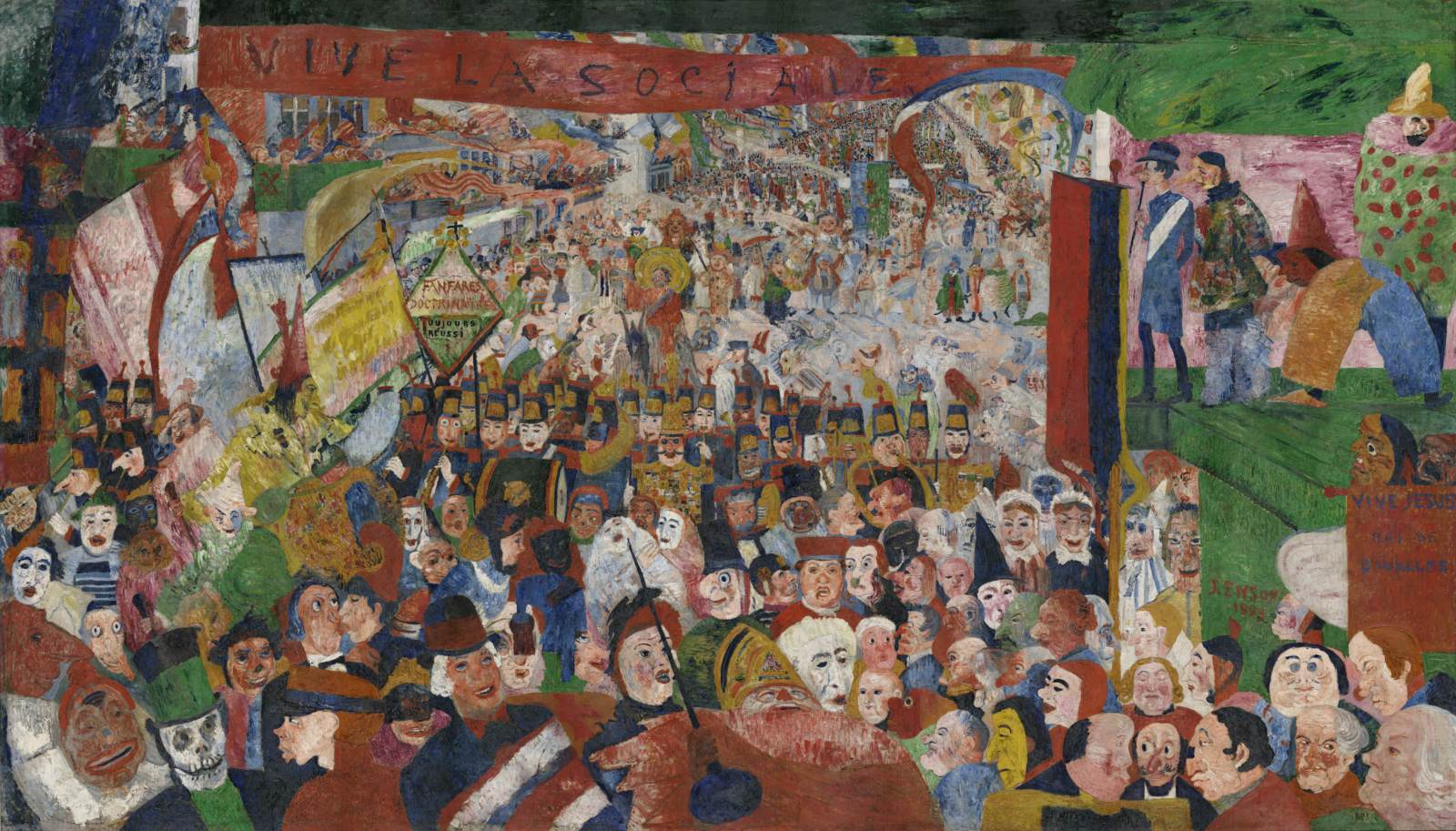
Christ's Entry into Brussels in 1889
- MEDIUM
- Oil on canvas, 253 x 431 cm
- TYPE
- Religious
PALETTE
HOVER OR TAP A SWATCH FOR NAME, SHARE AND HEX. SAMPLED FROM THE IMAGE — INDICATIVE, NOT A PIGMENT ANALYSIS.
DEVELOPMENT BUILD — NOT FOR PUBLIC USE. CONTRIBUTE ON GITHUB.
03 — ARTWORK
PALETTE
HOVER OR TAP A SWATCH FOR NAME, SHARE AND HEX. SAMPLED FROM THE IMAGE — INDICATIVE, NOT A PIGMENT ANALYSIS.
COMMENTARY
UNDERLINED TERMS ARE DEFINED IN THE GLOSSARY.
Christ's Entry into Brussels in 1889 1888 Oil on canvasA woven cloth used as a support for painting. The best-quality canvas is made of linen; other materials used are cotton, hemp, and jute. It is now so familiar a material that the word 'canvas' has become almost a synonym for an oil painting, but it was not until around 1500 that it began to rival the wooden panel (which was more expensive and took longer to prepare) as the standard support for movable paintings (the transition came later in Northern Europe than in Italy). Canvas is not suitable for painting on until it has been coated with a ground, which isolates the fabric from the paint; otherwise it will absorb too much paint, only very rough effects will be obtainable, and parts of the fabric may be rotted by the pigments. It must also be made taut on a stretcher or by some other means., 253 x 431 cm J. Paul Getty Museum, Los Angeles
James Ensor took on religion, politics, and art in this scene of Christ entering contemporary Brussels in a Mardi Gras parade. In response to the French pointillist style, Ensor used palette knives, spatulas, and both ends of his brush to put down patches of colours with expressive freedom.
Ensor's society is a mob, threatening to trample the viewer - a crude, ugly, chaotic, dehumanized sea of masks, frauds, clowns, and caricatures. Public, historical, and allegorical figures, along with the artist's family and friends, make up the crowd. The haloed Christ at the centre of the turbulence is in part a self-portraitThe Roman portrait bust survived in the form of life-sized reliquaries of saints, but it was in 15th century Florence that the individual features and character of a contemporary sitter were accurately recorded by sculptors such as Donatello, Desiderio da Settignano, Mino da Fiesole and the Rossellino. A similar degree of realism occurs in 15th century tomb sculpture. The equestrian portrait, based on antique statues such as the Marcus Aurelius monument (Rome, Campidoglio), was revived in the 14th century. Two examples in fresco are Simone Martini's Guidoriccio (c. 1328; Siena, Palazzo Pubblico) and the posthumous portrait of Sir John Hawkwood (1436; Florence, Cathedral) by Uccello, which gives the illusion of a 3-dimensional statue seen from below. The Venetian Republic ordered imposing monuments from Donatello (1447; Gattarnelata, Padua) and Verrocchio (14799; Colleoni, Venice), whilst other statesmen ordered their own images to be erected in public places, directly relating themselves to the military heroes of ancient Rome. Another form of political portraiture derived from antiquity was the commemorative portrait medal designed by artists such as Pisanello. The carved or painted profile portrait became popular in the 1450s. The realism of the clear, flattened image, painted under the influence of Flemish examples by the Pollaiuolo brothers, Piero della Francesca and Botticelli, was superseded by the three-quarter and frontal portrait, psychologically more complex, such as Leonardo's enigmatic Mona Lisa (Paris, Louvre) with her momentary smile or Andrea del Sarto's arresting Portrait of a Man (London, National Gallery). The 16th century portrait became generalized, Lotto's Andrea Odoni (1527; Royal Collection) being an idealized concept of a collector rather than an individual. Group portraits, decorating whole rooms, include the narrative scenes of the Gonzaga court painted by Mantegna (completed 1474; Mantua, Palazzo Ducale) and the elaborate schemes commissioned by the Farnese family in Rome from Vasari (1546; Palazzo della Cancelleria) and Salviati (after 1553; Palazzo Farnese). Portraits were also incorporated into religious narratives, as in Ghirlandaio's fresco cycle painted for Giovanni Tornabuoni in S. Maria Novella, Florence (1486-90).: mostly ignored, a precarious, isolated visionary amidst the herdlike masses of modern society. Ensor's Christ functions as a political spokesman for the poor and oppressed - a humble leader of the true religion, in opposition to the atheist social reformer Emile Littré, shown in bishop's garb holding a drumthe cylindrical or polygonal base of a dome. major's baton and leading on the eager, mindless crowd.
Above the crowd is a political banner bearing the legend Vive la Sociale ('Long live the Welfare State'); the implication is that Christ's message, like Ensor's, is not being heeded. Parody becomes a nightmare when one notices, lurking among the masks on the left foreground, the figure of Death in a top hat. After rejection by Les XXA group that began with 20 Belgian painters and sculptors as well as critics, founded to organize juryless exhibitions following their dissatisfaction with the selection process of the Brussels Academy and the Paris Salon. The group did not represent any one style, but exhibited works of Realism, Impressionism, Symbolism, and Art Nouveau, all together. The artist group played a significant role in the modernization of art in Belgium by inviting foreign artists as well to the exhibitions, including Whistler, Monet, and Renoir. The frequent participation of Signac and Seurat led to the development of an independent Belgian Neo-Impressionism with international flair.Important members of Les Vingts included, among others, James Ensor, Fernand Khnopff, Theo van Rysselberghe, and Henri van der Velde. The group dissolved itself in 1893 after holding a total of 126 exhibitions., the artists' association that Ensor had helped to found, the painting was not exhibited publicly until 1929. Ensor displayed Christ's Entry prominently in his home and studio throughout his life. With its aggressive, painterly style and merging of the public with the deeply personal, Christ's Entry was a forerunner of twentieth-century ExpressionismExpressionism is an artistic style in which the artist seeks to depict not objective reality but rather the subjective emotions and responses that objects and events arouse within a person. The artist accomplishes this aim through distortion, exaggeration, primitivism, and fantasy and through the vivid, jarring, violent, or dynamic application of formal elements. In a broader sense Expressionism is one of the main currents of art in the late 19th and early 20th centuries, and its qualities of highly subjective, personal, spontaneous self-expression are typical of a wide range of modern artists and art movements. More specifically, Expressionism as a distinct style or movement refers who became active in the years before World War I and remained so throughout much of the interwar period. Although the term Expressionist can be applied to artworks from any era, it is generally applied to art of the twentieth century. It may be said to start with Vincent van Gogh and then form a major stream of modern art embracing, among many others, Edvard Munch, fauvism and Henri Matisse, Georges Rouault, the Brücke and Blaue Reiter groups, Egon Schiele, Oskar Kokoschka, Paul Klee, Max Beckmann, most of Pablo Picasso, Henry Moore, Graham Sutherland, Francis Bacon, Alberto Giacometti, Jean Dubuffet, Georg Baselitz, Anselm Kiefer and the neo-expressionism of the 1980s..
The painting is signed and dated lower right, beneath the elevated platform: "J. ENSOR / 1888".
@online{wga-r4b0c0060f21ca7,
  author       = {Krén, Emil and Marx, Daniel},
  title        = {Christ's Entry into Brussels in 1889 by ENSOR, James},
  organization = {{Web Gallery of Art}},
  date         = {2026-09-13},
  url          = {https://beta.wga.hu/artists/ensor-james-r84cbb388497cf7/christs-entry-into-brussels-in-1889-r4b0c0060f21ca7},
  urldate      = {2026-09-13},
  langid       = {english}
}
ACCESSED 2026-09-13. REPLACE THE AUTHOR FIELD WITH THE COMMENTARY AUTHOR WHERE ONE IS NAMED.


