03 — ARTWORK
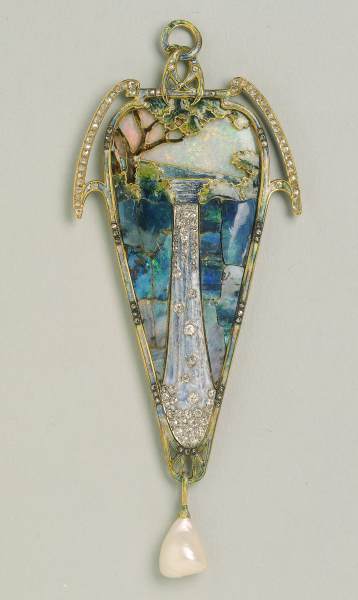
"Cascade" Pendant
- MEDIUM
- Gold, open enamel on spangles, opals, diamonds and baroque pearl, 12 x 5 cm
- TYPE
- Other
PALETTE
HOVER OR TAP A SWATCH FOR NAME, SHARE AND HEX. SAMPLED FROM THE IMAGE — INDICATIVE, NOT A PIGMENT ANALYSIS.
DEVELOPMENT BUILD — NOT FOR PUBLIC USE. CONTRIBUTE ON GITHUB.
CURRENT LOCATION · Petit Palais
03 — ARTWORK
PALETTE
HOVER OR TAP A SWATCH FOR NAME, SHARE AND HEX. SAMPLED FROM THE IMAGE — INDICATIVE, NOT A PIGMENT ANALYSIS.
COMMENTARY
UNDERLINED TERMS ARE DEFINED IN THE GLOSSARY.
"Cascade" PendantOne of a pair of related art works, or related elements within an art work. c. 1900 Gold, open enamelColoured glass in powder form and sometimes bound with oil, which is bonded to a metal surface or plaque by firing. on spangles, opals, diamonds and baroqueThe period in art history from about 1600 to about 1750. In this sense the term covers a wide range of styles and artists. In painting and sculpture there were three main forms of Baroque: (1) sumptuous display, a style associated with the Catholic Counter Reformation and the absolutist courts of Europe (Bernini, Rubens); (2) dramatic realism (Caravaggio); and (3) everyday realism, a development seen in particular in Holland (Rembrandt, Vermeer). In architecture, there was an emphasis on expressiveness and grandeur, achieved through scale, the dramatic use of light and shadow, and increasingly elaborate decoration. In a more limited sense the term Baroque often refers to the first of these categories. The development of the Baroque reflects the period's religious tensions (Catholic versus Protestant); a new and more expansive world view based on science and exploration; and the growth of absolutist monarchies. pearl, 12 x 5 cm Petit Palais, Paris
In 1895, Georges Fouquet took over from his father Alphonse Fouquet the jewellery company, which he had founded in 1860. Inspired by collaborators full of new ideas such as Alphonse Mucha and Charles Desrosiers, Fouquet completely transformed the art of jewellery.
He commissioned Mucha to make several exceptional items of jewellery, such as a bracelet for Sarah Bernhardt and entrusted him with decorating his new shop, which opened in 1900 at 6, Rue Royale, Paris. He commissioned Desrosiers, a former pupil of Grasset, to design jewellery for everyday use.
Fouquet's jewellery was known for its decorative character and clarity of execution. He frequently surrounded the outline of his pieces with a line of small diamonds to set off the main pattern. He often used enamels, appreciated for their transparency and delicate colour, and frequently combined them with opals chosen for their changing reflections, or baroque pearls, which displayed irregularities in their surface and material. He drew most of his inspiration from flora and fauna, which provided an inexhaustible repertoire of shapes and colours.
Fouquet made the present pendant after the design by Mucha and the decoration by Desrosiers.
@online{wga-r1b088654bc251d,
  author       = {Krén, Emil and Marx, Daniel},
  title        = {"Cascade" Pendant by FOUQUET, Georges},
  organization = {{Web Gallery of Art}},
  date         = {2026-09-13},
  url          = {https://beta.wga.hu/artists/fouquet-georges-rc40e6f2b788297/cascade-pendant-r1b088654bc251d},
  urldate      = {2026-09-13},
  langid       = {english}
}
ACCESSED 2026-09-13. REPLACE THE AUTHOR FIELD WITH THE COMMENTARY AUTHOR WHERE ONE IS NAMED.


