02 — ARTIST
FOUQUET, Jean
b. 1420 Tours · d. 1480 Tours

DEVELOPMENT BUILD — NOT FOR PUBLIC USE. CONTRIBUTE ON GITHUB.
02 — ARTIST
b. 1420 Tours · d. 1480 Tours
BIOGRAPHY
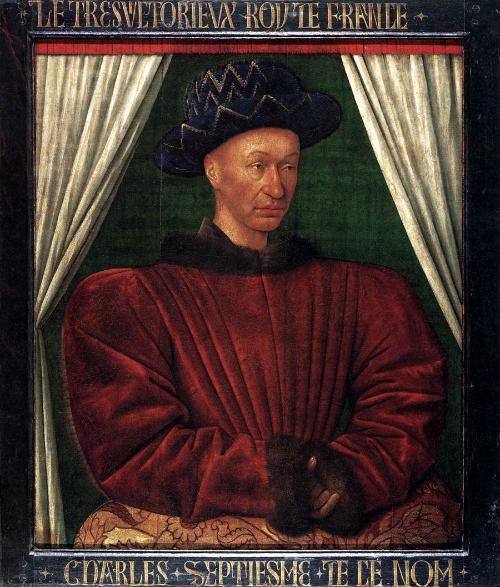
The outstanding French painter of the 15th century. He was born at Tours and is known to have been in Rome between 1443 and 1447, when he painted a portrait, now lost, of Pope Eugenius IV. Much has been made of this Italian journey, the influence of which can be detected in the perspective essays and Classical architecture of his subsequent works, but the strongly scrulptural character of his painting, which was deeply rooted in his native tradition, did not succumb to Italian influence.
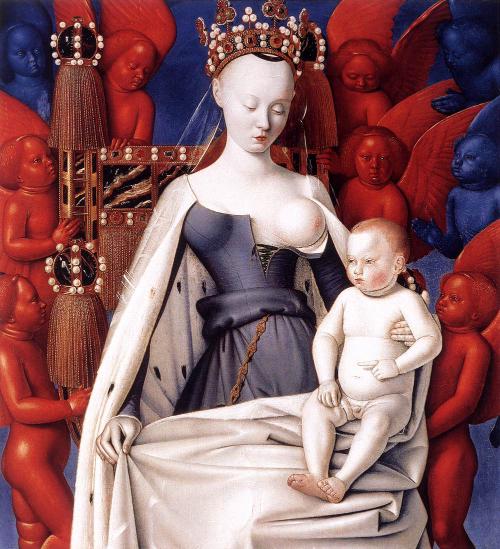
On his return from Italy Fouquet entered the service of the French court. His first patron was Étienne Chevalier, the royal secretary and lord treasurer, for whom he produced a Book of Hours (1450-60), now dismembered but mainly in the Museé Condé at Chantilly, and who appears in the Diptych of Melun (c. 1450), now divided between Antwerp (Museé Royal) and Berlin (Staatliche Museen). The Virgin in this work, at Antwerp, is rumored to be a portrait of Agnes Sorel, Charles VII's mistress, whom Chevalier had also loved. It was not until 1475 that Fouquet became Royal Painter (to Louis XI), but in the previous year he was asked to prepare designs for the king's tomb, and he must have been the leading court artist for many years.
Whether he worked on miniatures or on a larger scale in panel paintings, Fouquet's art had the same monumental character. His figures are modelled in broad planes defined by lines of magnificent purity. He was essentially a draughtsman, and it was his drawing that imparted to his compositions their balance and clarity. His sculptural sense of form went with a cool and detached temperament, and in his finest works the combination creates a deeply impressive gravity.
15 SELECTED · 39 CATALOGUED
During the Hundred Years' War against the English and beyond, French kings from Charles VII (1422-61) to François I (1515-47) had their court in the Loire valley. It was there that they built many of their finest residences. Jean Fouquet worked there, presumably after having done his apprenticeship as a miniaturist in Paris. A journey he undertook to Rome provided him with further inspiration, which he incorporated into his illustrations with great ingenuity. Most significant are the miniatures for the Book of Hours for Étienne Chevalier (c. 1410-1474), secretary and finance minister to King Charles VII of France (reigned 1422-1461). He was one of those bourgeois court officials who because of their great capabilities and loyalty, had risen in rank and influence in Paris and had as a result acquired considerable wealth. The creator of the miniatures in his Book of Hours was Jean Fouquet, with whom French 15th-century painting attained its undisputed zenith. Here we see landscapes typical of the early Italian Renaissance, along with depictions of palaces and castles typical of the Limbourg brothers or the Parisian School.
Originally this Book of Hours was a sumptuous manuscript rivaling the most beautiful manuscripts of the 15th century. Yet, it has suffered a sad fate. In the 18th century it was divided up into sections, with the loss of all the text pages except two. The illuminated pages were scattered in all directions in the 19th century. From the surviving 47 illuminated folios 40 are kept in the Musée Condé, Chantilly, 2 in the Musée du Louvre, Paris, 1 each in the Bibliothèque Nationale, Paris, British Library, London, Metropolitan Museum of Art, New York, Wildentein Foundation, London, and a private collection.
With Fouquet, who worked for the French ruling house together with other artists from Tourain, the great age of French illumination came to an end. The appearance of Robert Campin, Jan van Eyck and Rogier van der Weyden meant that the centre of gravity of European art shifted to Flanders and the Netherlands.
8 SELECTED · 39 CATALOGUED
This codex contains the history of the kingdom of France, from its mythical origins to the reign of King Charles V (1364-1380).
The Grandes Chroniques de France de Charles V (The Great Chronicle of France of Charles V) was recognised as the standard official history of the French monarchy. By the late 13th century it had become the custom of the monks of Saint-Denis to record remarkable contemporary events. This habit was then systematically continued by court historians, and ultimately developed into a historical project unique in the whole of Europe.
The custom continued at regular intervals. Work on the text of the present manuscript began as early as 1420-30, but it was not completed. Some 30 years later, the task was taken up again. The patron this time was King Charles VII (reigned 1422-1461). A Paris workshop seems to have been responsible for the border illustration, and Jean Fouquet created most of the 51 miniatures himself and did not pass them on to members of his workshop.
Although there were already richly illustrated copies of the Grandes Chroniques, Fouquet totally recast the historical events in the spirit of his time.
7 SELECTED · 39 CATALOGUED
Commentary is unavailable for this selection.
9 SELECTED · 39 CATALOGUED
Commentary is unavailable for this selection.
12 OF 39 RECORDS


@online{wga-fouquet-jean,
  author       = {Krén, Emil and Marx, Daniel},
  title        = {FOUQUET, Jean},
  organization = {{Web Gallery of Art}},
  date         = {2026-09-07},
  url          = {https://beta.wga.hu/artists/fouquet-jean-r317346f6b1b8dd},
  urldate      = {2026-09-07},
  langid       = {english}
}
ACCESSED 2026-09-07. REPLACE THE AUTHOR FIELD WITH THE COMMENTARY AUTHOR WHERE ONE IS NAMED.