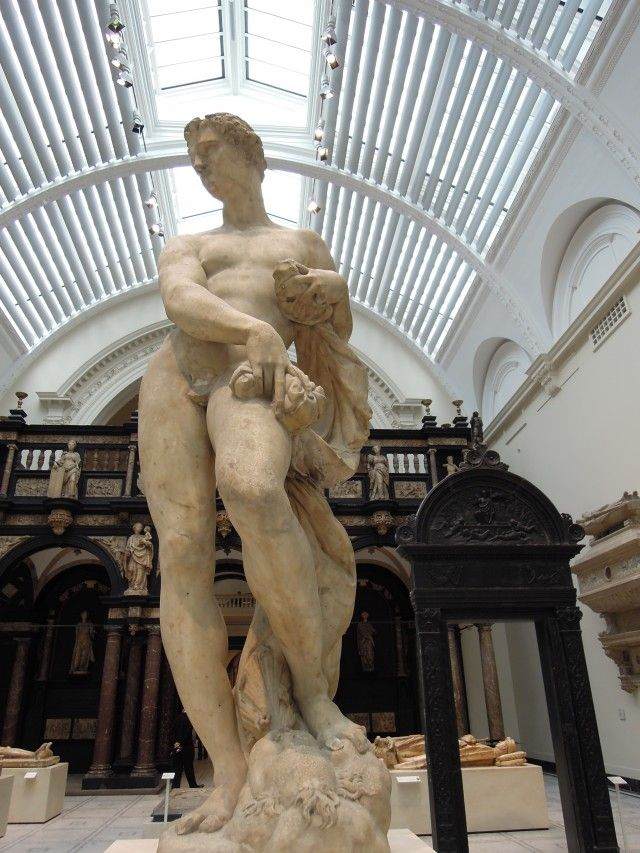
03 — ARTWORK
Zephyr
- MEDIUM
- Marble, height 185 cm
- TYPE
- Mythological
PALETTE
HOVER OR TAP A SWATCH FOR NAME, SHARE AND HEX. SAMPLED FROM THE IMAGE — INDICATIVE, NOT A PIGMENT ANALYSIS.
DEVELOPMENT BUILD — NOT FOR PUBLIC USE. CONTRIBUTE ON GITHUB.
03 — ARTWORK
PALETTE
HOVER OR TAP A SWATCH FOR NAME, SHARE AND HEX. SAMPLED FROM THE IMAGE — INDICATIVE, NOT A PIGMENT ANALYSIS.
COMMENTARY
UNDERLINED TERMS ARE DEFINED IN THE GLOSSARY.
The life-size marbleloosely applied to any hard limestone that can be sawn into thin slabs and will take a good polish so that it is suitable for decorative work; more strictly, it refers to metamorphosed limestones whose structure has been recrystallized by heat or pressure. Marbles are widely disseminated and occur in a great variety of colours and patterns, but certain types have been particularly prized by sculptors. The most famous of Greek white marbles in the ancient world was the close-grained Pentelic, which was quarried at Mount Pentelicon in Attica. The Elgin Marbles are carved in Pentelic. Widely used also were the somewhat coarser-grained translucent white marbles from the Aegean islands of Paros and Naxos. Parian marble was used for the celebrated Mausoleum at Halicarnassus. The pure white Carrara marble, quarried at Massa, Carrara, and Pietra Santa in Tuscany from the 3rd century BC, is the most famous of all sculptors' stones. It was used for the Apollo Belvedere, and was much favoured in the Renaissance, particularly by Michelangelo, who often visited the quarries to select material for his work. Neoclassical sculptors also favoured Carrara marble because of its ability to take a smooth, sleek surface, but it can look rather 'dead' compared with some of the finest Greek marbles. statue of Zephyr is shown standing with his left leg slightly bent, his foot resting on a cloud, and he wears a crown. Next to his left foot is the upturned face of a cherubIn Jewish, Christian, and Islamic literature, a celestial winged being with human, animal, or birdlike characteristics; a throne bearer of the deity. Derived from ancient Near Eastern mythology and iconography, these celestial beings serve important liturgical and intercessory functions in the hierarchy of angels. Old Testament descriptions of the cherubim emphasize their supernatural mobility and their cultic role as throne bearers of God, rather than intercessory functions. In Christianity the cherubim are ranked among the higher orders of angels and, as celestial attendants of God, continually praise him., who with his blown out cheeks symbolises the blowing wind that Zephyr represents. The wind that is shown blowing from the cherub's mouth goes up and becomes a billowing piece of cloth, held with both hands by Zephyr.
This statue is one of a series of thirteen marbles commissioned from Francavilla by Antonio di Zanobi Bracci in 1574 on the recommendation of the sculptor Giambologna for the garden of the Villaa residence in the country (in Italy); villas acquired palace-like characteristics from the Renaissance onwards. Bracci at Rovezzano, near Florence. The statues were acquired in 1750 by Frederick, Prince of Wales. The crated sculptures were transported to Kew, and in 1786 were apparently still in their crates and stored in a shed.
Apollo and Zephyr were discovered in the grounds at Kew in 1852, and underwent restoration by the sculptor Thomas Thorneycroft (1815-1885). They are lent to the museum by the Royal Botanic Gardens Kew.
@online{wga-r25fa304adf6391,
  author       = {Krén, Emil and Marx, Daniel},
  title        = {Zephyr by FRANCAVILLA, Pietro},
  organization = {{Web Gallery of Art}},
  date         = {2026-09-13},
  url          = {https://beta.wga.hu/artists/francavilla-pietro-r1df2e0087b6ce3/zephyr-r25fa304adf6391},
  urldate      = {2026-09-13},
  langid       = {english}
}
ACCESSED 2026-09-13. REPLACE THE AUTHOR FIELD WITH THE COMMENTARY AUTHOR WHERE ONE IS NAMED.


