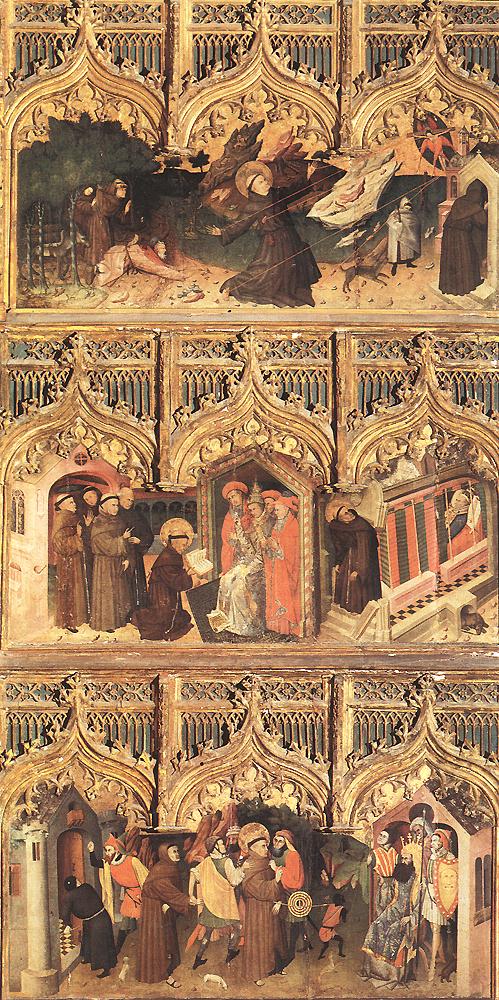
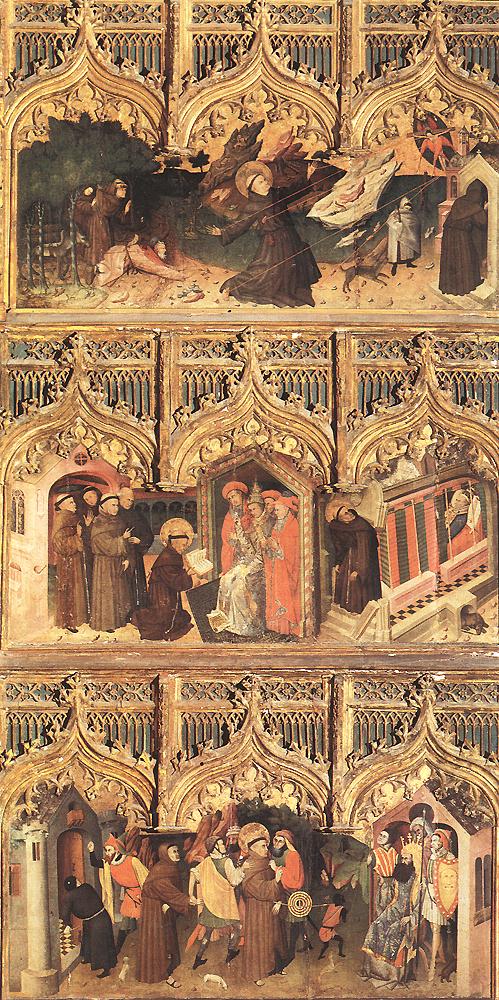
In León, the International GothicGLOSSARYEuropean art was characteristic of a rare uniformity for 60-70 years around 1400. Art historians have still not been able to come to an agreement on an appropriate name for it. The term "art around 1400" suits the style best which, because of its prevalence is referred to as international Gothic. The terms court style, soft style, beautiful style, trecento rococo and lyrical style, etc. are also used in art literature. Elements of style which were generally wide-spread, did not belong to any particular country and were characteristic of art in courts. In the second half of the 14th century, models appeared in court art in the circle of French-Flemish artists serving at French courts and Bohemian regions of the Emperor's Court which determined works of art all over Europe at the end of the century. Human figures, landscapes and spaces in a realistic approach were accompanied by a peculiar quality of dreams, decorative dynamism and deep emotional charge. It is called as a soft style on the basis of lyrical expressions and drapes: it is more than a simple system of formal motifs, it denominates a kind of behaviour. Artists of the period were engaged in learning the human soul until their attention was attracted to the world (e.g. Donatallo, Masaccio and Jan van Eyck). style was first introduced by a painter of great refinement, whose French origin is reflected in his name, Nicolás Francés. He was already living in León during the episcopate of Alfonso de Cusanza (1424-1437). In the CathedralGLOSSARYThe principal church of a province or diocese, where the throne of the bishop is placed. For reasons lost to time and tradition, a cathedral always faces west - toward the setting sun. The altar is placed at the east end. The main body, or nave, of the cathedral is usually divided into one main and two side aisles. These lead up to the north and south transepts, or arms of the cross, the shape in which a cathedral is usually formed. records he is described as an artist in stained glass, though he is also the author of the great retableGLOSSARYOrnamental panel behind an altar and, in the more limited sense, the shelf behind an altar on which are placed the crucifix, candlesticks, and other liturgical objects. The panel is usually made of wood or stone, though sometimes of metal, and is decorated with paintings, statues, or mosaics depicting the Crucifixion or a similar subject. Although frequently forming part of the architectural structure of the church, especially in the High Gothic period, retables can be detached and, sometimes, as in the case of the famous retable by Hubert and Jan van Eyck, "The Adoration of the Lamb" (1432, Cathedral of Saint-Bavon, Ghent), consist merely of a painting. Probably the most well-known retable is that in the Basilica of St Mark in Venice, which is one of the most remarkable examples in existence of the craft of the jeweler and goldsmith. Originally commissioned in 976, the St. Mark's retable was enlarged and enriched in the 13th century. With the development of freestanding altars, retables have become extinct., executed in 1434. Francés painted extensively and well. His work includes the mural decorations in the cloisterGLOSSARYquadrilateral enclosure surrounded by covered walkways, the centre of activity for the inhabitants of a monastery. and two compositions in the ambulatoryGLOSSARYSemicircular or polygonal circulation space enclosing an apse or a straight-ended sanctuary. of León cathedral, together with various paintings on wood. His style appears to derive from that of the Paris school of the first quarter of the fifteenth century. In particular, he possesses the same same subtlety of tone, the same grace in arranging the elements of his composition against a landscape background, and the same neatness of detail, but above all the same harmony of color. Until his death in 1468, he was for thirty years the foremost painter of the school of León.