03 — ARTWORK
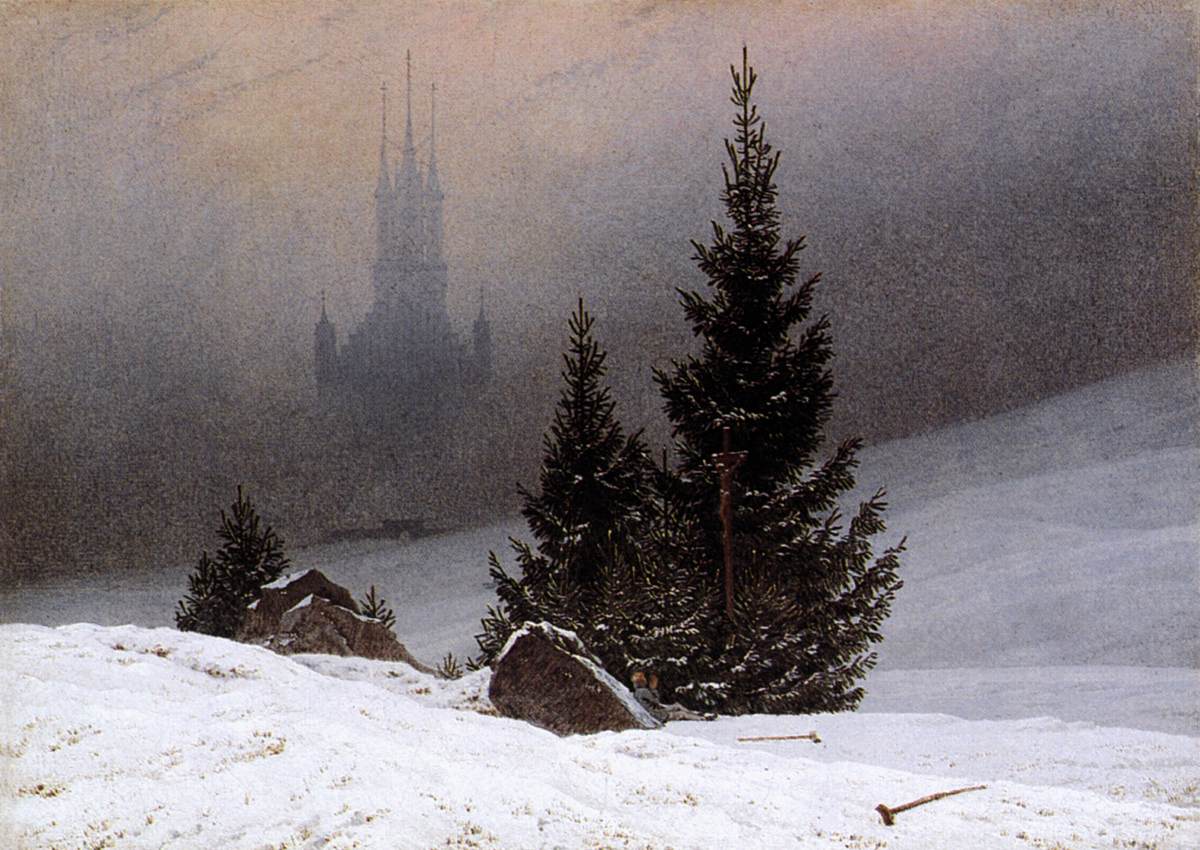
Winter Landscape
FRIEDRICH, Caspar David · 1811 →
- MEDIUM
- Oil on canvas, 32 x 45 cm
- TYPE
- Landscape
PALETTE
HOVER OR TAP A SWATCH FOR NAME, SHARE AND HEX. SAMPLED FROM THE IMAGE — INDICATIVE, NOT A PIGMENT ANALYSIS.
DEVELOPMENT BUILD — NOT FOR PUBLIC USE. CONTRIBUTE ON GITHUB.
CURRENT LOCATION · National Gallery
03 — ARTWORK
FRIEDRICH, Caspar David · 1811 →
PALETTE
HOVER OR TAP A SWATCH FOR NAME, SHARE AND HEX. SAMPLED FROM THE IMAGE — INDICATIVE, NOT A PIGMENT ANALYSIS.
COMMENTARY
UNDERLINED TERMS ARE DEFINED IN THE GLOSSARY.
One of the leading artists of the German Romantic movement, born in the small Baltic seaport of Greifswald and trained at the Academy in Copenhagen, Friedrich specialised in landscape painting. His aim was not, as he wrote, 'the faithful representation of air, water, rocks and trees...but the reflection of [the artist's] soul and emotion in these objects'. Later, using landscape to convey subjective feelings, he also invested it with symbolismAn artistic movement that arose in France toward the end of the nineteenth century, primarily in literature, in opposition to the reigning schools of Realism and Impressionism. Symbolism rejected objectivity in favour of the subjective, and turned away from the direct representation of reality in favour of a synthesis of many different aspects of it, aiming to suggest ideas by means of ambiguous yet powerful symbols. Among the artists associated with the movement were Odilon Redon, Gustave Moreau and Puvis de Chavannes in France, Fernand Khnopff in Belgium, Jan Toorop in Holland, Ferdinand Hodler in Switzerland, Gustave Klimt in Austria, and Giovanni Segantini in Italy.. Natural elements such as mountains, sea, trees, the seasons of the year and the times of day, often acquired religious significance.
Winter Landscape was originally exhibited by Friedrich in 1811 in Weimar with another winter scene, now in the museum in Schwerin. In the bleak Schwerin picture, a tiny figure on crutches stares out across a snow-covered plain. He is surrounded by the gnarled trunks of dead or dying oaks, and stumps of felled trees stretch away into the distance. But the uncompromising desolation of this image is countered by its companion now in London. Here the same cripple has abandoned his crutches. He leans against a sturdy rock, raising his hands in prayer before a crucifix gleaming against the vigorous evergreen branches of young fir trees. On the horizon the facade and spires of a GothicGothic, which may well have originated with Alberti as a derogatory term and which certainly corresponds to Vasari's 'maniera tedesca' ('German style'), is properly the descriptive term for an artistic style which achieved its first full flowering in the Ile de France and the surrounding areas in the period between c. 1200 and c. 1270, and which then spread throughout northern Europe. It is characterized by the hitherto unprecedented integration of the arts of sculpture, painting, stained glass and architecture which is epitomized in the great cathedrals of Chartres, Amiens, and Reims or in the Sainte Chapelle in Paris. In all the arts the predominantly planar forms of the Romanesque are replaced by an emphasis on line. There is a transcendental quality, whether in the soaring forms of the pointed arches or in the new stress on the humanity of Christ, which similarly distinguishes it from the preceding Romanesque style. In thinking of Nicola (d. c. 1284) or Giovanni Pisano (d. after 1314) there is same danger of forgetting what had happened in French sculpture half a century or more earlier, and likewise it is hard to remember that the spectacular achievements of early Renaissance art are a singularly localized eddy in the continuing stream of late gothic European art. By northern European standards few Italian works of art can be called gothic without qualification, and the story of 13th and 14th century Italian architecture is as much one of resistance to the new style as of its reception, whether directly from France or through German or central European intermediaries. In sculpture and in painting, the Italian reluctance to distort the human figure, conditioned by a never wholly submerged awareness of the omnipresent antique heritage, gives a special quality to the work of even those artists such as Giovanni Pisano or Simone Martini who most closely approached a pure gothic style. Nevertheless, the vitalizing role of Northern gothic art throughout the early Renaissance and the period leading up to it should never be underestimated. The artistic, like the cultural and commercial, interaction was continuous and much of the Italian achievement is incomprehensible if seen in isolation. It is not merely at the level of direct exchanges between one artist and another, or the influence of one building; painting, manuscript or piece of sculpture upon another, that the effects are to be felt. The streaming quality of line which is so characteristic of Brunelleschi's early Renaissance architecture surely reflects a sensitivity to the gothic contribution which is entirely independent of, and lies much deeper than, the superficial particularities of form. The counterflow of influence and inspiration from South to North must likewise not be underrated. In particular, the contribution of Italian painters from Duccio and Simone Martini onwards is central to the evolution of the so-called International Gothic style developing in Burgundy, Bohemia and north Italy in the late 14th and early 15th centuries. church, whose silhouette echoes that of the firs, rise like a vision out of a bank of mist. Shoots of grass push through the snow, and the sky is streaked with the glow of dawn. The mortal despair in the first painting is here transformed into the hope of resurrection, the salvation vouchsafed through Christ's sacrifice on the cross.
Friedrich was not the only one of his countrymen in this period to draw an analogy between 'native German' Gothic church architecture and the natural growth of forest trees, and the imagery here almost certainly reflects his sympathies with the patriotic and democratic movements of the day as well as his religious faith.
Winter Landscape was painted with surprisingly few pigments, suggesting that Friedrich was less interested in colour than in smoothly graduated tones. He achieved the striking effect of shimmering, transparent haze by careful stippling with the point of the brush, using a blue pigmentcoloured powder mixed with binding agents such as oil, glue, or resin to make paint. - smalt - which is transparent in an oil medium.
Suggested listening (streaming mp3, 37 minutes):
Schubert: Songs, transcripted for piano by Franz Liszt
@online{wga-r20b620baad2cdb,
  author       = {Krén, Emil and Marx, Daniel},
  title        = {Winter Landscape by FRIEDRICH, Caspar David},
  organization = {{Web Gallery of Art}},
  date         = {2026-09-13},
  url          = {https://beta.wga.hu/artists/friedrich-caspar-david-r902592c990c403/winter-landscape-r20b620baad2cdb},
  urldate      = {2026-09-13},
  langid       = {english}
}
ACCESSED 2026-09-13. REPLACE THE AUTHOR FIELD WITH THE COMMENTARY AUTHOR WHERE ONE IS NAMED.


