03 — ARTWORK
Exterior view
- MEDIUM
- Photo
- TYPE
- Other
PALETTE
HOVER OR TAP A SWATCH FOR NAME, SHARE AND HEX. SAMPLED FROM THE IMAGE — INDICATIVE, NOT A PIGMENT ANALYSIS.
DEVELOPMENT BUILD — NOT FOR PUBLIC USE. CONTRIBUTE ON GITHUB.
CURRENT LOCATION · San Giovanni in Laterano
03 — ARTWORK
PALETTE
HOVER OR TAP A SWATCH FOR NAME, SHARE AND HEX. SAMPLED FROM THE IMAGE — INDICATIVE, NOT A PIGMENT ANALYSIS.
COMMENTARY
UNDERLINED TERMS ARE DEFINED IN THE GLOSSARY.
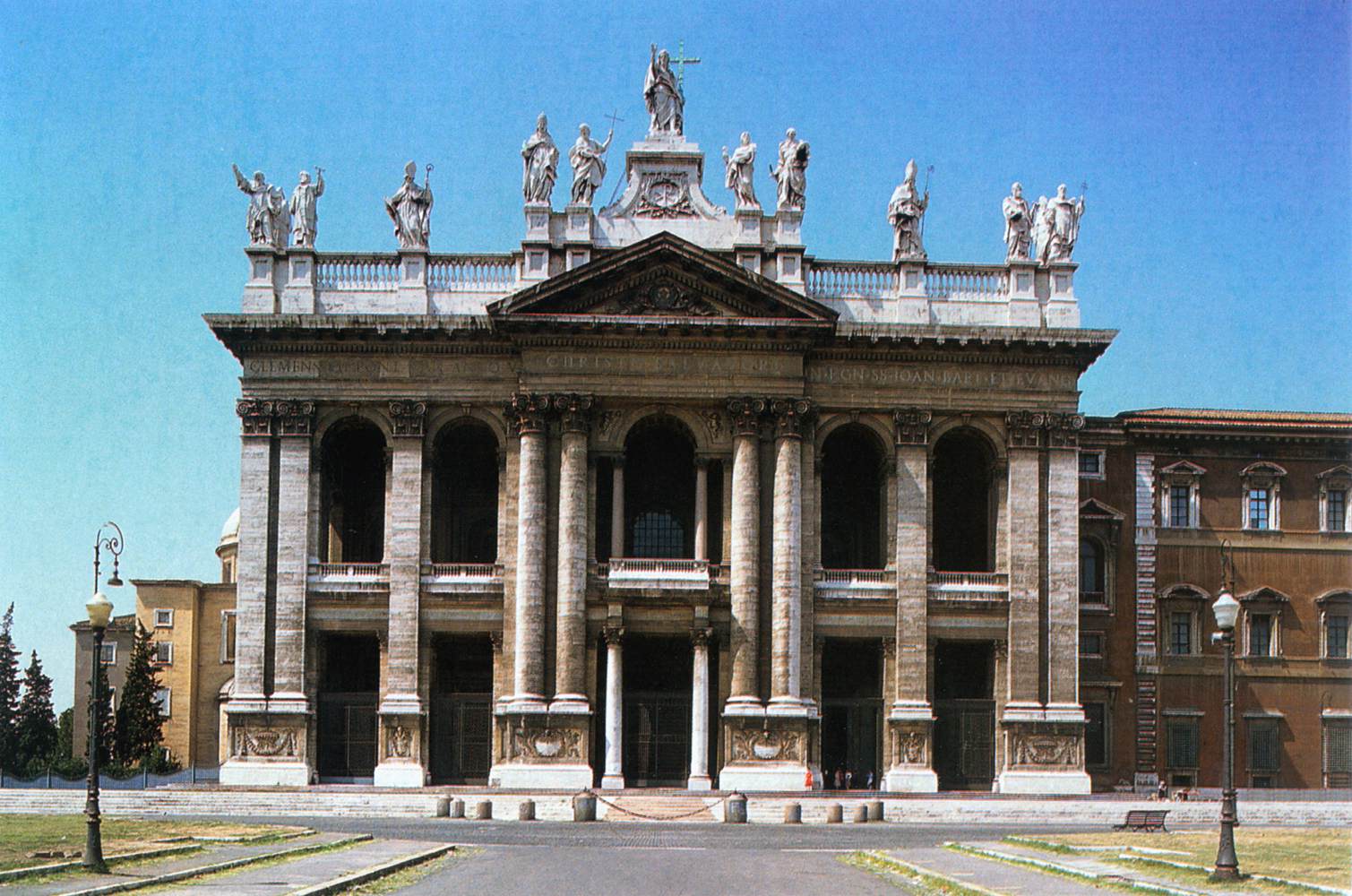
In 1632 Pope Clement XII decreed that a competition should be held for the façadethe front or principal face of a building, especially one elaborately constructed; a blind façade is a façade that is purely decorative and does not relate to the structure of the building. of San Giovanni in Laterano. Twenty-six architects from Rome and elsewhere took part. The competition became infamous, not least for the intrigue surrounding it. Apart from all this, the ultimate selection of Galilei's design proved to be of historic significance since it served to promote classicalRelating to the culture of ancient Greece and Rome (classical Antiquity). The classical world played a profoundly important role in the Renaissance, with Italian scholars, writers, and artists seeing their own period as the rebirth (the "renaissance") of classical values after the Middle Ages. The classical world was considered the golden age for the arts, literature, philosophy, and politics. Concepts of the classical, however, changed greatly from one period to the next. Roman literature provided the starting point in the 14th century, scholars patiently finding, editing and translating a wide range of texts. In the 15th century Greek literature, philosophy and art - together with the close study of the remains of Roman buildings and sculptures-expanded the concept of the classical and ensured it remained a vital source of ideas and inspiration. architecture during a time that did not generally favour the style.
Galilei created a façade for San Giovanni in Laterano based on the Roman tradition of Carlo Maderno and Michelangelo. The relationship between closed and open façade sections was new and produced strongly contrasting light and dark planes which emphasized the orders. A sense of classical discipline pervades the whole design and the large-scale features are directly in the Roman tradition.
The picture shows the main façade of the church.
The archive catalogues no further works by this artist.
TRY SAME COLLECTION →@online{wga-rb3578a48dd4bf8,
author = {Krén, Emil and Marx, Daniel},
title = {Exterior view by GALILEI, Alessandro},
organization = {{Web Gallery of Art}},
date = {2026-09-13},
url = {https://beta.wga.hu/artists/galilei-alessandro-r934a2359baec8b/exterior-view-rb3578a48dd4bf8},
urldate = {2026-09-13},
langid = {english}
}ACCESSED 2026-09-13. REPLACE THE AUTHOR FIELD WITH THE COMMENTARY AUTHOR WHERE ONE IS NAMED.

