03 — ARTWORK
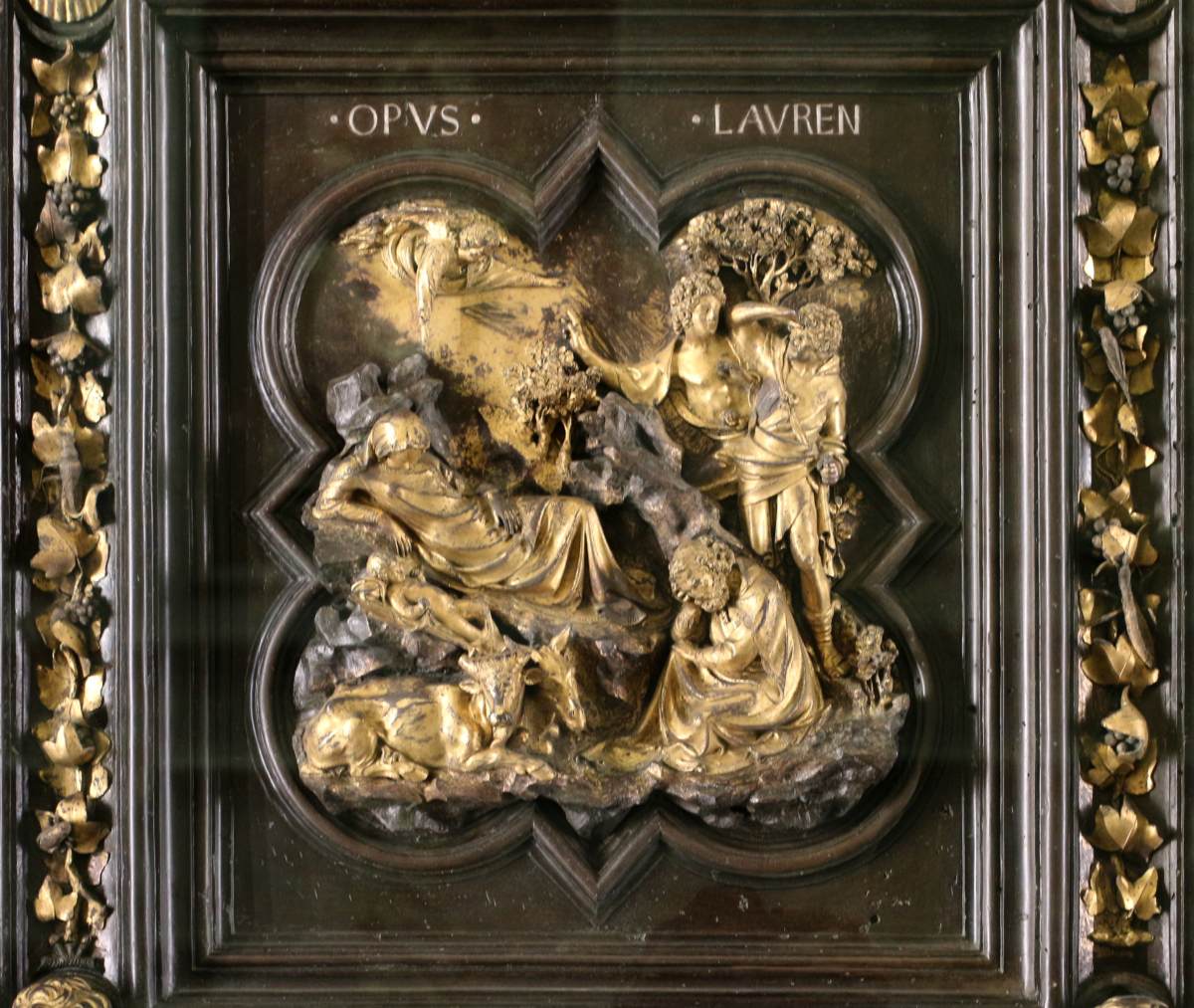
North doors panels: 2. Nativity
- MEDIUM
- Gilded bronze
- TYPE
- Religious
PALETTE
HOVER OR TAP A SWATCH FOR NAME, SHARE AND HEX. SAMPLED FROM THE IMAGE — INDICATIVE, NOT A PIGMENT ANALYSIS.
DEVELOPMENT BUILD — NOT FOR PUBLIC USE. CONTRIBUTE ON GITHUB.
CURRENT LOCATION · Baptistery (Florence)
03 — ARTWORK
PALETTE
HOVER OR TAP A SWATCH FOR NAME, SHARE AND HEX. SAMPLED FROM THE IMAGE — INDICATIVE, NOT A PIGMENT ANALYSIS.
COMMENTARY
UNDERLINED TERMS ARE DEFINED IN THE GLOSSARY.
The theme for Ghiberti's north doors of the BaptisteryHall or chapel situated close to, or connected with, a church, in which the sacrament of baptism is administered. The form of the baptistery originally evolved from small, circular Roman buildings that were designated for religious purposes (e.g., the Temple of Venus, Baalbek, Lebanon, AD 273, and the Mausoleum of Diocletian, Spalato [Split, Croatia], AD 300); but because baptism originally was performed on only three holidays, Easter, Pentecost, and Epiphany, enlargement of the older Roman buildings became necessary to accommodate the growing numbers of converts. Baptisteries were among the most symbolic of all Christian architectural forms; and the characteristic design that was developed by the 4th century AD can be seen today in what is probably the earliest extant example, the baptistery of the Lateran palace in Rome, built by Sixtus III, pope between 432 and 440. The baptistery was commonly octagonal in plan, a visual metaphor for the number eight, which symbolized in Christian numerology a new beginning. As eight follows the "complete" number, seven, so the beginning of the Christian life follows baptism. Customarily, a baptistery was roofed with a dome, the symbol of the heavenly realm toward which the Christian progresses after the first step of baptism. The baptismal font was usually octagonal, set beneath a domical ciborium, or canopy, and encircled by columns and an ambulatory--features that were first used in the baptistery by the Byzantines when they altered Roman structures. Baptisteries commonly adjoined the atrium, or forecourt, of the church and were often large and richly decorated, such as those at Pisa, Florence, Parma, and Nocera in Italy; el Kantara, Alg.; and Poitiers, France. After the 6th century they were gradually reduced to the status of small chapels inside churches. In the 10th century, when baptism by affusion (pouring liquid over the head) became standard practice in the church, baptisteries, or baptismal chapels, were often omitted entirely. In most modern churches the font alone serves for baptism; something of earlier symbolism survives, however, in its usual location near the church door - an allusion to entering the Christian life. is the life of Christ in 20 scenes with the 8 lower panels containing the Evangelists and Fathers of the ChurchA title given to those leaders of the early Christian Church whose writings had made an important contribution to the development of doctrine. Saints Ambrose, Augustine, Jerome, and Gregory the Great were often considered the four principal Fathers of the Church.. As these doors were kept shut, except on feast days, the scenes read from the bottom accross both wings.
View the arrangement of the panels on the north doors of the Baptistery.
The picture shows the Nativity, one of the 20 scenes from the life of Christ. In this reliefA sculptural work in which all or part projects from the flat surface. There are three basic forms: low relief (bas-relief, basso rilievo), in which figures project less than half their depth from the background; medium relief (mezzo-rilievo), in which figures are seen half round; and high relief (alto rilievo), in which figures are almost detached from their background. of the Nativity the landscape foreground follows the frame, and the main figures, the Virgin and the shepherds, are placed on a central plane. From the left springs out a herald angel. In the Nativity Ghiberti induces a greater sense of depth than in the earlier Annunciationthe term for the event described in the Gospel according to St. Luke, when the Angel Gabriel brings the Virgin Mary the news that she is to bear her son, Jesus Christ. The Annunciation was among the most widespread pictorial subjects of European art during the Middle Ages and the Renaissance. relief. This is achieved by methods of extraordinary subtlety, the clenched left hand of one of the two shepherds protruding beyond the frame, a contrast in scale between the right arm of the second shepherd and the distant tree nearby, and above all by the Virgin's head thrust forward from the relief plane and represented looking downwards at the Child.
@online{wga-r8fc183fc081637,
  author       = {Krén, Emil and Marx, Daniel},
  title        = {North doors panels: 2. Nativity by GHIBERTI, Lorenzo},
  organization = {{Web Gallery of Art}},
  date         = {2026-09-13},
  url          = {https://beta.wga.hu/artists/ghiberti-lorenzo-raaf1e6e5ade357/north-doors-panels-2-nativity-r8fc183fc081637},
  urldate      = {2026-09-13},
  langid       = {english}
}
ACCESSED 2026-09-13. REPLACE THE AUTHOR FIELD WITH THE COMMENTARY AUTHOR WHERE ONE IS NAMED.


