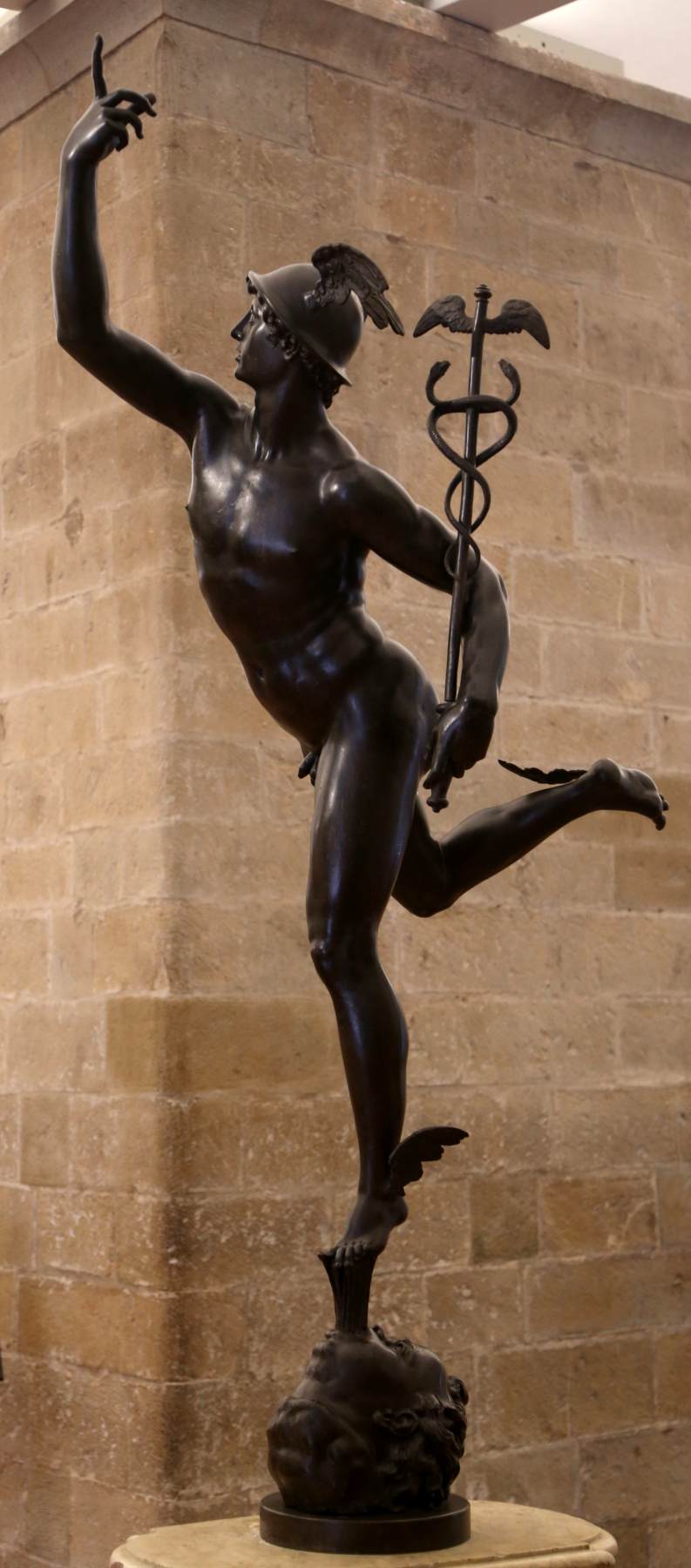
03 — ARTWORK
Mercury (front view)
- MEDIUM
- Bronze, height 180 cm
- TYPE
- Mythological
PALETTE
HOVER OR TAP A SWATCH FOR NAME, SHARE AND HEX. SAMPLED FROM THE IMAGE — INDICATIVE, NOT A PIGMENT ANALYSIS.
DEVELOPMENT BUILD — NOT FOR PUBLIC USE. CONTRIBUTE ON GITHUB.
CURRENT LOCATION · Museo Nazionale del Bargello
03 — ARTWORK
PALETTE
HOVER OR TAP A SWATCH FOR NAME, SHARE AND HEX. SAMPLED FROM THE IMAGE — INDICATIVE, NOT A PIGMENT ANALYSIS.
COMMENTARY
UNDERLINED TERMS ARE DEFINED IN THE GLOSSARY.
The most celebrated sculpture by Giambologna is the Mercury, known in four versions whose chronology is uncertain. His first design, a heavy wingless figure, is preserved in a model in Bologna. When Giambologna returned to Florence, he referred to his earlier work in a second version, a flying Mercury, now lost or identical to one in Vienna. This bronzeAn alloy of copper (usually about 90 per cent) and tin, often also containing small amounts of other metals such as lead or zinc. Since antiquity it has been the metal most commonly used in cast sculpture because of its strength, durability, and the fact that it is easily workable - both hot and cold - by a variety of processes. It is easier to cast than copper because it has a lower melting-point, and its great tensile strength makes possible the protrusion of unsupported parts - an advantage over marble sculpture. The colour of bronze is affected by the proportion of tin or other metals present, varying from silverish to a rich, coppery red, and its surface beauty can be enhanced when it acquires a patina. was send by Cosimo as a diplomatic gift to the Holy Roman Emperor Maximillian II, when they were negotiating the marriage of Maximilian's sister Giovanna to Francesco de' Medici. The messenger god was Maximilian's protector and the pose was based on a medal of Maximilian by Leone Leoni (1551).
The fourth, a flying variant in Florence (shown in the picture) was completed by 1580, when it became a fountain figure at the Villaa residence in the country (in Italy); villas acquired palace-like characteristics from the Renaissance onwards. Medici, Rome. Mercury balances on a bronze columna vertical structural member having a circular cross-section and usually consisting of a base, a long shaft, and a capital. of air issuing from the mouth of Zephyr, over which flowed water, increasing the illusion that he was floating. The work shows a study of Verrocchio's Putto and Dolphin and Rusitici's Mercury, both for the Medici and is indebted to the Mercury on the basemolded foot of a pillar or column providing the transition from the plinth to the shaft. of Cellini's Perseus but has more dynamism.
The god assumes an arabesque, balanced precariously on his toes, and points upward to Jupiter. It is Mannerist in that it can be appreciated from all angles and is elongated and elegant; yet these features contrast with its amazing physicality and an evident study of weights and balances. The preciosity of "Maniera" is blended with what became BaroqueThe period in art history from about 1600 to about 1750. In this sense the term covers a wide range of styles and artists. In painting and sculpture there were three main forms of Baroque: (1) sumptuous display, a style associated with the Catholic Counter Reformation and the absolutist courts of Europe (Bernini, Rubens); (2) dramatic realism (Caravaggio); and (3) everyday realism, a development seen in particular in Holland (Rembrandt, Vermeer). In architecture, there was an emphasis on expressiveness and grandeur, achieved through scale, the dramatic use of light and shadow, and increasingly elaborate decoration. In a more limited sense the term Baroque often refers to the first of these categories. The development of the Baroque reflects the period's religious tensions (Catholic versus Protestant); a new and more expansive world view based on science and exploration; and the growth of absolutist monarchies. illusionismThe painting techniques that create the realistic impression of solid, three-dimensional objects (such as picture frames, architectural features, plasterwork etc.) and the freedom derived from wax.
@online{wga-rd033ba8f1f677f,
  author       = {Krén, Emil and Marx, Daniel},
  title        = {Mercury (front view) by GIAMBOLOGNA},
  organization = {{Web Gallery of Art}},
  date         = {2026-09-13},
  url          = {https://beta.wga.hu/artists/giambologna-rd5b510539e17a3/mercury-front-view-rd033ba8f1f677f},
  urldate      = {2026-09-13},
  langid       = {english}
}
ACCESSED 2026-09-13. REPLACE THE AUTHOR FIELD WITH THE COMMENTARY AUTHOR WHERE ONE IS NAMED.


