03 — ARTWORK
Crucifix
- MEDIUM
- Tempera and gold on fir panel, 468 x 375 cm
- TYPE
- Religious
PALETTE
HOVER OR TAP A SWATCH FOR NAME, SHARE AND HEX. SAMPLED FROM THE IMAGE — INDICATIVE, NOT A PIGMENT ANALYSIS.
DEVELOPMENT BUILD — NOT FOR PUBLIC USE. CONTRIBUTE ON GITHUB.
CURRENT LOCATION · Ognissanti
03 — ARTWORK
PALETTE
HOVER OR TAP A SWATCH FOR NAME, SHARE AND HEX. SAMPLED FROM THE IMAGE — INDICATIVE, NOT A PIGMENT ANALYSIS.
COMMENTARY
UNDERLINED TERMS ARE DEFINED IN THE GLOSSARY.
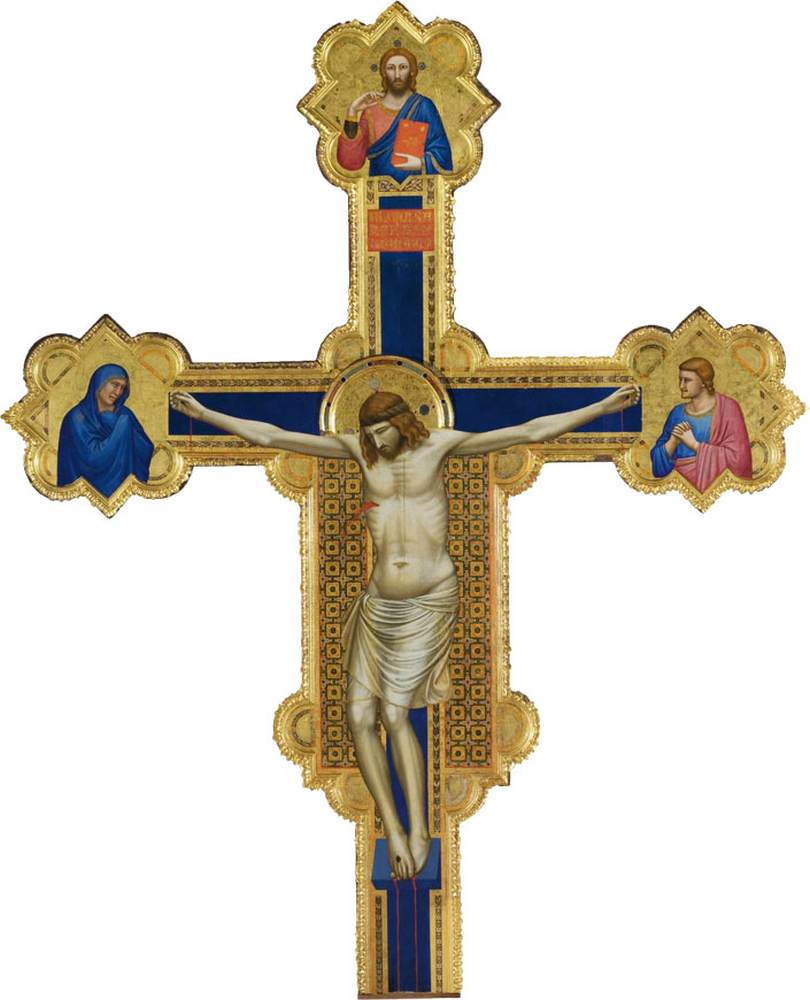
The crucifix was first attributed to Giotto by Lorenzo Ghiberti, who in his Commentaries quoted other works of the master in the altars of the church of Ognissanti, like the Virgin of Ognissanti and the Dormitio Virginis. Originally it was probably located on the presbyteryThe raised space at the end of a church's nave which contains the high altar and is reserved for members of the clergy., dominating the navethe main interior space of a church building. It may have parallel aisles on each side, often separated from it by pillars, and is intersected by the transept, which cuts across it at the point where the choir begins. and the faithful, near the Virgin of Ognissanti.
In poor condition, it was kept in a room adjacent to the basilicaa church building, usually facing east, with a tall main nave and two or four side aisles of lesser height. There may also be a transept between the nave and the choir, which is reserved for the clergy. Originally, the basilica was an ancient Greek administrative building, and the Romans used this form for markets and law courts; it then became a place of assembly for the early Christians, and thus a church. and attributed to an artist close to Giotto and possessing great pictorial capacities.
The work was restored from 2005 onwards by Opificio delle pietre dura from Florence and was attributed to Giotto himself, for a date which is around 1315. On November 6, 2010, the crucifix was reinstalled inside the left transeptsection of a church at right-angles to the nave and in front of the choir., enhanced by proper illuminationThe decoration of manuscripts, one of the most common forms of medieval art; because of its monastic origins, usually of religious texts. The practice extends from heavy decorations of initial letters and inter-woven margin patterns (as in Celtic examples) to miniatures and and full-page illuminations, often of a formal and grandiose kind (as in Byzantine manuscripts). Rich colors are a common feature, in particular a luxirious use of gold and silver. Illuminations survived the advent of printing for some time and only died out with the rise of printed illustration in the 16 century..
Intended for the procession, it is in conformity with the monumental representations of Christ in the cross of the time, namely: the Christ on the cross is in the suffering position; the body falling; the belly prominent on its perizonium; the head leaning forward touching the shoulder; the prominent ribs; the bloody wounds; the superimposed feet.
The crucifix has small panels with scenes on the ends of the cross: the Virgin Mary on the left clothed in blue, St John on the right, hands clasped, and on top the titulus in red is surmounted by a blessing Christ accompanied by the Book. The background contains patterned gold behind the body of Christ.
The cleaning and retouching of the blackened cross has revealed individual brush strokes and the bright colour of the lapis lazuli used by the artist. This expensive pigmentcoloured powder mixed with binding agents such as oil, glue, or resin to make paint. now dominates the background of the work. Infrared photography and X-rays studies unearthed clear proof of the authorship of Giotto.
@online{wga-r5851c84dac18f2,
  author       = {Krén, Emil and Marx, Daniel},
  title        = {Crucifix by GIOTTO di Bondone},
  organization = {{Web Gallery of Art}},
  date         = {2026-09-14},
  url          = {https://beta.wga.hu/artists/giotto-di-bondone-rbbbd987e3570d4/crucifix-r5851c84dac18f2},
  urldate      = {2026-09-14},
  langid       = {english}
}
ACCESSED 2026-09-14. REPLACE THE AUTHOR FIELD WITH THE COMMENTARY AUTHOR WHERE ONE IS NAMED.


