03 — ARTWORK
Christ on the Cold Stone
- MEDIUM
- Oil on panel, 112 x 84 cm
- TYPE
- Religious
PALETTE
HOVER OR TAP A SWATCH FOR NAME, SHARE AND HEX. SAMPLED FROM THE IMAGE — INDICATIVE, NOT A PIGMENT ANALYSIS.
DEVELOPMENT BUILD — NOT FOR PUBLIC USE. CONTRIBUTE ON GITHUB.
03 — ARTWORK
PALETTE
HOVER OR TAP A SWATCH FOR NAME, SHARE AND HEX. SAMPLED FROM THE IMAGE — INDICATIVE, NOT A PIGMENT ANALYSIS.
COMMENTARY
UNDERLINED TERMS ARE DEFINED IN THE GLOSSARY.
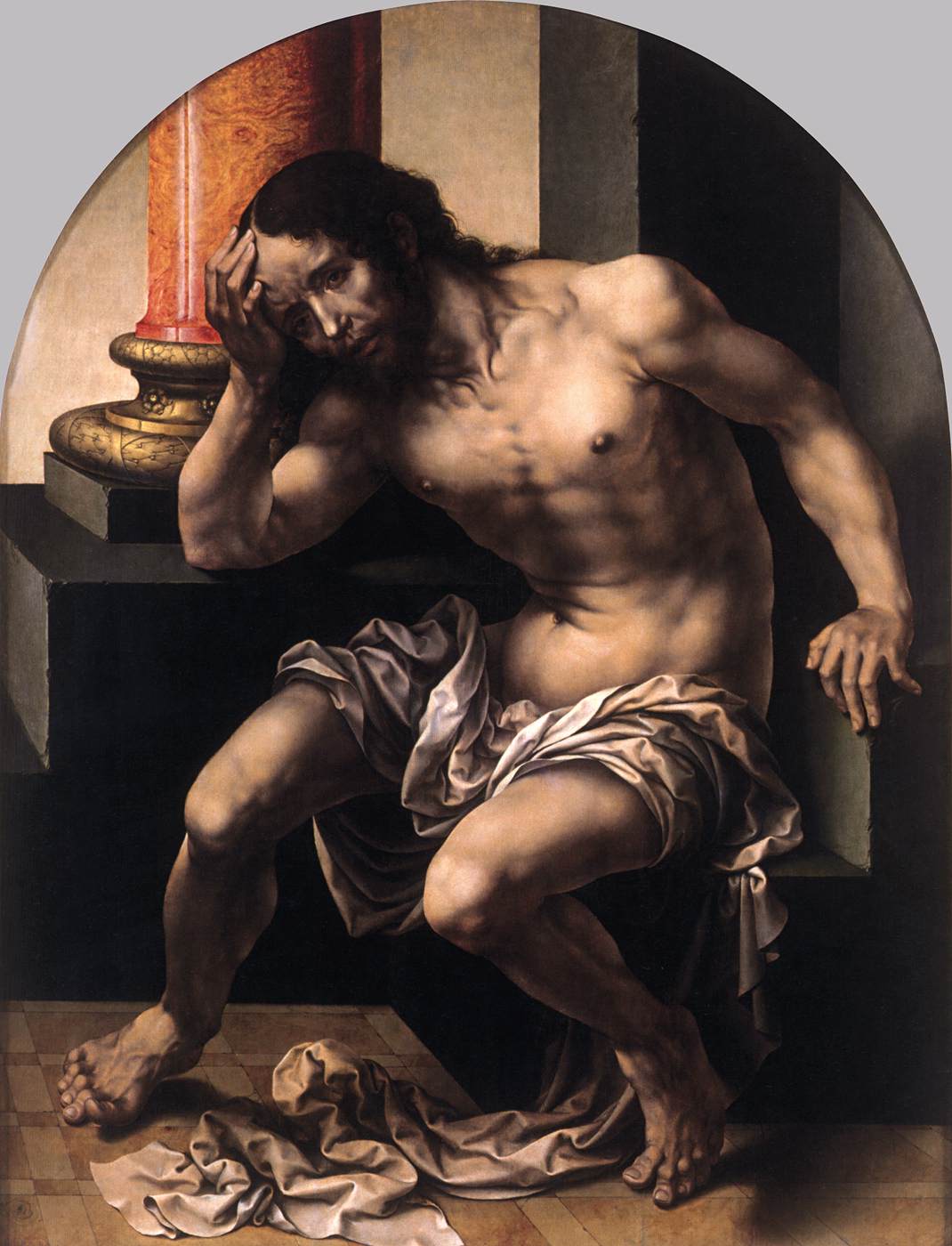
Christ on the Cold Stone c. 1530 Oil on panelTerm in painting for a support of wood, metal, or other rigid substance, as distinct from canvas. Until the adoption of canvas in the 15th century nearly all the movable paintings of Europe were executed on wood, and even up to the beginning of the 17th century it is probable that as much painting was done on the one support as on the other. Painters who worked on a small scale often used copper panels (Elsheimer is a leading example), and in the colonial art of South America copper and tin and even lead and zinc were used. On a larger scale, slate has occasionally been used as a support, notably by Rubens for his altarpiece for Sta Maria in Vallicella (the Chiesa Nuova) in Rome; the picture he originally painted was said to reflect the light unpleasantly and slate was used for the replacement to produce a more matt finish. For wood panels the Italian masters of the Renaissance preferred white poplar, while oak was the most common wood used in northern Europe. Many other types were used, however; analysis of the contents of art galleries has yielded a long list, including beech, cedar, chestnut, fir, larch, linden, mahogany, olive, and walnut. In the 20th century cedar, teak, and dark walnut are favourites, and modern painters have also used plywood, fibre-board, and other synthetic materials as supports., 112 x 84 cm Real Colegio del Corpus Christi, Valencia
This painting is also known as the Man of SorrowsA depiction of Christ during his Passion, bound, marked by flagellation, and crowned with thorns.. Christ is depicted here as the melancholy hero whose taut musculature and profoundly distraught expression reveal the depth of his anguish. The physical bulk of the figure and the exaggerated modeling of his muscular form led some early on to identify him as Samson. Gossart did not separate biblical from mythological subject matter in his continuing development of the sculptural form of the body as a way to convey meaning. The common source for several of the male figures in his late paintings was the <a onclick="return OpenOther('/html/h/heemsker/1/z_belved.html')" href="/html/h/heemsker/1/z_belved.html">Belvedere Torso.</a>
Gossart's completion of the fragment may have been inspired by Marcantonio Raimondi's signed and dated engravingA print made from a metal plate that has had a design cut into it with a sharp point. Ink is smeared over the plate and then wiped off, the ink remaining in the etched lines being transferred when the plate is pressed very firmly onto a sheet of paper., the <a onclick="return OpenOther('/html/r/raimondi/mars.html')" href="/html/r/raimondi/mars.html">Mars, Venus, and Eros</a> of 1508. In the unimpeded view and detailed articulation of the musculature of the torsos, Gossart's Christ and Raimondi's Mars bear a striking resemblance.
@online{wga-r3fd17a5b3142cc,
  author       = {Krén, Emil and Marx, Daniel},
  title        = {Christ on the Cold Stone by GOSSART, Jan},
  organization = {{Web Gallery of Art}},
  date         = {2026-09-13},
  url          = {https://beta.wga.hu/artists/gossart-jan-r3dc6e56b5e425a/christ-on-the-cold-stone-r3fd17a5b3142cc},
  urldate      = {2026-09-13},
  langid       = {english}
}
ACCESSED 2026-09-13. REPLACE THE AUTHOR FIELD WITH THE COMMENTARY AUTHOR WHERE ONE IS NAMED.