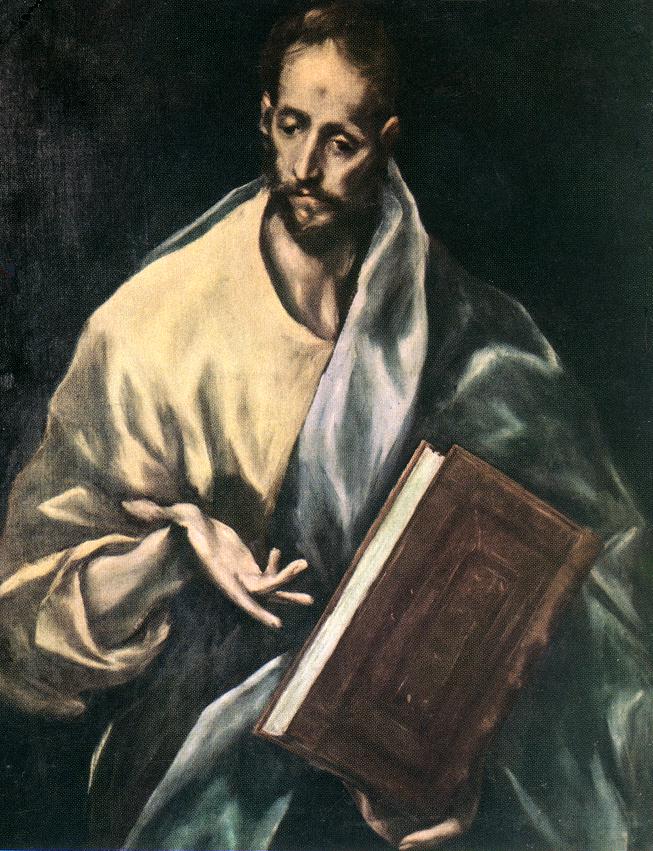
03 — ARTWORK
Apostle St James the Less
- MEDIUM
- Oil on canvas, 97 x 77 cm
- TYPE
- Religious
PALETTE
HOVER OR TAP A SWATCH FOR NAME, SHARE AND HEX. SAMPLED FROM THE IMAGE — INDICATIVE, NOT A PIGMENT ANALYSIS.
DEVELOPMENT BUILD — NOT FOR PUBLIC USE. CONTRIBUTE ON GITHUB.
03 — ARTWORK
PALETTE
HOVER OR TAP A SWATCH FOR NAME, SHARE AND HEX. SAMPLED FROM THE IMAGE — INDICATIVE, NOT A PIGMENT ANALYSIS.
COMMENTARY
UNDERLINED TERMS ARE DEFINED IN THE GLOSSARY.
Apostleone of the twelve disciples of Jesus, chosen personally by him from amongst his large crowd of followers in order to continue his work and preach the gospels. St James the Less is generally regarded as the same person as James 'the Lord's brother', mentioned by St Paul (Gal. 1:19), who became the first bishop of Jerusalem. Though 'brother' could here apply to any male relation, it came to be taken in the strict sense and was the source of the tradition that represents Christ and the saint somewhat alike in appearance. This similarity is helpful in identifying St James in scenes such as the Last SupperChrist's last meal with His disciples before His arrest and trial; the rite of communion is based on this. One of most famous depictions of the event is a fresco painted by Leonardo da Vinci.. It was sometimes given as the reason for the kiss of Judas, because the soldiers then knew which man to arrest. According to early sources James was martyred by being thrown from the roof of the Temple and then stoned and beaten to death. The Golden Legend relates that 'a man in that company took a fuller's staff and smote him on the head, that his brains fell all abroad'.
Apostle St James the Less in Art
James holds a fuller's staff, which may be short- or long-handled, having a clubbed head; or it is shaped like a flat bat. It was once used by the fuller in the process of finishing cloth, to compact the material by beating it. From the early 14th century, especially in German art, he may instead hold a hatter's bow, which was used in the manufacture of felt for hats and by wool-workers to clean wool. It may be shown without a bow-string.
James was the patron saint of hat-makers, mercers and other similar medieval guildsGuilds were essentially associations of masters in particular crafts, trades, or professions. In Italy they go back a long way; there is documentary evidence of guilds in 6th century Naples. In origin they were clubs which observed religious festivals together and attended the funerals of their members, but in time they acquired other functions. Their economic function was to control standards and to enforce the guild's monopoly of particular activities in a particular territory. Their political function was to participate in the government of the city-state. In some cities, notably Florence in the 14th century, only guildsmen were eligible for civic office, thus excluding both noblemen (unless they swallowed their pride and joined, as some did), and unskilled workers like the woolcombers and dyers. In Florence in 1378 these groups demanded the right to form their own guilds, and there were similar movements of protest in Siena and Bologna. Guilds were also patrons of art, commissioning paintings for guildhalls, contributing to the fabric fund of cathedrals and collaborating on collective projects like the statues for Orsanmichele at Florence. The guilds were not equal. In Florence, the 7 'Greater Guilds', including such prestigious occupations as judges and bankers, outranked the 14 'Lesser Guilds', and in general the guild hierarchy was reflected in the order of precedence in processions. The great age of the guilds was the 13th and 14th centuries. The economic recession after 1348 meant fewer opportunities for journeymen to become masters, and greater hostility between master and man. The shift from trade to land in the 15th and 16th centuries meant a decline in the social standing of the crafts. In some towns, such as Brescia and Vicenza, guild membership actually became a disqualification instead of a qualification for municipal office. The guilds lost their independence and became instruments of state control. In 16th century Venice, for example, they were made responsible for supplying oarsmen for the galleys of the state.. As bishop of Jerusalem he may wear episcopal robes, with mitre and crozierThe crook-shaped staff carried by a bishop. The crook is intended to resemble a shepherd's crook, i.e. it symbolizes the shepherd (the bishop) looking after his flock..
El Greco's painting does not follow thetraditional representations of the Apostle.
@online{wga-rc478981cdb8456,
  author       = {Krén, Emil and Marx, Daniel},
  title        = {Apostle St James the Less by GRECO, El},
  organization = {{Web Gallery of Art}},
  date         = {2026-09-09},
  url          = {https://beta.wga.hu/artists/greco-el-r8ef3afacca162f/apostle-st-james-the-less-rc478981cdb8456},
  urldate      = {2026-09-09},
  langid       = {english}
}
ACCESSED 2026-09-09. REPLACE THE AUTHOR FIELD WITH THE COMMENTARY AUTHOR WHERE ONE IS NAMED.


