03 — ARTWORK
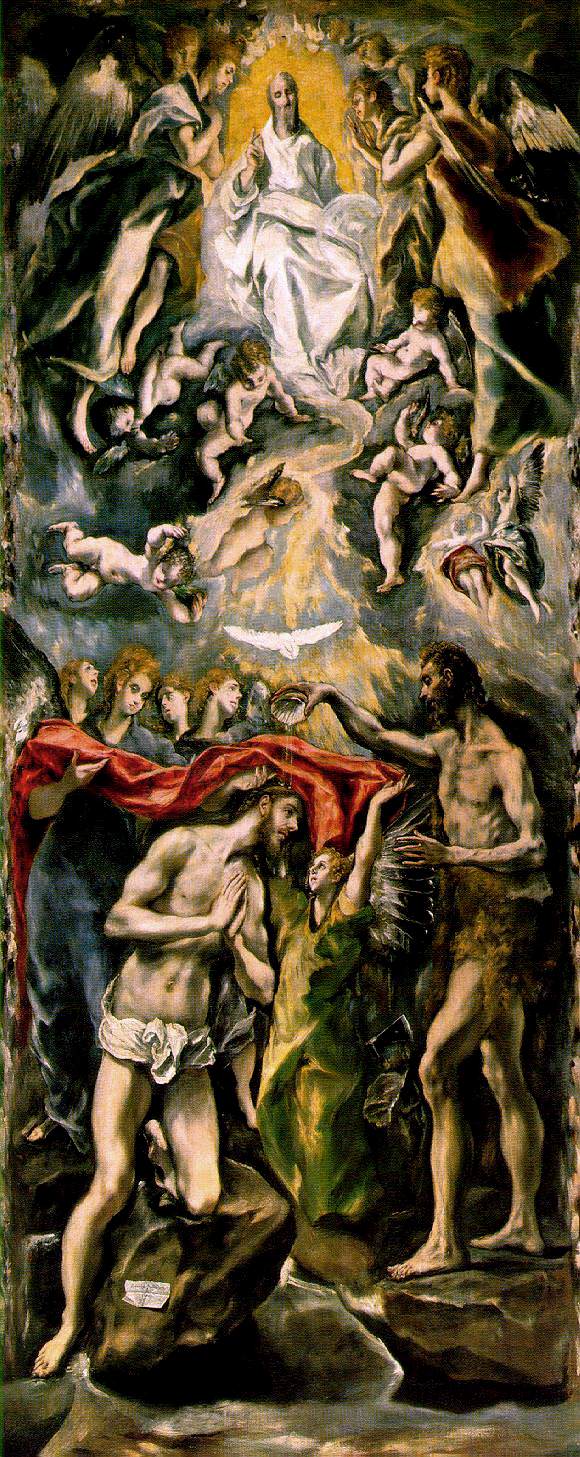
The Baptism
- MEDIUM
- Oil on canvas, 350 x 144 cm
- TYPE
- Religious
PALETTE
HOVER OR TAP A SWATCH FOR NAME, SHARE AND HEX. SAMPLED FROM THE IMAGE — INDICATIVE, NOT A PIGMENT ANALYSIS.
DEVELOPMENT BUILD — NOT FOR PUBLIC USE. CONTRIBUTE ON GITHUB.
03 — ARTWORK
PALETTE
HOVER OR TAP A SWATCH FOR NAME, SHARE AND HEX. SAMPLED FROM THE IMAGE — INDICATIVE, NOT A PIGMENT ANALYSIS.
COMMENTARY
UNDERLINED TERMS ARE DEFINED IN THE GLOSSARY.
Painted for the high altar of the Colegio de Doña Maria, Madrid. The retableOrnamental panel behind an altar and, in the more limited sense, the shelf behind an altar on which are placed the crucifix, candlesticks, and other liturgical objects. The panel is usually made of wood or stone, though sometimes of metal, and is decorated with paintings, statues, or mosaics depicting the Crucifixion or a similar subject. Although frequently forming part of the architectural structure of the church, especially in the High Gothic period, retables can be detached and, sometimes, as in the case of the famous retable by Hubert and Jan van Eyck, "The Adoration of the Lamb" (1432, Cathedral of Saint-Bavon, Ghent), consist merely of a painting. Probably the most well-known retable is that in the Basilica of St Mark in Venice, which is one of the most remarkable examples in existence of the craft of the jeweler and goldsmith. Originally commissioned in 976, the St. Mark's retable was enlarged and enriched in the 13th century. With the development of freestanding altars, retables have become extinct. no longer exists, and the paintings are dispersed. The subjects of the paintings of the retable are not recorded, but it is assumed that they illustrated the Life of Christ. For reasons of size, style, and subject matter, the following paintings probably came from the retable: the Annunciationthe term for the event described in the Gospel according to St. Luke, when the Angel Gabriel brings the Virgin Mary the news that she is to bear her son, Jesus Christ. The Annunciation was among the most widespread pictorial subjects of European art during the Middle Ages and the Renaissance., the widest painting, in the centre (the church was dedicated to the Virgin of the Annunciation); the Adoration of the Shepherds and the Baptism of Christ, two paintings of the same size, on the left and right of the Annunciation; the CrucifixionAn important method of capital punishment, particularly among the Persians, Seleucids, Jews, Carthaginians, and Romans from about the 6th century BC to the 4th century AD. Constantine the Great, the first Christian emperor, abolished it in the Roman Empire in AD 337, out of veneration for Jesus Christ, the most famous victim of crucifixion. There were various methods of performing the execution. Usually, the condemned man, after being whipped, or "scourged," dragged the crossbeam of his cross to the place of punishment, where the upright shaft was already fixed in the ground. Stripped of his clothing either then or earlier at his scourging, he was bound fast with outstretched arms to the crossbeam or nailed firmly to it through the wrists. The crossbeam was then raised high against the upright shaft and made fast to it about 9 to 12 feet (approximately 3 metres) from the ground. Next, the feet were tightly bound or nailed to the upright shaft. A ledge inserted about halfway up the upright shaft gave some support to the body; evidence for a similar ledge for the feet is rare and late. Over the criminal's head was placed a notice stating his name and his crime. Death, apparently caused by exhaustion or by heart failure, could be hastened by shattering the legs (crurifragium) with an iron club, so that shock and asphyxiation soon ended his life. above the Annunciation; and the Resurrection and Pentecost, another pair of identical size, flanking the Crucifixion (the whole forming a retable of a type known in the Escorial). Such an arrangement gives a chronological sequence to the events of the Life of Christ. The payment of 6000 ducados (for the paintings and retable) indicate a large commission. Small versions, probably models, exist for the three paintings more generally accepted as belonging to the retable, the Annunciation, the Adoration of the Shepherds and the Baptism of Christ.
Probably originally on the right of the retable of the Colegio de Doña María, balancing the Adoration of the Shepherds, and painted at the same time. A small version, possibly the model for the large painting, is in the Galleria Corsini, Rome. A later development of this subject, only treated once before, in the Modena TriptychA painting in three sections, usually an altarpiece, consisting of a central panel and two outer panels, or wings. In many medieval triptychs the two outer wings were hinged so that could be closed over the center panel. Early triptychs were often portable., is the painting for the Hospital de San Juan Bautista, Toledo, probably completed after his death by Jorge Manuel. The pose of the Christ is related to that of the Saint Sebastian of c. 1580. The bipartite composition can be related to the Burial of the Count of Orgaz, the portraits giving place to the range of angels. The splendid ecstatic figure of the angel, between the Baptist and Christ, is one of a number of such symbols that he began to introduce into his painting. If his figures - the actual participants in the action - become increasingly dematerialised, these new symbols appear as emotions materialised in gesture and colour.
@online{wga-r3ca5bbb1639d27,
  author       = {Krén, Emil and Marx, Daniel},
  title        = {The Baptism by GRECO, El},
  organization = {{Web Gallery of Art}},
  date         = {2026-09-09},
  url          = {https://beta.wga.hu/artists/greco-el-r8ef3afacca162f/the-baptism-r3ca5bbb1639d27},
  urldate      = {2026-09-09},
  langid       = {english}
}
ACCESSED 2026-09-09. REPLACE THE AUTHOR FIELD WITH THE COMMENTARY AUTHOR WHERE ONE IS NAMED.


