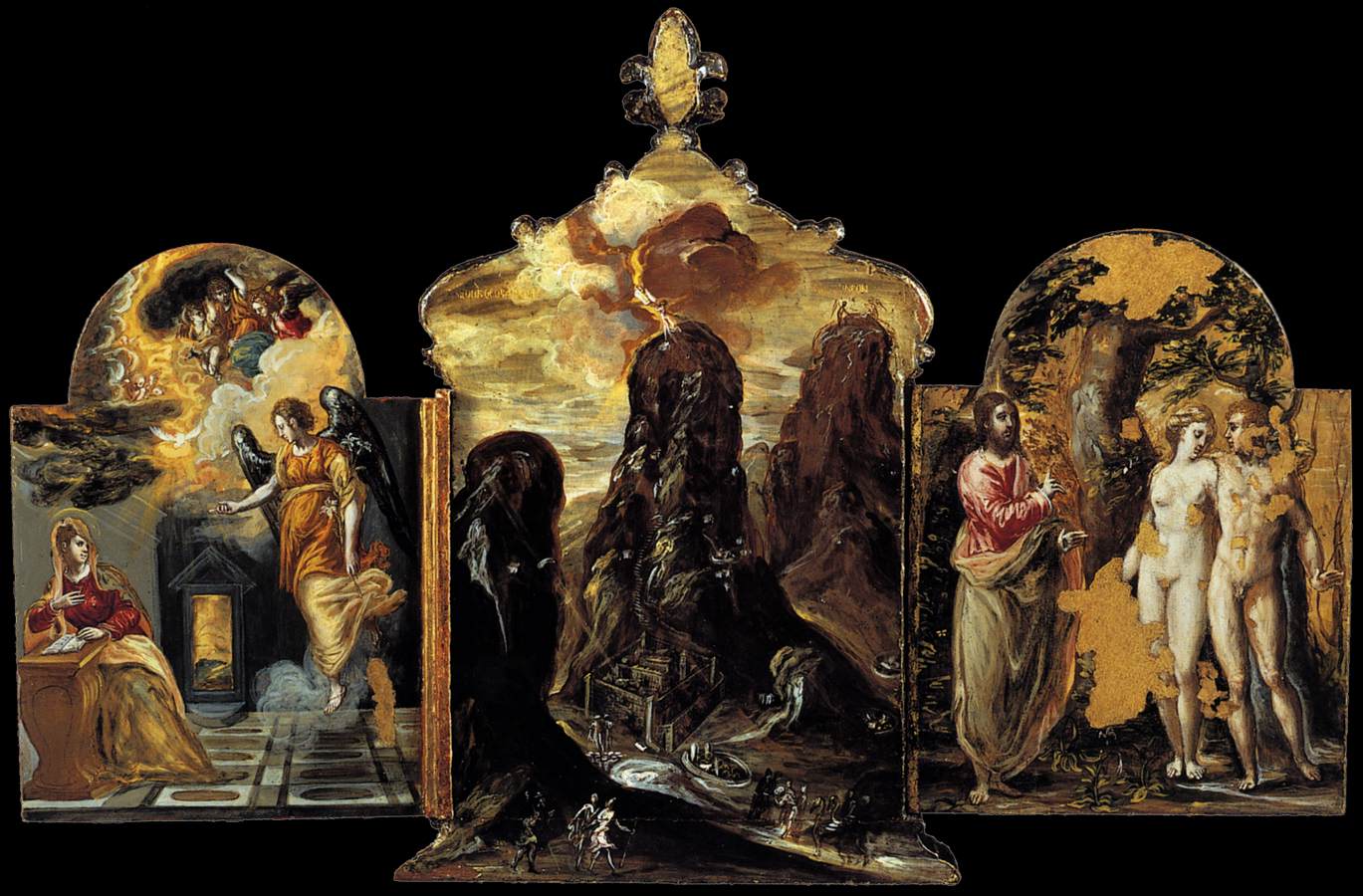
Small portable altarpieceA picture or sculpture that stands on or is set up behind an altar. The term reredos is used for an ornamental screen or partition, not directly attached to the altar table but affixed to the wall behind it. A diptych is an altarpiece consisting of two panels, a triptych one of three panels, and a polyptych one of four or more panels. From the 14th to 16th century, the altarpiece was one of the most important commissions in European art; it was through the altarpiece that some of the most decisive developments in painting and sculpture came about. with hinged wings, painted on both sides, of a type similar in form to others produced in Crete in the sixteenth century, but with an Italian Renaissance frame. The subjects on the front, from left to right, are the Adoration of the Shepherds, the AllegoryA work of art which represents some abstract quality or idea, either by means of a single figure (personification) or by grouping objects and figures together. Renaissance allegories make frequent allusions both to both Greek and Roman legends and literature, and also to the wealth of Christian allegorical stories and symbols developed during the Middle Ages. of a Christian Knight, and the Baptism; and on the back, the Annunciationthe term for the event described in the Gospel according to St. Luke, when the Angel Gabriel brings the Virgin Mary the news that she is to bear her son, Jesus Christ. The Annunciation was among the most widespread pictorial subjects of European art during the Middle Ages and the Renaissance., Mount Sinai, and Adam and Eve.
The theme of Mount Sinai, on the back of the central panelTerm in painting for a support of wood, metal, or other rigid substance, as distinct from canvas. Until the adoption of canvas in the 15th century nearly all the movable paintings of Europe were executed on wood, and even up to the beginning of the 17th century it is probable that as much painting was done on the one support as on the other. Painters who worked on a small scale often used copper panels (Elsheimer is a leading example), and in the colonial art of South America copper and tin and even lead and zinc were used. On a larger scale, slate has occasionally been used as a support, notably by Rubens for his altarpiece for Sta Maria in Vallicella (the Chiesa Nuova) in Rome; the picture he originally painted was said to reflect the light unpleasantly and slate was used for the replacement to produce a more matt finish. For wood panels the Italian masters of the Renaissance preferred white poplar, while oak was the most common wood used in northern Europe. Many other types were used, however; analysis of the contents of art galleries has yielded a long list, including beech, cedar, chestnut, fir, larch, linden, mahogany, olive, and walnut. In the 20th century cedar, teak, and dark walnut are favourites, and modern painters have also used plywood, fibre-board, and other synthetic materials as supports., was of Cretan origin, and faithfully repeats a traditional Byzantine model. The picture shows pilgrims on the way to the Monasterythe complex of buildings used by a community of monks. Among the main elements of the complex are the church, cloister, chapter house (used by the governing body), refectory (dining room) and dormitory (sleeping quarters)., and the Mountain as the Road to Heaven. The reference to Saint Catherine in both the central panels has been suggested as a possible indication of the artist's connection' in Crete with the monastery of Saint Catherine, a dependency of that of Mount Sinai, and the most important school of painting in the island. The other compositions are similarly not original, but here the artist has used engravings after Italian (mainly Venetian) compositions as his models. The repetition of traditional images was usual in Byzantine artThe art ofthe Byzantine Empire, which had its capital in Constantinople (Byzantium), from the 5th century to the fall of Constantinople to the Turks in 1453. Based largely on Roman and Greek art, Byzantine art also absorbed a wide of influences, notable from Syria and Egypt. Byzantine art was essentially a spiritual and religious art, its forms highly stylized, hieratic and unchanging (central images were thought to derive from original portraits). It also served to glorify the emperor. Among its most distinctive products were icons, mosaics, manuscript illuminations, and work in precious metals. The strong influence of the Byzantine style on medieval Italian painting can be seen in the works of Cimabue, Duccio, and Giotto..