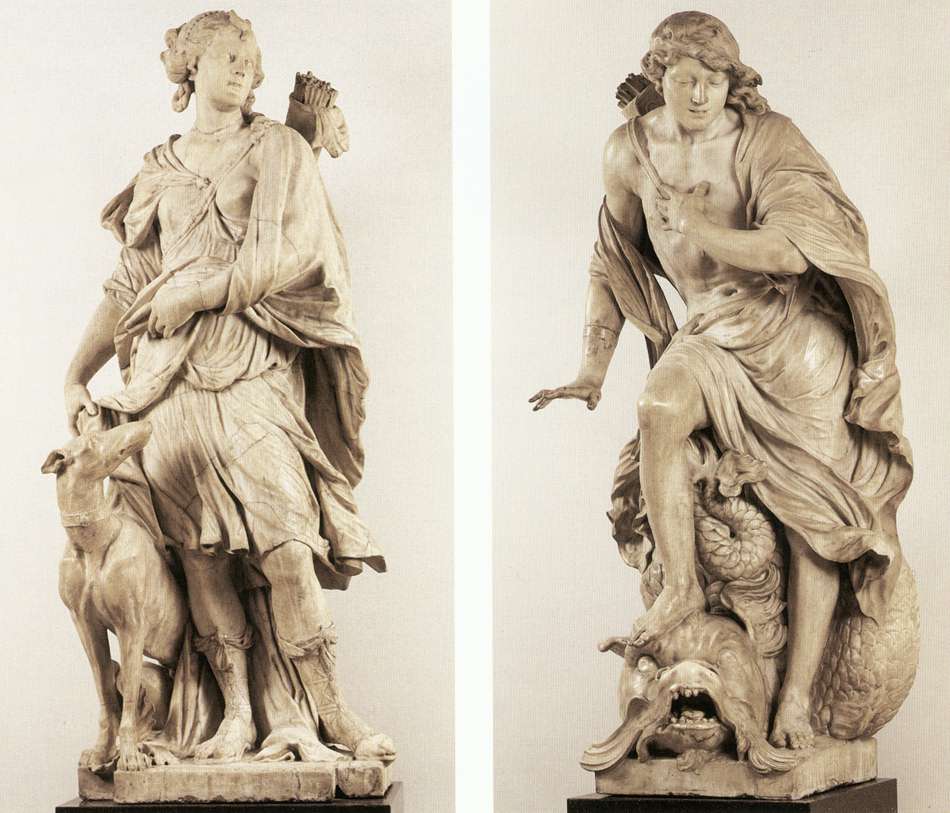
03 — ARTWORK
Diana and Narcissus
- MEDIUM
- Marble, height 182,2 and 168,5 cm, respectively
- TYPE
- Mythological
PALETTE
HOVER OR TAP A SWATCH FOR NAME, SHARE AND HEX. SAMPLED FROM THE IMAGE — INDICATIVE, NOT A PIGMENT ANALYSIS.
DEVELOPMENT BUILD — NOT FOR PUBLIC USE. CONTRIBUTE ON GITHUB.
03 — ARTWORK
PALETTE
HOVER OR TAP A SWATCH FOR NAME, SHARE AND HEX. SAMPLED FROM THE IMAGE — INDICATIVE, NOT A PIGMENT ANALYSIS.
COMMENTARY
UNDERLINED TERMS ARE DEFINED IN THE GLOSSARY.
The sculptor Grupello, born in 1644 in Geraardsbergen of an Italian officer and a Flemish mother, and who made a brilliant career for himself in Germany, is unjustly little known in his own country. This is all the harder to explain given that the sculptures that he completed in Brussels before departing for Düsseldorf in 1695 are among his best works. After training at Artus Quellinus the Younger's studio in Antwerp and spending time in Paris and The Hague, Grupello settled in Brussels, where the Thurn and Taxis family ordered two marbleloosely applied to any hard limestone that can be sawn into thin slabs and will take a good polish so that it is suitable for decorative work; more strictly, it refers to metamorphosed limestones whose structure has been recrystallized by heat or pressure. Marbles are widely disseminated and occur in a great variety of colours and patterns, but certain types have been particularly prized by sculptors. The most famous of Greek white marbles in the ancient world was the close-grained Pentelic, which was quarried at Mount Pentelicon in Attica. The Elgin Marbles are carved in Pentelic. Widely used also were the somewhat coarser-grained translucent white marbles from the Aegean islands of Paros and Naxos. Parian marble was used for the celebrated Mausoleum at Halicarnassus. The pure white Carrara marble, quarried at Massa, Carrara, and Pietra Santa in Tuscany from the 3rd century BC, is the most famous of all sculptors' stones. It was used for the Apollo Belvedere, and was much favoured in the Renaissance, particularly by Michelangelo, who often visited the quarries to select material for his work. Neoclassical sculptors also favoured Carrara marble because of its ability to take a smooth, sleek surface, but it can look rather 'dead' compared with some of the finest Greek marbles. statues of Diana and Narcissus from him for their residency garden. The park of the sumptuous patricianoriginally a member of the ancient Roman nobility; from the Middle Ages onwards a term for a noble, wealthy citizen. house, on the site of the current Petit Sablon, was considerably extended when Lamoral II Claudius Francis Count of Thurn and Taxis, a renowned art connoisseur with faultless taste, succeeded in buying a plot of land from the cloisterquadrilateral enclosure surrounded by covered walkways, the centre of activity for the inhabitants of a monastery. of the Friars Minor. That Grupello obtained this commission from the Postmaster-General or his son should not surprise us; his superior talent was already widely known.
Diana, the goddess of nature and hunting, the twin sister of Apollo, is depicted with a greyhound. She is dressed in a flowing mantleAn overcoat, worn open, popular during the second half of the 15th century and the 16th century and often lined with fur along the hem and around the collar. It reached to the knee or foot, depending on the social class of the wearer. with a quiver on her back. Narcissus refers also to Greek mythology. The beautiful young man was so overcome by his own image reflected by a fountain that he fell into ecstasy. In despair at being unable to seize this alter ego he languished and died. Grupello represents the moment of this sublimeTerm that came into general use in the 18th century to denote a new aesthetic concept that was held to be distinct from the beautiful and the Picturesque and was associated with ideas of awe and vastness. The outstanding work on the concept of the Sublime in English was Edmund Burke's A Philosophical Enquiry into the Origin of our Ideas of the Sublime and Beautiful (1757). This book was one of the first to realize (in contrast with the emphasis on clarity and precision during the Age of Enlightenment) the power of suggestiveness to stimulate imagination. The cult of the Sublime had varied expressions in the visual arts, notably the taste for the 'savage' landscapes of Salvator Rosa and the popularity among painters of subjects from Homer, John Milton, and Ossian (the legendary Gaelic warrior and bard, whose verses - actually fabrications - were published in the 1760s to great acclaim). The vogue for the Sublime, with that for the Picturesque, helped shape the attitudes that led to Romanticism. admiration. The young man carries a quiver on his back. His right foot rests on a dolphin, symbol of water. His left hand portrays his self love whilst the tenseness in his right hand expresses the sense of horror that overwhelms him when he realises that he is anchored to the spot.
The Diana can possibly be dated to around 1680-85, based on the likeness with a Diana statue in Versailles that was produced in 1679 by Coysevox. The more dynamic Narcissus can be compared with Charles Le Brun's preparatory designs for Versailles. The French influence on both statues is indisputable, but Grupello successfully and originally combined French classicalRelating to the culture of ancient Greece and Rome (classical Antiquity). The classical world played a profoundly important role in the Renaissance, with Italian scholars, writers, and artists seeing their own period as the rebirth (the "renaissance") of classical values after the Middle Ages. The classical world was considered the golden age for the arts, literature, philosophy, and politics. Concepts of the classical, however, changed greatly from one period to the next. Roman literature provided the starting point in the 14th century, scholars patiently finding, editing and translating a wide range of texts. In the 15th century Greek literature, philosophy and art - together with the close study of the remains of Roman buildings and sculptures-expanded the concept of the classical and ensured it remained a vital source of ideas and inspiration. elements with naturalistic Flemish baroqueThe period in art history from about 1600 to about 1750. In this sense the term covers a wide range of styles and artists. In painting and sculpture there were three main forms of Baroque: (1) sumptuous display, a style associated with the Catholic Counter Reformation and the absolutist courts of Europe (Bernini, Rubens); (2) dramatic realism (Caravaggio); and (3) everyday realism, a development seen in particular in Holland (Rembrandt, Vermeer). In architecture, there was an emphasis on expressiveness and grandeur, achieved through scale, the dramatic use of light and shadow, and increasingly elaborate decoration. In a more limited sense the term Baroque often refers to the first of these categories. The development of the Baroque reflects the period's religious tensions (Catholic versus Protestant); a new and more expansive world view based on science and exploration; and the growth of absolutist monarchies.. In 1780 the two statues were transferred to the newly laid out Brussels city park, and subsequently entrusted to the museum.
@online{wga-r27bb691f867d09,
  author       = {Krén, Emil and Marx, Daniel},
  title        = {Diana and Narcissus by GRUPELLO, Gabriel},
  organization = {{Web Gallery of Art}},
  date         = {2026-09-09},
  url          = {https://beta.wga.hu/artists/grupello-gabriel-r90903d9d8ccc74/diana-and-narcissus-r27bb691f867d09},
  urldate      = {2026-09-09},
  langid       = {english}
}
ACCESSED 2026-09-09. REPLACE THE AUTHOR FIELD WITH THE COMMENTARY AUTHOR WHERE ONE IS NAMED.


